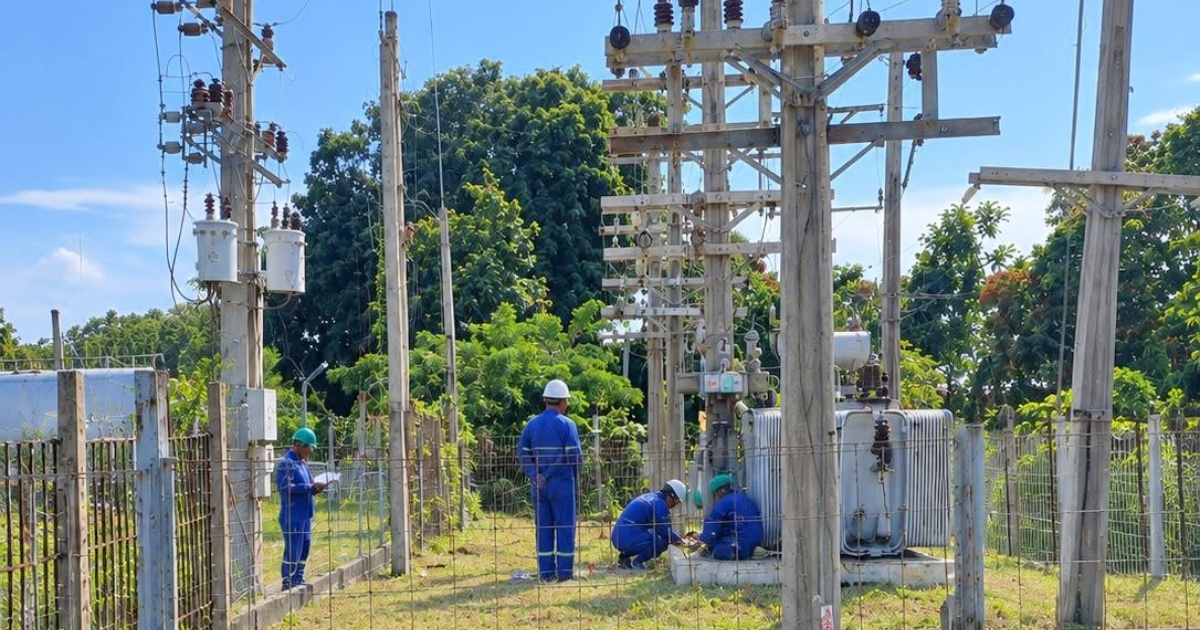
The Havana Electric Company (EELH) has disclosed via their official Facebook page the deployment of chemical traps within their substations to identify individuals stealing dielectric oil from transformers. This initiative aligns with strategies already in place across other provinces in the country.
The official statement is brief but explicit: "Havana Electric Company safeguards its substations by implementing CHEMICAL TRAPS designed to pinpoint those involved in potential thefts of dielectric oil from transformers."
The Functionality of Chemical Traps
While the EELH has not provided detailed information on the exact mechanism, a similar approach was explained recently by authorities in Jobabo, Las Tunas, in relation to photovoltaic installations just days before Havana's announcement.
Journalist Yaidel Miguel Rodríguez Castro from Radio Cabaniguán elucidated the process: "This involves a chemical that adheres to the skin and is invisible to the naked eye, yet it becomes visible under ultraviolet light, revealing contact marks."
For those suggesting that gloves could easily circumvent this measure, the journalist responded, "That's where the naivety lies, assuming gloves act as an effective barrier."
Nationwide Strategy Expansion
Havana is not the first to adopt this strategy. Back in May 2026, Las Tunas had already implemented chemical traps in partnership with the Ministry of the Interior after experiencing multiple thefts of dielectric oil and transformer components.
The invisible method, initially used against solar panel thefts in Jobabo, indicates the strategy's reach across the country's entire energy infrastructure, from transformers to photovoltaic setups.
Civic Reaction: Irony and Demands
The EELH's announcement was met with a blend of skepticism, irony, and pent-up frustration in the public's comments.
Several users joked that the public warning serves as a tip-off to the thieves themselves: "And now they've just been told to bring gloves," one user commented.
Others took the opportunity to demand repairs for substations that have been out of operation for months: Apolo has been inactive since June 3, and the facility serving Las Minas, La Gallega, and Arango has been down since July 22, with no resolution in sight.
Another user pointed out a shared contradiction: "But they don’t set traps for those who steal electricity and sell it."
This remark highlights a broader issue: while the government intensifies measures against infrastructure theft, the ongoing electrical crisis remains unresolved. As of Wednesday, Cuba experienced a demand of 2,461 MW with only 1,060 MW available, and Havana faced 129 circuit disruptions.
Dielectric Oil: A Highly Sought-After Commodity
This fluid serves critical functions in transformers, providing electrical insulation and cooling. When stolen, it causes the equipment to overheat, suffer short circuits, and ultimately become unusable, leaving entire communities without power for extended periods.
Despite its importance, dielectric oil is in high demand on the black market, where it's resold as a lubricant or alternative fuel for tractors at prices up to 500 Cuban pesos per liter, amid a severe fuel shortage.
The Minister of Energy and Mines, Vicente de la O Levy, acknowledged before the National Assembly that the volume of oil stolen is "almost comparable" to production levels within the same timeframe, with some areas experiencing up to 105 days without electricity due to irreparable transformer damage.
Legal Framework: From Theft to Sabotage
The Supreme People's Court's Ruling 475 has reclassified these thefts as sabotage, imposing penalties ranging from 7 to 30 years in prison, life imprisonment, or death penalty in the most severe cases.
According to the Office of the Attorney General, over 460 criminal investigations were initiated between 2025 and the first half of 2026 for crimes against the National Electrical System, with more than 300 cases involving dielectric oil theft, detected across all provinces and in 97 municipalities.
Understanding Havana's Chemical Trap Strategy
How do the chemical traps in Havana's electrical system work?
The chemical traps use a substance that adheres to the skin invisibly, but becomes visible under ultraviolet light, thereby identifying individuals who come into contact with the transformers.
Why is dielectric oil targeted by thieves in Cuba?
Dielectric oil is targeted due to its high demand on the black market, where it is sold as a lubricant or alternative fuel for tractors, especially amid a severe fuel shortage in the country.
What legal actions are taken against thefts in the Cuban electrical system?
The theft of dielectric oil and related components is classified as sabotage, with penalties ranging from 7 to 30 years in prison, life imprisonment, or the death penalty in the most serious cases.