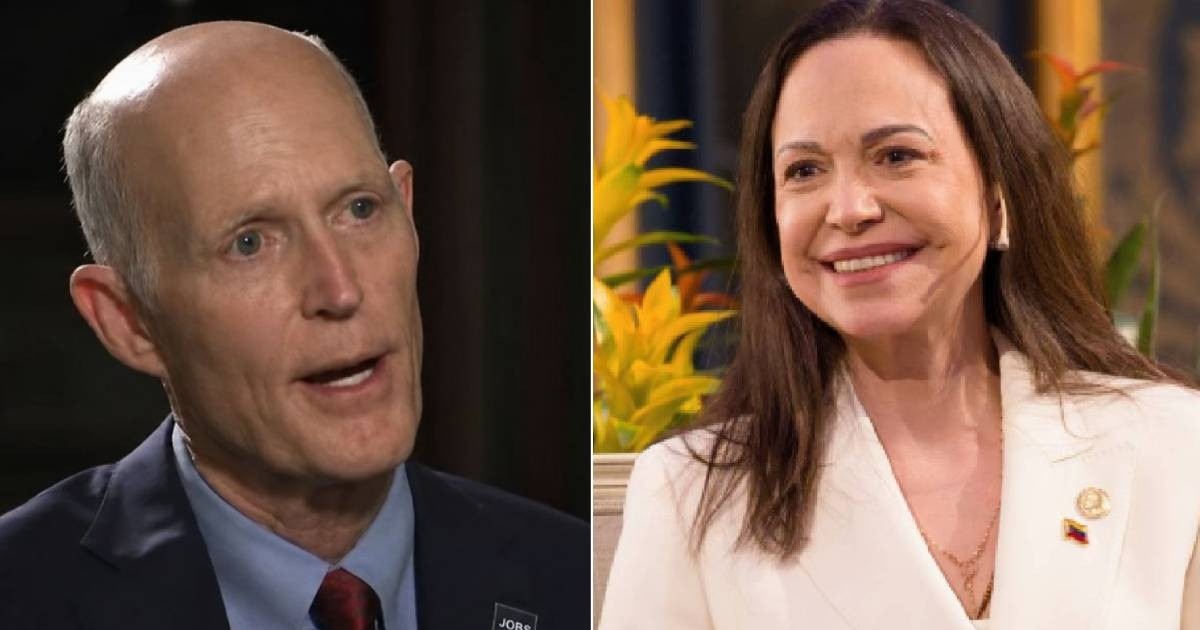
On Tuesday, U.S. Senator Rick Scott disclosed having a phone conversation with Venezuelan opposition leader María Corina Machado. In an extensive statement shared on X, he affirmed that the 2025 Nobel Peace Prize recipient possesses the right mindset, capability, and, most importantly, the backing of the Venezuelan people to move towards elections and the establishment of a prosperous democratic republic.
Scott, a key advocate for Venezuela's democratic cause within the U.S. Congress, emphasized that Machado is prepared to return to her homeland "in a peaceful and constructive manner." She is willing to engage with those currently in power, including acting President Delcy Rodríguez, as well as with public and private sector entities.
"The best thing for everyone right now is for María Corina Machado to be in Venezuela," Scott stated. "Across every state in her homeland and among all social groups, people are seeking her leadership and support. They want her there to help build the future."
The senator explicitly thanked President Trump and Secretary of State Marco Rubio for their efforts regarding Venezuela: "They have ended a threat to the United States while also improving the lives of the Venezuelan people and restoring an ally." Scott also confirmed discussions with the Trump administration about Machado's potential return to the country.
This statement comes amidst a flurry of diplomatic activity surrounding Venezuela. On September 22, Trump met with Delcy Rodríguez in New York on the sidelines of the UN General Assembly, marking the first meeting between a U.S. president and a Venezuelan leader in over 11 years. Days later, Rodríguez promised elections in Venezuela at the same forum, albeit without specifying dates or timelines.
Machado has faced at least seven unsuccessful attempts to return to her country since December 2025. The most recent was on September 22, when she was denied entry three times while trying to cross from Panama. She has been abroad for more than 18 months, separated from her family and without a valid passport due to Venezuelan authorities' refusal to renew it.
Scott's tone in this message contrasts with his stance just three days prior, when he demanded guarantees for a genuine democratic transition and warned that "the United States knows exactly who Delcy Rodríguez is." However, this Tuesday, he portrayed Machado as a figure open to dialogue, aligning with Washington and Caracas' diplomatic rapprochement.
A sign of this gradual progress emerged on Monday when Machado's press chief, Claudia Macero, returned to Venezuela, an event the opposition leader publicly celebrated as an indication of advancement.
Rubio, on his part, has conditioned Machado's return on the presence of real security guarantees and has demanded preconditions from the Chávez regime: a legitimate National Electoral Council, press freedom, international observation, and sufficient time for the opposition to organize.
"Her leadership will be extraordinary not only for the United States but for countries worldwide. She fights for peace, prosperity, and democratic freedom. That is what Venezuelans deserve, and I am proud to work with her," Scott concluded in his statement.
Venezuelan Political Developments and Machado's Role
What is María Corina Machado's current status with returning to Venezuela?
María Corina Machado has faced multiple unsuccessful attempts to return to Venezuela, with the most recent being on September 22, when she was denied entry three times. She has been outside the country for over 18 months without a valid passport due to renewal refusals by Venezuelan authorities.
How has the U.S. supported Venezuela's democratic movement?
The U.S., particularly through figures like Rick Scott, President Trump, and Marco Rubio, has supported Venezuela's democratic movement by ending threats to U.S. interests, improving Venezuelan lives, and restoring alliances. They have also engaged diplomatically to facilitate Machado's potential return.