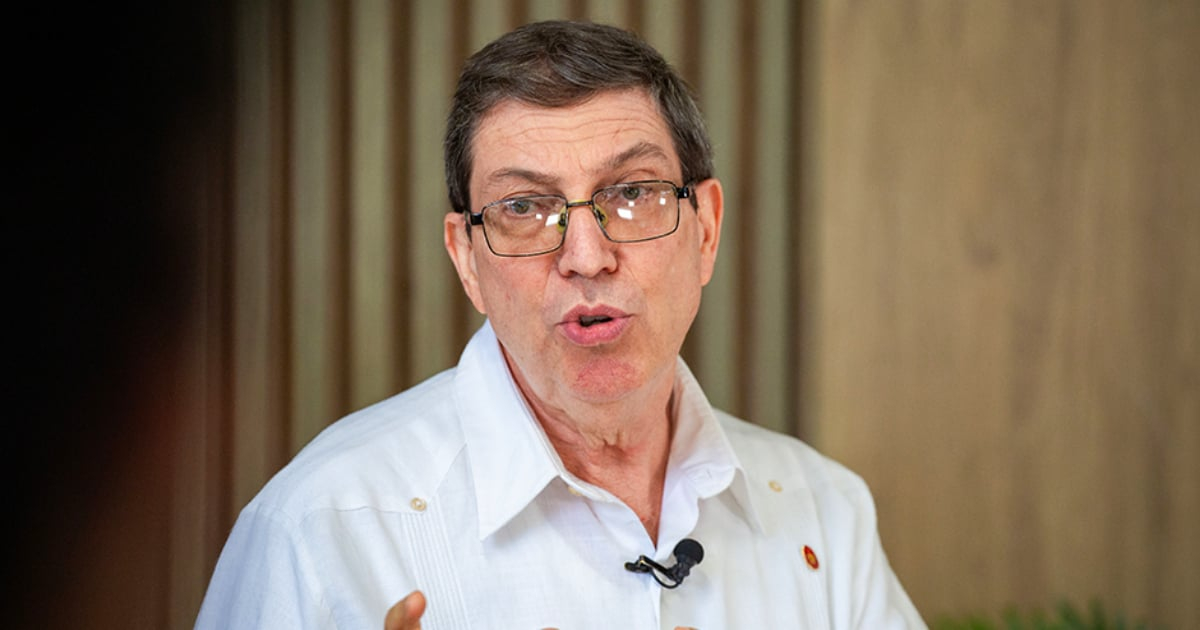
Cuban Foreign Minister Bruno Rodríguez Parrilla responded critically on Tuesday to the latest restrictions announced by the United States against Cuba, accusing Washington of hindering academic exchanges, restricting private sector businesses, and attempting to stall economic reforms initiated by Havana.
In a message shared on social media platform X, Rodríguez stated that the U.S. government has introduced "another wave of blockade measures against the Cuban people," citing the removal of people-to-people exchanges, new limitations on academic and research activities, and increased financial constraints.
"Additionally, prohibitions are tightened to prevent Cuban private entities from conducting direct business with U.S. entities and banks, including banning U-turn transactions," the Cuban diplomat wrote.
This reaction follows the announcement by the Office of Foreign Assets Control (OFAC) of the U.S. Treasury Department, which on Tuesday revealed a new tightening of American regulations on Cuba, set to take effect on September 30.
Among the changes is the removal of the general license for group educational trips known as people-to-people, as well as the general authorization for organizing or attending professional meetings and conferences in Cuba. Authorized academic activities will also face stricter requirements.
Washington has further expanded restrictions on transactions with entities listed on the Cuba Restricted List. Starting Wednesday, the prohibition extends not just to certain direct transactions but also to indirect financial operations where a person under U.S. jurisdiction acts as an intermediary.
Rodríguez specifically criticized this point, asserting that the U.S. "prohibits indirect operations with entities on the State Department's unilateral restricted entities list."
Another measure directly impacts Cuban private entrepreneurs. OFAC has rescinded an authorization introduced in 2024 that allowed certain independent entrepreneurs to open and operate accounts in U.S. banking institutions. Banks maintaining these accounts must block the associated funds unless another applicable authorization exists, requiring a specific OFAC license to unblock them.
While the measure does not entirely eliminate the possibility for Cuban citizens to hold certain accounts in the U.S., it revokes the special regime benefiting independent private sector entrepreneurs. The authorization for processing U-Turn transactions, which allowed U.S. financial institutions to process certain fund movements related to Cuba when both the origin and destination were outside the U.S., also disappears.
Rodríguez directly linked these decisions to the economic transformations announced by the Cuban government for 2026. "These new blockade measures aim to obstruct the ongoing economic transformation process," he stated.
Havana claims to have implemented 158 of the 176 Economic and Social Transformations announced in June, accounting for 89% of the program, although Prime Minister Manuel Marrero Cruz acknowledged this week that these measures have yet to yield concrete results in production, income, prices, and employment.
The foreign minister also argued that the new restrictions contradict statements by U.S. officials who claim to support the growth of Cuba's private sector. "Both the public and private sectors are openly attacked, despite some U.S. officials saying they want to help its development," he wrote.
The Trump administration holds a different stance. Washington asserts that its measures aim to limit the income and operations of structures linked to the Cuban state, military, and security apparatus while maintaining certain authorizations directed at the private sector and humanitarian activities.
This clash of positions comes shortly after Cuban Deputy Prime Minister and Minister of Foreign Trade and Foreign Investment, Oscar Pérez-Oliva Fraga, also blamed U.S. sanctions for hampering economic reforms and attracting foreign investment.
Rodríguez further used his message to challenge recent statements by U.S. Secretary of State Marco Rubio. "Less than 24 hours ago, the Secretary of State said 'Cuba has already fallen,' yet now additional measures need to be applied," the foreign minister wrote.
This criticism is part of a broader confrontation between the two governments. Just on Saturday, Rodríguez declared before the United Nations General Assembly that Cuba is willing to maintain trade and business relations with U.S. companies, but any rapprochement would depend on changes in Washington's policy.
Frequently Asked Questions about U.S.-Cuba Relations
What are the new U.S. restrictions on Cuba?
The new restrictions include the removal of licenses for people-to-people educational trips, stricter rules for academic activities, and expanded prohibitions on transactions with entities on the Cuba Restricted List.
How do these restrictions affect Cuban private entrepreneurs?
The restrictions eliminate a previous authorization allowing certain Cuban entrepreneurs to open accounts in U.S. banks, requiring a specific OFAC license to access funds, effectively hampering their financial operations.
How has Havana reacted to the new U.S. measures?
Havana criticizes the measures as an attempt to obstruct economic reforms and argues that they contradict U.S. claims of supporting Cuba's private sector growth.