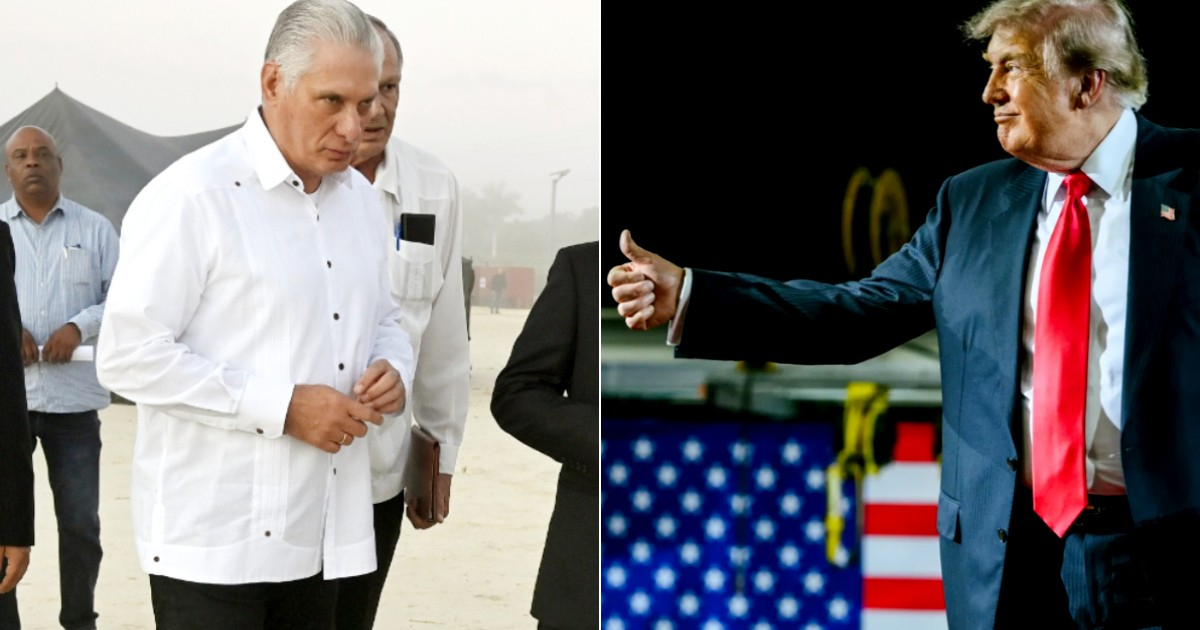
The Cuban government has firmly dismissed reports of potential business engagements between its officials and companies connected to former President Donald Trump. In an interview with Reuters from Havana, the allegations were categorically denied.
Óscar Pérez-Oliva Fraga, Vice President of the Council of Ministers and Minister of Foreign Trade and Foreign Investment, stated unequivocally, "I am not aware of any company directly linked to President Trump that has approached Cuba."
The minister further emphasized that neither he nor any other Cuban government representative had met with business executives associated with the former U.S. president.
Investigation Sparks Denial
This denial comes in response to a The Guardian investigation published on September 17. The report suggested that executives linked to Donald Trump Jr. and Eric Trump traveled to Cuba under the banner of Dominari Holdings—a firm based in Trump Tower, New York—to explore potential hotel industry ventures.
According to the investigation, these executives allegedly met with Raúl Guillermo Rodríguez Castro, known as "El Cangrejo," the grandson of Raúl Castro and a MININT officer who has served as an informal conduit between Havana and Washington.
Donald Trump Jr. and Eric Trump joined the advisory board of Dominari Holdings in February 2025, and together, they own 13.4% of the company, as reported by The Guardian based on regulatory filings.
Broader Political Context
In May, CIA Director John Ratcliffe reportedly met with "El Cangrejo" in Havana following reports from Axios about secret talks between Rodríguez Castro and Secretary of State Marco Rubio.
Beyond denying the contacts, Pérez-Oliva used the interview to reiterate that the U.S. trade embargo remains the primary barrier to the economic reforms the Cuban government seeks to implement.
"It's not our policy to prevent American companies from investing in Cuba, trading with Cuba, or doing business of any kind with Cuba. What blocks this possibility is the existence of the trade embargo," the official stated.
He specifically highlighted the oil embargo imposed in January 2026, which, according to the regime, slashed fuel imports by 80% to 90%, effectively cutting off supplies from Mexico, Venezuela, and other traditional providers, leading to electricity generation deficits exceeding 2,000 MW.
Contradictory Signals
Pérez-Oliva also clarified that mining companies Sherritt International and Antilles Gold have not withdrawn from Cuba but are assessing alternatives in light of U.S. sanctions.
His denial comes amidst a week marked by mixed signals between the two governments. Last Friday, Foreign Minister Bruno Rodríguez Parrilla addressed the UN, expressing Cuba's openness to commercial relations with U.S. companies, but conditioned any agreement on negotiations "in sovereign equality and without preconditions."
On the same day, Trump stated at the White House that "Cuba and we will make a deal," expressing a desire to "open Cuba to our people," dismissing immediate military action and favoring a negotiated solution.
The backdrop includes over two dozen rounds of sanctions since January 2026 and the withdrawal of European hotel chains like Meliá and Iberostar, completed in July, as American investors show growing interest in strategic Cuban assets in tourism, mining, and energy.
Rodríguez Parrilla was even more direct in quoting Secretary Rubio: "According to the Secretary of State, the official policy of the United States is to close every valve, exit, or survival formula for Cuba."
FAQs on U.S.-Cuba Relations and Business Ties
What is the current status of the U.S. trade embargo on Cuba?
The U.S. trade embargo on Cuba remains in place, significantly hindering economic interactions between American companies and the Cuban market.
Have any American companies expressed interest in investing in Cuba?
Yes, there is growing interest from American investors in Cuban sectors such as tourism, mining, and energy, despite the existing trade embargo.
What are the implications of the oil embargo imposed on Cuba?
The oil embargo has drastically reduced Cuba's fuel imports by 80% to 90%, severely affecting its electricity generation and energy supply.