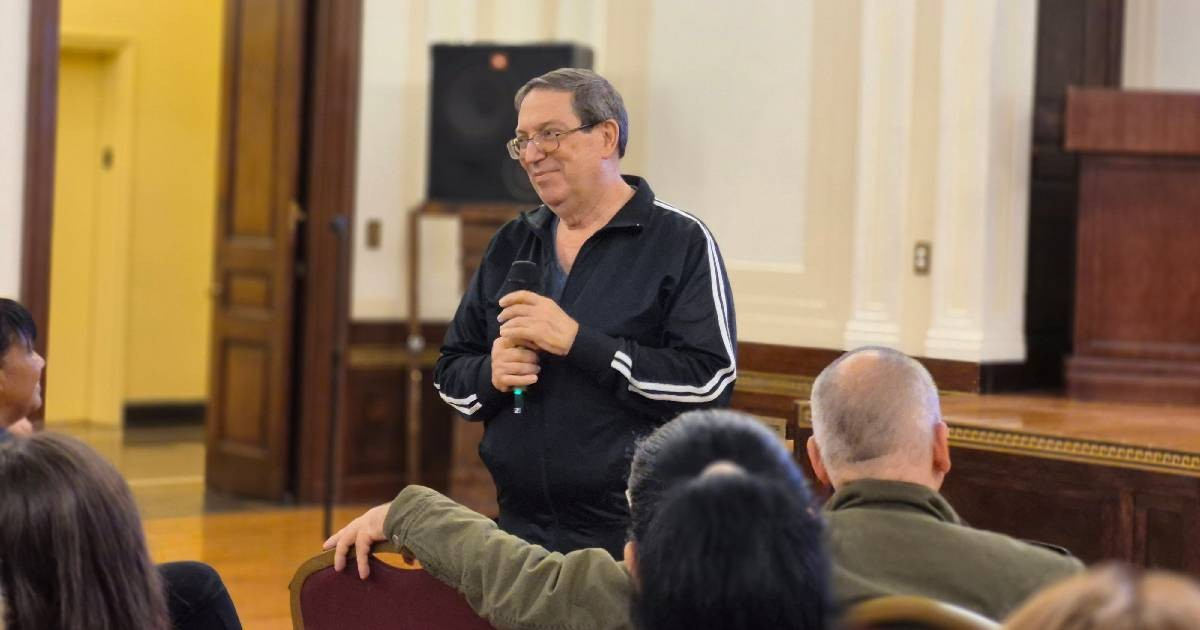
While millions of Cubans endure power outages lasting up to 20 hours daily and the electrical grid has experienced eight total failures this year, Foreign Minister Bruno Rodríguez Parrilla marked the 66th anniversary of the Committees for the Defense of the Revolution (CDR) from the Cuban Mission to the UN in New York. He was accompanied by members of the regime's diplomatic delegation.
Rodríguez shared images on X of the event held at the diplomatic mission's building, stating, "We celebrate the 66th anniversary of the CDR's founding with @CubaONU members. We reaffirm the Revolutionary Diplomacy's unyielding commitment to defending the Homeland, the Revolution, and Socialism."
This celebration in New York starkly contrasts with the severe situation on the island.
Power Crisis Worsens in Cuba
On September 18, Cuba experienced its eighth nationwide blackout of the year. A failure in the 220-kilovolt transmission lines between Matanzas-Cienfuegos and Matanzas-Santa Clara led to a cascading disconnection of the National Electroenergetic System, leaving over nine million people without electricity for about 32 hours.
The situation was dire enough for the U.S. Embassy in Havana to issue a security alert, warning of widespread disruptions to telephone and internet services.
Following the blackout, more than 80% of radio base sites and nearly 70% of telecommunications cabinets were out of service, resulting in a 58% loss of internet traffic.
Growing Concerns Over Impacts of Blackouts
Earlier in September, blackouts simultaneously affected up to 70% of the island, with electricity availability at only 1,020 megawatts against a demand of 3,300 megawatts.
The United Nations highlighted that these blackouts threaten the vaccination efforts for 70,000 children. Meanwhile, Foreign Affairs magazine warned mid-September that the island is approaching a "point of no return" in its crisis.
As Rodríguez celebrated in New York, the national celebration for the CDR's anniversary took place in Matanzas—recognized as the national vanguard in annual emulation and the epicenter of electrical failures—where the organization's national coordinator, Gerardo Hernández Nordelo, participated in events while the province remained in darkness.
Political Responses Amidst Crisis
Miguel Díaz-Canel took the opportunity to post five messages on X, urging an expansion of CDR surveillance, linking it to energy conservation and the prevention of crime, drugs, and corruption: "Surveillance is not abandoned; it is expanded," he wrote.
Rodríguez's presence in New York is part of his extensive agenda during the 81st session of the UN General Assembly, where he repeatedly blamed Washington for Cuba's crisis and described the embargo as a "collective punishment."
On September 22, the Cuban delegation walked out of the UN hall during President Donald Trump's speech, in which he labeled Cuba as a "completely failed state" and predicted the regime's end.
Three days later, in an interview with NBC News, Rodríguez credited Cuba's relative stability to the government's "efficacy," a claim that starkly contrasts with the reality of an island where the economic model has been deteriorating for decades and the electrical infrastructure is increasingly prone to collapse.
Understanding Cuba's Current Crisis
What is causing the frequent blackouts in Cuba?
The blackouts are primarily due to failures in the electrical transmission lines, insufficient power generation capacity, and an aging infrastructure.
How is the Cuban government responding to the crisis?
The government has blamed external factors, such as the U.S. embargo, for the crisis and has called for increased surveillance and energy conservation efforts.
What impact are the blackouts having on the Cuban population?
The blackouts have disrupted daily life, affected telecommunications, and pose a risk to critical health initiatives like child vaccinations.