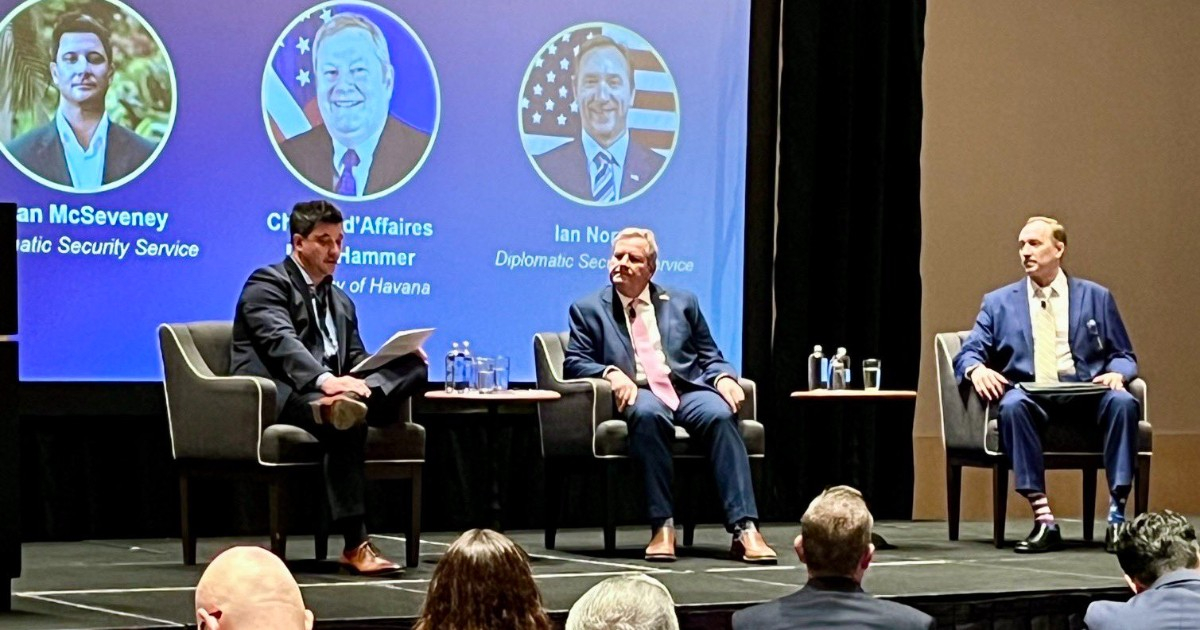
Mike Hammer, the head of the U.S. Embassy in Cuba, recently made a trip to Mexico City to attend the OSAC Americas & Energy Fall 2026 Summit. This event, hosted at the Hyatt Regency on September 21 and 22, captured significant international attention regarding the situation in Cuba, with many expressing hopes for a transformation on the island.
The summit, organized by the State Department's Overseas Security Advisory Council (OSAC), brought together diplomats, corporate security executives, and investors to discuss security and investment issues in the region. A particular focus was placed on the risk landscape for Mexico, Venezuela, Cuba, and the Eastern Caribbean.
While in Mexico City, Hammer led a discussion titled "A Fireside Chat on Cuba," an open dialogue about the island, alongside representatives from the State Department's Diplomatic Security Service. He also met with Deputy Assistant Secretary of State for Diplomatic Security Todd Wilcox and U.S. Ambassador to Mexico, Ron Johnson.
The U.S. Embassy in Cuba shared via social media that Hammer noticed considerable interest in Cuba's current state and the potential for change. This trip is part of Hammer's ongoing diplomatic efforts since his arrival in Cuba in November 2024, characterized by an active and public diplomatic style rare in Cuba's context.
In February 2026, Hammer embarked on a tour to Madrid and Rome, urging support for a "peaceful and prompt" transition, emphasizing that "Cuba's future will be decided by Cubans." In May, he participated in the Southern Command’s Chiefs of Mission Conference in Doral, Florida, alongside Secretary of State Marco Rubio and SOUTHCOM Commander General Francis L. Donovan, which attracted significant international media coverage.
Just before heading to Mexico, Hammer visited Santa Clara and Villa Clara to oversee the distribution of U.S. humanitarian aid and meet with advocates for change, including activist Coco Fariñas. This aid is part of the $100 million Washington pledged to Cuba, distributed through the Catholic Church, Caritas, and independent NGOs, bypassing the Cuban government.
Tensions surrounding Hammer's diplomatic agenda intensified following a CBS News revelation about an internal U.S. Army memo. This document queried the availability of military units like military police brigades, engineering battalions, and medical brigades for SOUTHCOM within 90 to 120 days, in planning related to Cuba.
While the memo didn't directly mention Cuba or order any deployment, officials confirmed its connection to planning for the island. Analysts suggest that the units' profiles — logistics, engineering, military police, and medical support — align more with humanitarian or stabilization missions than conventional military actions.
Though there's no explicit evidence that Hammer is building a network for "the day after," his diplomatic activities — international travels, military briefings, civil society engagement, and participation in security forums — point to a coordinated strategy aimed at garnering international support and preparing for a potential shift in Cuba.
President Donald Trump himself stated on Friday that "Cuba is failing miserably" and that the U.S. "wants to open Cuba to our people."
International Interest in Cuba's Future
What was the main focus of the OSAC Americas & Energy Fall 2026 Summit?
The summit focused on security and investment challenges in the Americas, with particular attention to the risk landscape in Mexico, Venezuela, Cuba, and the Eastern Caribbean.
What is Mike Hammer's role in the context of Cuba?
As the head of the U.S. Embassy in Cuba, Mike Hammer is actively engaged in a diplomatic mission to foster international support for change in Cuba, involving public diplomacy and international collaboration.
How is U.S. humanitarian aid being distributed in Cuba?
The U.S. has pledged $100 million in aid to Cuba, which is being distributed through the Catholic Church, Caritas, and independent NGOs, without involving the Cuban government.