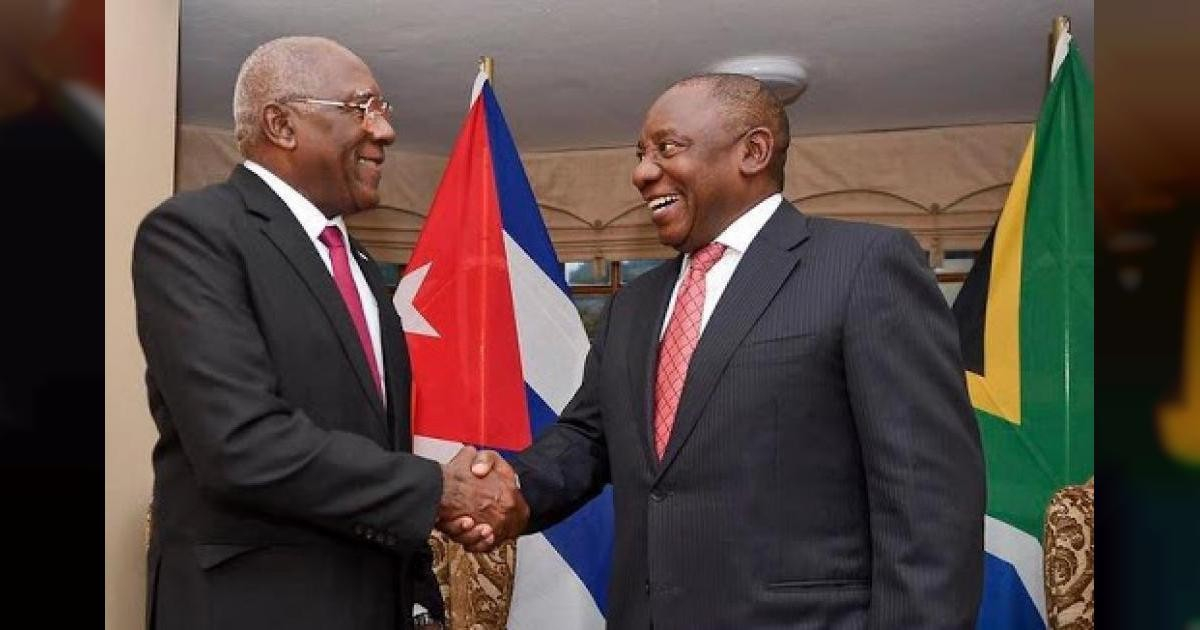
South Africa's expenditure of over 1,400 million rands, equivalent to more than 80 million dollars, on agreements and cooperative programs with Cuba has once again stirred controversy. This time, the debate arises amidst revelations about the deteriorating condition of the African nation's diplomatic properties abroad.
Ryan Smith, a member of the Democratic Alliance (DA) and its spokesperson on international affairs, has criticized the government's priorities. His concerns follow a parliamentary response from the Minister of International Relations and Cooperation, Ronald Lamola, which highlighted that necessary repairs for South African embassies and other foreign properties are estimated to cost around 830 million rands.
These figures are derived from reports over a three-year period regarding the state of such properties. Specifically, the repairs for the South African High Commission in the United Kingdom are estimated at approximately 170 million rands, while those for the embassy in the Netherlands are around 110 million.
Financial Priorities Under Scrutiny
Smith has contrasted these pending expenses with the approximately 1,400 million rands allocated to various agreements with Cuba over the past decade. He has accused the African National Congress (ANC) of prioritizing international political alliances over domestic needs.
However, this sum isn't solely financial aid to Havana. A DA investigation, based on parliamentary responses, placed the combined cost of agreements with Cuba at 1,425 million rands across five government departments.
The largest share went to Defense, totaling over 1,076 million rands. Other allocations included 138 million for Public Works, 83 million for Health, 64.6 million for Human Settlements, Water, and Sanitation, and 63 million for Basic Education. These funds were tied to hiring Cuban professionals and service providers, among other things.
Long-Standing Controversies
The substantial agreements between Havana and Pretoria have been a source of contention for years. In 2021, details emerged about bilateral contracts in military, water management, and health sectors, reportedly exceeding 93 million dollars at the time. These figures, published then, are separate from the 1,425 million rands currently cited by the DA, which are based on agreements and expenses identified over the last ten years.
The hiring of 24 Cuban engineers to work on South Africa's water infrastructure sparked significant criticism. The union Solidaridad took the matter to court, arguing that there were qualified, unemployed South African professionals available for these roles.
Health cooperation has also faced scrutiny. In 2024, it was revealed that the Gauteng province was spending around 745,000 dollars annually on 11 Cuban doctors, while hundreds of South African professionals struggled to find employment in the public sector.
Historic and Recent Disputes
The medical cooperation between the two nations dates back to a 1996 agreement signed during the administrations of Nelson Mandela and Fidel Castro. South Africa has also sent students to Cuban universities and hired Cuban healthcare professionals.
Another controversial episode occurred during the pandemic, when the South African Armed Forces purchased Interferon Alpha-2b from Cuba for about 17.7 million dollars, initially lacking necessary health authorizations. Some of the medications were eventually destroyed or returned, and the irregularities in the transaction were subject to investigations and political criticism.
In December 2024, the South African Air Force ended a program that had been sending cadets to train in Cuba since 2014. Military authorities cited challenges in aligning the training received in Cuba with South African operational standards.
Controversies have persisted into recent years. In early September 2026, the South African National Defense Union (SANDU) called for an investigation into allegations that 38 South African soldiers sent to Cuba for training were pressured to give part of their allowances to needy Cuban citizens. The South African Defense Forces later denied any coercion for financial contributions.
Despite these disputes, the South African government maintains a close relationship with Havana. In August, the Parliamentary Portfolio Committee on International Relations reaffirmed its support for Cuba, highlighting bilateral cooperation in health, education, and professional training. It also noted a previous economic assistance package, including a credit component of 210 million rands, with approximately 13 million still pending repayment. According to Parliament, Cuba has adhered to the agreed payment schedules.
This new controversy arises as South African opposition sectors demand that public resources allocated to foreign policy focus on internal needs and the maintenance of the country's diplomatic infrastructure.
"Taxpayer money funding the DIRCO budget is not intended to keep the ANC's international friends afloat," Smith stated, urging a reallocation of budgetary priorities by the Ministry of International Relations.
Frequently Asked Questions on South Africa-Cuba Relations
Why is South Africa's spending on Cuba controversial?
The spending is controversial due to the large sums involved, which some argue could be better used to address domestic issues within South Africa, such as the maintenance of diplomatic properties and employment for local professionals.
What sectors are involved in the agreements between South Africa and Cuba?
The agreements involve several sectors, including defense, public works, health, human settlements, water and sanitation, and basic education. These sectors have benefited from Cuban professionals and service providers.
How has the South African government responded to the criticisms?
The South African government has maintained its supportive stance towards Cuba, emphasizing the importance of bilateral cooperation and citing previous economic assistance packages as evidence of Cuba's adherence to repayment schedules.