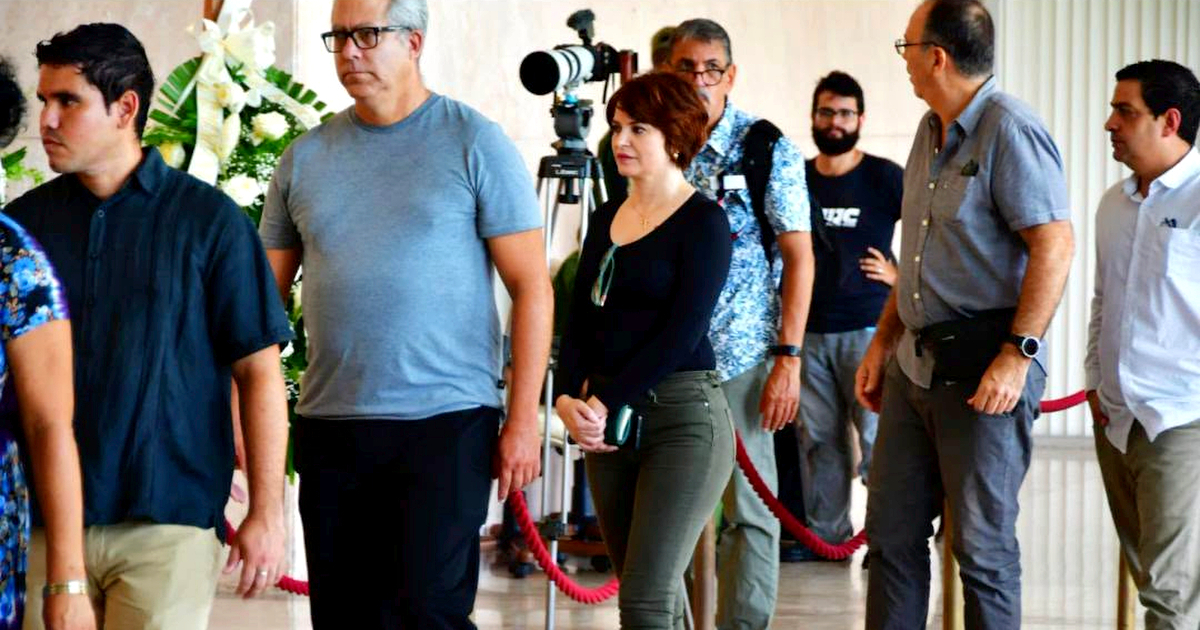
In response to the recent CBS News leak regarding U.S. military preparations around Cuba, Ana Hurtado reverted to her usual narrative, dismissing it as "psychological warfare" waged by Washington against Havana.
"What the United States doesn't want leaked, doesn't get leaked," she posted on Facebook, implying that the report about potential U.S. Army support units—logistics, medical, engineering, and military police—was merely an intimidation tactic.
While this statement might align with the regime's propaganda, it overlooks a crucial aspect: in security politics, leaks can also serve as indicators. In Cuba's case, these indicators have been accumulating for months.
U.S. Military Preparations Around Cuba
CBS reported that the U.S. Army Reserve is assessing whether it can provide the Southern Command with military police units, medical personnel, engineers, and logistical support within a 90 to 120-day timeframe.
The report clarified that there is no public deployment order or announced decision to intervene in Cuba, but it also highlighted that several U.S. officials link these preparations to planning around the island.
Context of U.S. Actions and Rhetoric
This nuance is significant. It doesn't confirm an imminent operation, but neither does it allow the matter to be dismissed as mere theatrics.
Since the capture of Nicolás Maduro, the Trump administration has intensified its rhetoric toward Cuba, labeling the island a threat to U.S. national security, pressuring the regime's energy supply, increasing aerial surveillance in the Caribbean, bolstering regional capabilities in Puerto Rico and Guantánamo, and reiterating that Cuba will not be allowed to serve as a platform for adversaries like Russia, China, and Iran.
Adding to this are Trump's own statements about "taking Cuba," deploying an aircraft carrier, and applying direct pressure on the regime. Figures like Marco Rubio and Pete Hegseth within his circle have reinforced the notion that the U.S. president's warnings are not meant to be ignored.
Thus, Hurtado's response is as telling as the leak she seeks to mock.
Hurtado's Connections and Motives
The Spanish commentator is not a detached observer. Journalistic investigations have identified her as the wife of Senén Casas Más, who is linked to the inner circle of Alejandro Castro Espín, a figure associated with Cuban military intelligence and the son of Raúl Castro.
This connection perhaps sheds light on why Hurtado's message echoes the language of intelligence services while aligning with the regime's propaganda narrative in the face of each external pressure signal.
Hurtado's argument is that Washington is merely playing scare tactics. However, recent experience in Venezuela suggests a more uncomfortable reality for Havana: before acting against Maduro, the U.S. also issued warnings, leaks, deployments, sanctions, statements, and warnings that the Chavismo regime chose to underestimate.
Not every warning leads to an operation. Not every leak translates into an order. But a regime that survives by interpreting power signals should know that mocking them doesn't make them false.
The real question isn't whether CBS has published the precursor to an intervention. The question is why Havana persists in dismissing a series of warnings that Washington has been increasingly making visible as mere propaganda.
U.S.-Cuba Relations and Military Preparations: Common Questions
What did CBS News report about U.S. military preparations around Cuba?
CBS News reported that the U.S. Army Reserve is evaluating the provision of military police units, medical personnel, engineers, and logistical support to the Southern Command within a 90 to 120-day period.
Why does Ana Hurtado refer to the U.S. military preparations as 'psychological warfare'?
Ana Hurtado suggests that the U.S. military preparations are an intimidation tactic by Washington against Havana, dismissing them as mere psychological warfare.
How has the Trump administration intensified its stance toward Cuba?
The Trump administration has labeled Cuba a national security threat, pressured its energy supply, increased aerial surveillance, and reinforced regional military capabilities, among other measures.