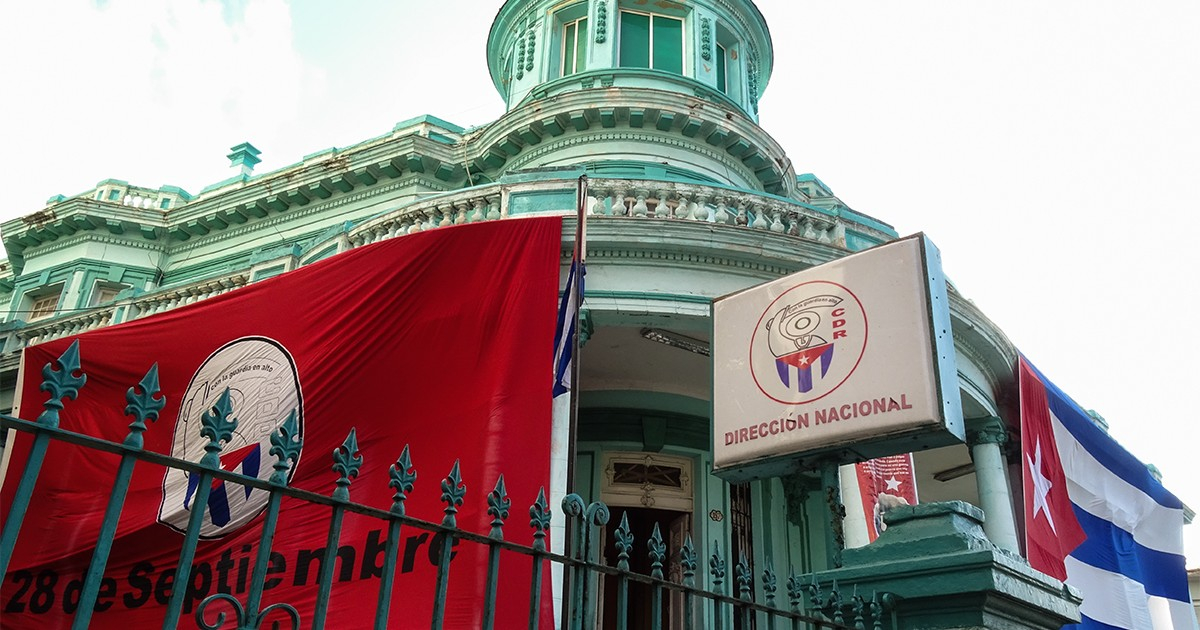
On Sunday, Alina Bárbara López Hernández, an intellectual and activist from Matanzas, shared a post on her Facebook page titled "Living by Appearances." In it, she dismantles the official portrayal of the Committees for the Defense of the Revolution (CDR) using a specific example: Matanzas being named the National Vanguard of the organization, an event celebrated on Saturday at the Sauto Theater.
The ceremony, described by the state-run newspaper Granma as "a beautiful reward for their achievements," was attended by local authorities from Matanzas, the national vice-coordinator of the CDRs, Yosveny Verdeal Castellanos, and coordinators from Santiago de Cuba and Pinar del Río. López Hernández's post comes just before the 66th anniversary of the CDRs, which is observed on Monday, September 28.
Living in the same city, the activist contrasts the official recognition with a reality often overlooked by these grand events: According to the semiannual report from the Cuban Citizen Audit Observatory (OCAC), Matanzas leads the national rankings for murders (18), assaults (21), and thefts (155) in the first half of 2026. The region has also been the center of several epidemics in recent years.
"Like everywhere else on the Island, the CDRs in Matanzas have become a massive, ineffective bureaucratic structure without the social foundation to support it. Many people don't even pay the monthly dues; meetings, night watches, voluntary workdays, blood donations, or celebrations tied to September 28 are not happening. We have neighborhoods left in the dark and vulnerable to crime," López Hernández expressed.
To further illustrate this collapse, López Hernández cites a personal example: a building across from her home, colloquially known as "The Kremlin" due to the fervent activism of its residents—many of whom work at the Provincial Communist Party School. This building was once a model of activism visited by leaders. "For years now, The Kremlin has joined the apathy of the surrounding neighborhood. The lively events, filled with loud music, speeches, and communal cooking, are but a memory," she noted.
López Hernández argues that the decline is not ideological but material: "People are too stressed about what they'll eat, how they'll cook, how they'll light their homes at night, how to prevent thefts, and how they'll survive the next day." Nationally, murders in Cuba increased by 42.9% in the first half of 2026, rising from 63 to 90 compared to the same period the previous year, according to the OCAC.
The activist also incorporates comments from Miguel Díaz-Canel, who acknowledged the organization's decline during a meeting with CDR leaders and members: "Many people think this organization is outdated, irrelevant under current conditions, and contributes nothing." Despite this, the leader insisted otherwise, urging the structure to "reinvent itself" amid the crisis.
This official acknowledgment of decline contrasts with the anniversary celebrations: The regime awarded 134 CDR members under Presidential Decree 1284, signed on the 3rd of this month and published in the Official Gazette 20 days later. Meanwhile, national coordinator Gerardo Hernández Nordelo promotes initiatives like "My Neighborhood for the Homeland" to revitalize the structure.
However, López Hernández believes none of these initiatives address the core issue. "Events like the one at Sauto Theater attempt to project an image of revolutionary traditions maintained over time; however, they unfold like rituals, with leaders disconnected from reality and indifferent to people's suffering," she wrote.
She concluded with a statement encapsulating her assessment: "These leaders are the last bastion of what once was the Cuban revolution and its Committees for Defense. They indeed reinvent themselves daily."
The Decline of Cuba's CDRs: Key Questions Answered
What is the main criticism of the CDRs in Matanzas?
The main criticism is that the CDRs have become a vast, ineffective bureaucratic structure lacking social support, with many residents not participating in their activities.
What specific issues did López Hernández highlight in Matanzas?
López Hernández highlighted that Matanzas leads the nation in murders, assaults, and thefts and has been the epicenter of various epidemics, reflecting a disconnect between official recognition and reality.
How has the Cuban government responded to the decline of CDRs?
The government has recognized the decline, with leaders like Díaz-Canel acknowledging the problem and calling for the CDRs to reinvent themselves, despite continuing with ceremonial recognitions and initiatives.