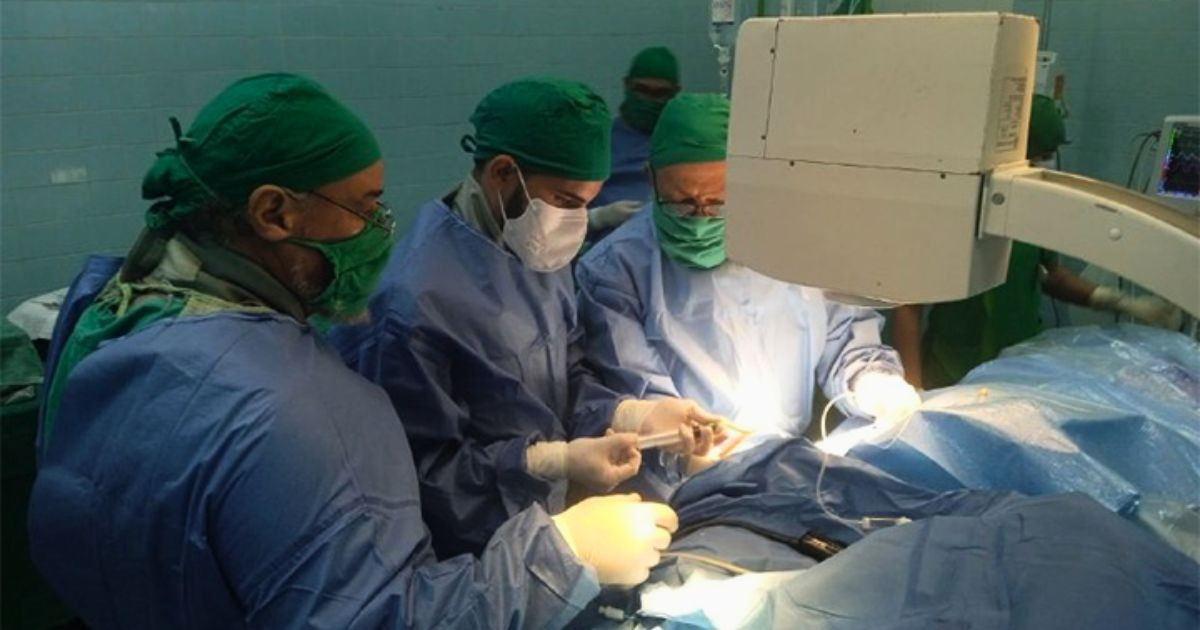
For the first time, a multidisciplinary team of urology experts in Pinar del Río successfully performed a percutaneous nephrolithotomy at the Pepe Portilla pediatric hospital. This minimally invasive procedure, designed to remove kidney stones, marks an unprecedented achievement for this children's healthcare center.
The patient, 16-year-old Adrián Rodríguez Vélez from the central municipality, suffers from a metabolic disorder affecting calcium, phosphate, and magnesium levels, as reported by the Cuban News Agency (ACN).
Adrián had been dealing with a staghorn calculus—a large kidney stone occupying significant portions of the renal collecting system—leading to frequent, particularly septic, crises. Previous treatments included various approaches, such as open surgery, according to sources.
Roberto Caveda Carrasco, a first-degree urology specialist at Pepe Portilla and head of the provincial urology service, spearheaded the operation. He described it as a milestone of institutional collaboration: "We established a link with the minimally invasive department of the Abel Santamaría Cuadrado hospital, where the equipment is housed. This enables the pediatric hospital to effectively perform such minimally invasive surgeries, which are vital for preserving kidney function." He also noted, "The surgery was complex, lasting three hours, but it was successful," as reported by the media.
The procedure was supported by Tadeo Miguel Ferreiro Valdés, a second-degree urology specialist from Abel Santamaría Cuadrado hospital—the largest in the province. He emphasized that the endoscopic technique, which includes an endocamera, provides enhanced visibility and better surgical access compared to conventional methods.
This surgery also served as a training experience for Misael Hernández, a newly graduated urology specialist, and Jonathan Cuba, a fourth-year pediatric resident.
The success of the surgery was also attributed to the pediatric hospital's Anesthesiology team. Jackson Castillo Pozo, head of the Anesthesia service, highlighted teamwork as a crucial element of success, with the operation being conducted under endotracheal general anesthesia.
This achievement is particularly significant given the severe healthcare crisis affecting Pinar del Río and the country, with tens of thousands of surgeries pending. Since at least February of that year, power outages and shortages have forced the postponement of elective surgeries in Cuba's westernmost province, prioritizing only emergencies, pregnant women, oncology patients, and those undergoing hemodialysis.
Percutaneous nephrolithotomy has been part of Cuba's medical landscape for decades. Endourological procedures of this nature began in Havana's Hermanos Ameijeiras Hospital in the late 1980s and gradually spread across other regions.
This technique is also among the options for treating pediatric urolithiasis, though the widespread application of minimally invasive techniques in children has been limited by equipment and instrument availability.
In this challenging context, the pediatric nephrolithotomy performed last Friday signifies a tangible advancement for the Pepe Portilla hospital's problem-solving capabilities, serving as a beacon of progress amid the stark deficiencies faced by Cuba's healthcare system, particularly in the provinces.
Key Insights on Pediatric Nephrolithotomy in Cuba
What is percutaneous nephrolithotomy?
Percutaneous nephrolithotomy is a minimally invasive surgical procedure used to remove kidney stones by accessing the kidney through a small incision in the back.
Why is this procedure significant for pediatric patients in Pinar del Río?
This procedure is significant because it represents the first time such a minimally invasive technique has been performed at the Pepe Portilla pediatric hospital, improving the hospital's ability to treat complex kidney stone cases in children.
How does the current healthcare crisis in Cuba affect surgical procedures?
The ongoing healthcare crisis in Cuba, marked by power outages and resource shortages, has resulted in the postponement of elective surgeries, with priority given to emergencies and critical cases only.