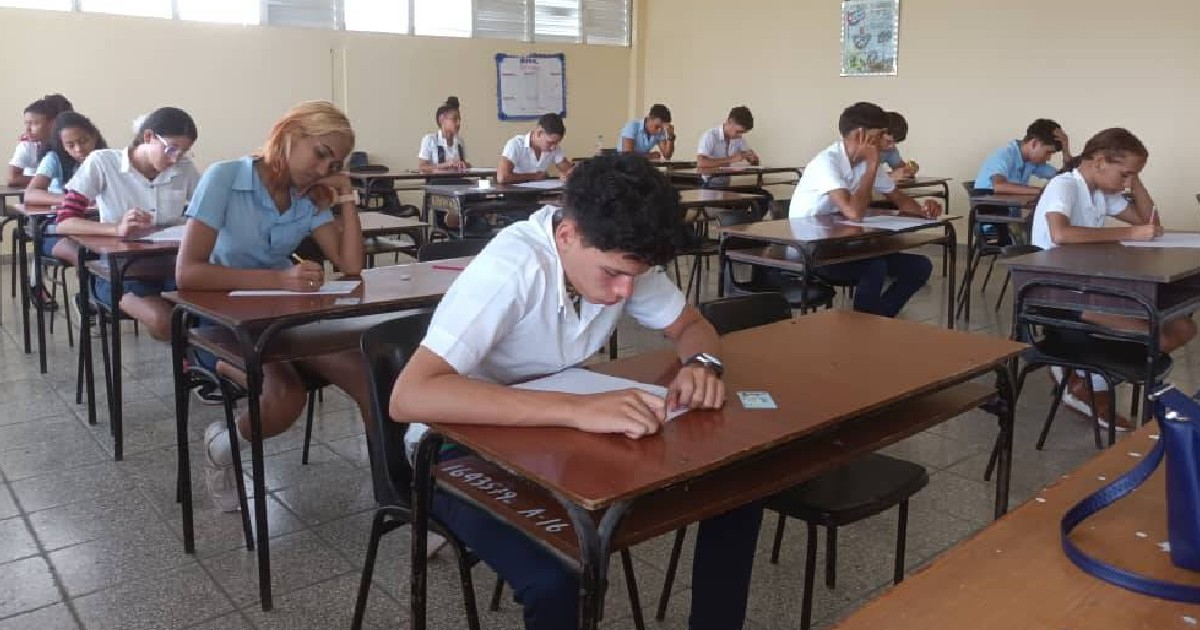
A middle school English teacher from Ramón López Peña in San Cristóbal, Artemisa, has sparked conversation through a poignant reflection shared on social media. She argues that the implementation of the double school session is not a pedagogical solution but rather a way to mask the deterioration of the Cuban educational system.
The teacher, known as Juana, is 36 years old, a mother of two, and shared her thoughts on Facebook through her former instructor from the teacher training college, Pepe Morejón. Morejón publicly supported and disseminated her message, urging the educational authorities in San Cristóbal and the province to abolish the measure, criticizing it as having "only administrative value, lacking any pedagogical and psychological merit."
"When the double session was announced, it felt like a punch to the gut," Juana wrote. "Not because I'm against teaching more, but because I understand what it means in a place like ours, where getting transport is a miracle, water comes sporadically, and power outages last 18, 20, or even 24 hours."
The teacher describes her day starting at six in the morning, burdened with the uncertainty of water and electricity availability. She arrives at school already fatigued, teaching in overcrowded classrooms of 40 students without fans or snacks during breaks. "The double session brought nothing with it. No additional teachers, no extra food, no better transport, no more electricity. Just more hours," she emphasized.
Without access to audio-visual aids or the internet, she teaches English "using chalk and a board, with songs I make up, through gestures." Adding to the challenge is the shortage of teachers in English, mathematics, and history at her school. Her salary, in this context, is an insult: "I earn less than the price of a chicken. It's not enough for shoes, soap, or even a decent snack for my children."
The salary figures are stark. Resolution 18/2026, effective from July 1, 2026, set basic salaries for teachers between 6,130 and 7,735 Cuban pesos per month, depending on their qualification level. As per the informal exchange rate at the end of September, these amounts equate to less than $11.
A basic purchase in the informal market can easily surpass a newly graduated teacher's salary. The consequence is an exodus: "Those of us who remain do so for the students, not for the paycheck," Juana lamented.
Her testimony is not isolated. The 2026-2027 school year, which began on September 1, started with a deficit of at least 24,000 teachers—12.5% of the needed positions—leaving tens of thousands of students without a primary instructor. Before the school year began, Education Minister Naima Ariatne Trujillo Barreto admitted that schools would open under "very difficult" conditions.
The post prompted responses from numerous educators who confirmed similar experiences. A university professor from Pinar del Río stated she remains in the classroom "out of love and dedication," but her salary "doesn't even cover the rice needed for a week." A retired teacher with 44 years of service revealed her pension doesn't cover a carton of eggs per month, forcing her to work four jobs. "Will Cuban teachers only rest in the cemetery?" she questioned.
Juana concluded her reflection with a powerful statement of defiance and hope: "I wish one day Cuban schools will be places where teaching isn't an act of forced heroism. Until then, I'll continue teaching English as best as I can, but I won't pretend this system works."
Understanding the Cuban Education Crisis
What is the double school session in Cuba?
The double school session is an administrative measure that extends the school day, purportedly to improve educational outcomes, but criticized for lacking supporting resources like teachers, food, and infrastructure.
Why are Cuban teachers dissatisfied with their salaries?
Cuban teachers are dissatisfied because their salaries, as established by Resolution 18/2026, are insufficient to meet basic living costs, forcing many to take on additional jobs or leave the profession.
How has the teacher shortage impacted Cuban education?
The teacher shortage has led to a significant number of students beginning the school year without a primary instructor, further exacerbating the challenges within the Cuban educational system.