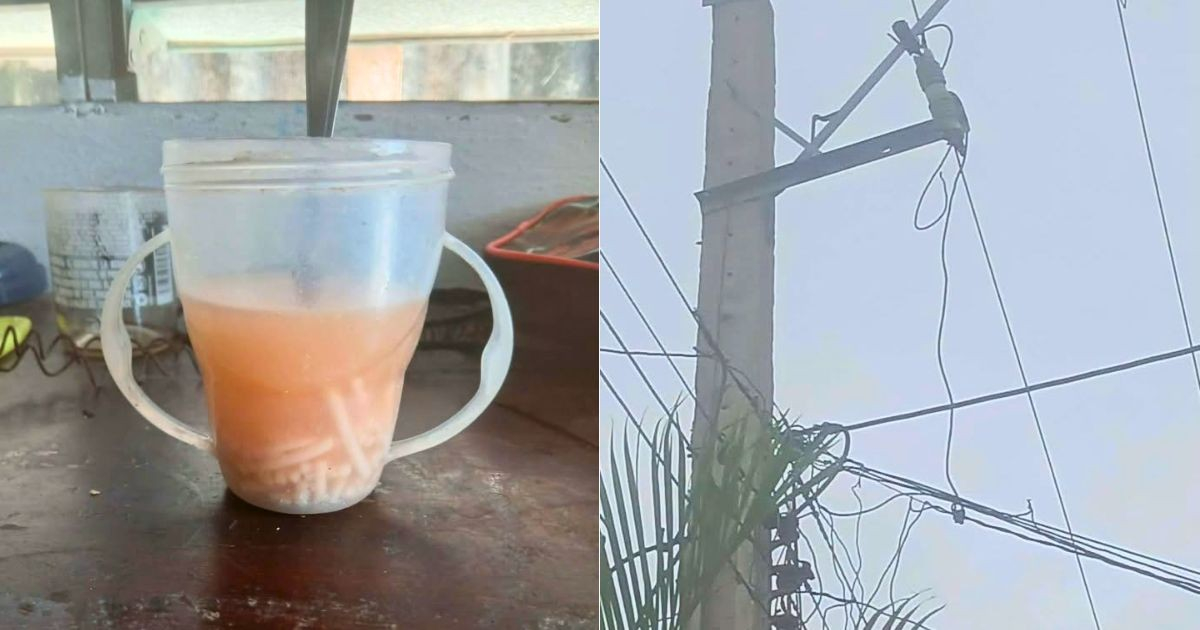
A mother residing in Caibarién, located in the Villa Clara province, came forward on Sunday through journalist Mario J. Pentón, revealing that residents of 22nd Street, between 23rd and 25th, have been left in the dark for 12 days due to a transformer malfunction that local authorities have failed to address.
Fearing backlash, the woman requested anonymity as she recounted how the issue began. According to her, the transformer "shorted out and blew a high-tension fuse, something they could have fixed right here in the municipality. They promised a swift response, yet nothing has been done."
The affected area includes bedridden individuals and children who require ventilation. The complainant, a mother of two with one child receiving medical care in Santa Clara, emphasized the necessity of remaining anonymous, given her children’s sole dependency on her.
State Response Falls Short
State assistance has been limited to offering subpar food. "Their only 'solution' was to sell a watery soup at noon, prepared in Brisas del Mar, priced at 150 pesos per serving. We are fed up with being mocked," the woman detailed in her message to the journalist.
Furthermore, the local Communist Party of Cuba (PCC) secretary had assured the dispatch of a water truck during the scheduled supply cycle, yet the vehicle never arrived.
Recurring Power Struggles Across Cuba
The situation in Caibarién is not isolated. This coastal town previously endured a fire at the Van Troi 2 substation on June 16, which damaged the transformer and left 15 districts without electricity. Municipal manager Rogelio Ruiz Rodríguez attributed the incident to overheating caused by high temperatures and peak consumption.
Such scenarios are echoed throughout the island. In mid-month, a San Miguel del Padrón resident reported going 17 days without power, forcing her children to sleep on the street due to the heat. Meanwhile, a doctor in Matanzas had been without electricity for nearly three months, caring for her bedridden mother, and in Camagüey, residents mentioned waiting 15 to 20 days without a solution from officials.
Fear of retaliation is prevalent: in August, a Lawton mother faced threats of police intervention after voicing concerns over the lack of water and electricity.
Looming Transformer Shortage
The scarcity of transformers is a challenge acknowledged by Cuban officials. In June, the Electric Union admitted to the lack of immediate access to equipment and parts needed to replace damaged units. The nation largely relies on three repair and recovery facilities in Havana, Villa Clara, and Manzanillo.
In Havana alone, an average of 25 transformers fail daily, with some days exceeding 60 malfunctions, as reported by the state-run Canal Caribe. Cuban media indicate that the combined production and recovery capacity of these facilities is about 70 units per day, insufficient to meet demand.
National conditions exacerbate local outages. On the 18th of this month, Cuba experienced its eighth nationwide blackout of the year. In the weeks leading up to the Caibarién complaint, power cuts simultaneously affected between 65% and 70% of the nation during peak hours, with generation shortfalls often exceeding 2,000 MW.
Understanding Cuba's Power Crisis
What caused the power outage in Caibarién?
The outage was due to a malfunctioning transformer that shorted out and blew a high-tension fuse, an issue that local authorities have not yet resolved.
How have local authorities responded to power outages?
Authorities have offered minimal assistance, such as selling low-quality food, but have failed to provide long-term solutions or fulfill promises like delivering water.
Is the power outage issue unique to Caibarién?
No, similar power struggles are occurring throughout Cuba, with other areas also experiencing prolonged outages and inadequate responses from authorities.