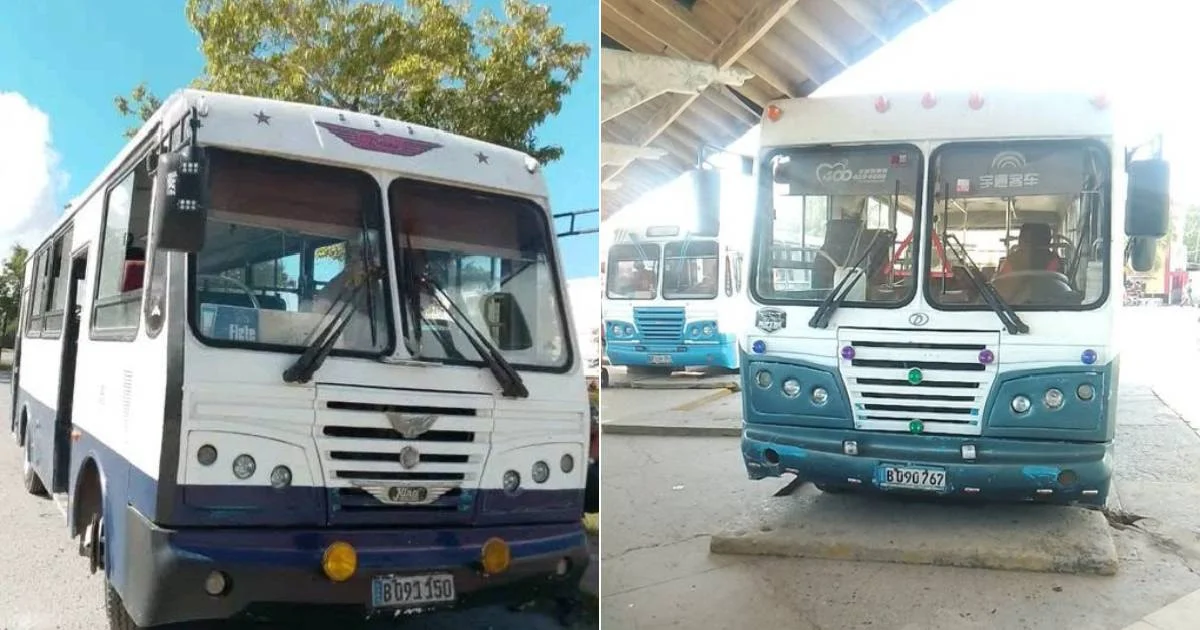
The mayor of Colombia, a municipality in Las Tunas province, heralded government economic reforms as a success by highlighting that state-operated buses now charge 800 pesos per ride—a fee equating to nearly a quarter of the Cuban minimum monthly wage of 3,210 pesos.
Official newspaper 26 reported on Saturday the statements of Héctor Ramón Pérez Zequeira, who described the review of his administration's performance as "very positive" and affirmed that "the impact of the transformations is real and tangible."
Pérez framed his comments within the 176 economic and social transformations approved by the National Assembly last June.
According to Pérez, state buses now run on fuel through a "cooperative co-production," with the 800 pesos fare representing "400 pesos less than the previous ticket price," which he believes has fostered "real competition."
He compared this to privately-managed rented buses, which charge "slightly over 1,000 pesos" to reach the city of Las Tunas, whereas previously the cost exceeded 3,000 pesos.
The mayor also highlighted the resumption of the route to Camagüey, although he acknowledged that the prices "are not what the public desires."
Colombia, he asserted, boasts the lowest transportation fares in the entire province.
Beyond transportation, Pérez cited other achievements in Colombia: the local bakery, which had been "almost entirely halted," resumed production; Las Delicias motel installed 32 kilowatts of solar panels that are already generating revenue; and a small and medium-sized enterprise (SME) will undertake the installation of panels in the municipality's commercial and gastronomic units.
"The first thing that needs to change is our mindset," the mayor argued.
What the official presents as an accomplishment starkly contrasts with the reality faced by Cubans across the rest of the country. A truck ride from Bayamo to Manzanillo costs 2,000 pesos, and a trip covering the approximately 900 kilometers from Santiago de Cuba to Havana can range between 5,000 and 6,000 pesos.
"Believe it or not, transportation has improved. The issue is that people don't want to travel anywhere because they can't afford the transportation costs," opposition leader José Daniel Ferrer García remarked recently.
Last week, it was revealed that in the capital of Las Tunas, 20 electric tricycles that served as an alternative urban mobility option had been inactive for two weeks due to the lack of an electrical suppressor unavailable anywhere in the country.
Meanwhile, the reactivation of the Morón-Camagüey train sparked criticism for its 1,500 pesos fare, with users questioning on social media, "Is this a ticket to Ciego or a flight to Paris?" In Cienfuegos, the planned reactivation of five urban routes scheduled for October 1 hinges on private individuals supplying the fuel the State cannot provide.
Key Insights on Cuba's Transportation Challenges
What is the cost of a state bus ride in Colombia, Las Tunas?
The cost of a state bus ride in Colombia, Las Tunas, is 800 pesos.
How do the transportation costs in Colombia compare to other regions in Cuba?
Colombia boasts the lowest transportation fares in Las Tunas province, whereas other regions like Santiago de Cuba to Havana can cost between 5,000 and 6,000 pesos for a trip.
What other economic achievements did the mayor of Colombia highlight?
The mayor highlighted the resumption of local bakery production, installation of solar panels at Las Delicias motel, and a SME's plan to install panels in commercial units as significant achievements.