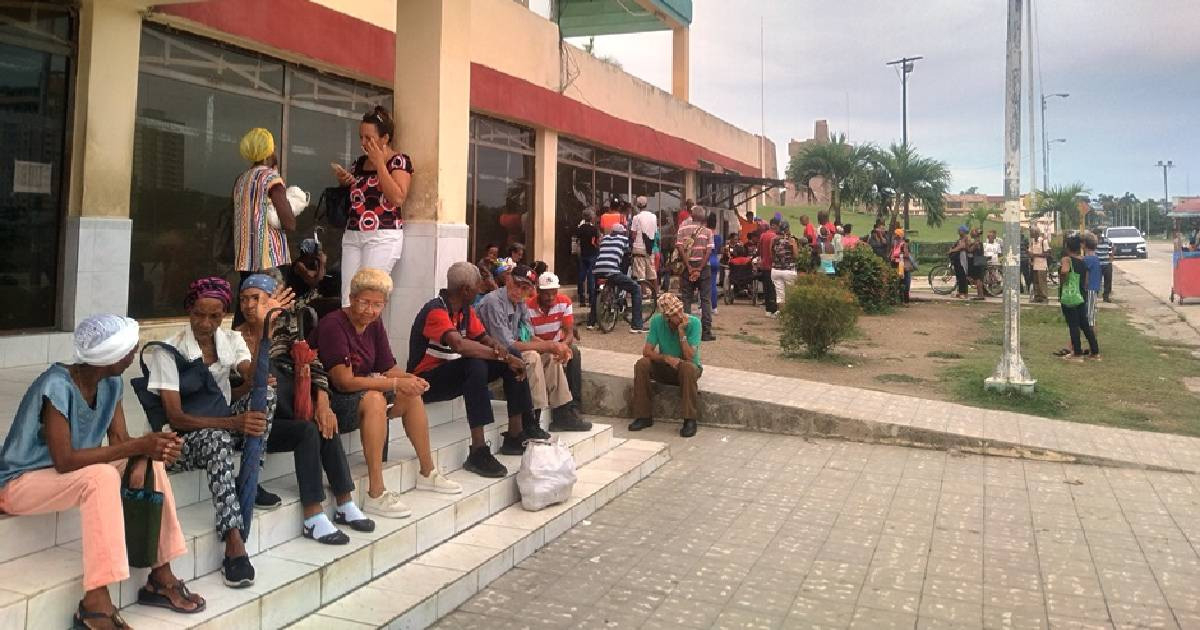
Despite three years having passed since the implementation of banking reforms, over 31,000 retirees and pensioners in Guantánamo continue to visit bank branches each month to collect their pensions, as reported by the official newspaper, Venceremos, this past Friday.
In Guantánamo province, there are more than 49,600 retirees and pensioners. However, only 18,582 individuals, accounting for about 37% of the total, have adopted alternative payment methods that bypass bank counters. These alternatives include postal services, bank agents, and private businesses.
The remaining 63%, predominantly elderly individuals, remain reliant on bank branches to receive their pensions. The challenges associated with this system encompass lengthy queues, disputes, mistreatment, and the illegal sale of spots in line for elderly individuals to access their funds, as acknowledged by the press outlet.
Banking System Reforms and Their Impact
The Central Bank of Cuba's Resolution 111/2023 introduced restrictions on cash transactions and encouraged the adoption of electronic channels for financial operations.
President Miguel Díaz-Canel framed the reform as a means to "profoundly modernize the country's banking and financial system," aiming to create more efficient, digital, and accessible banks for the general populace.
However, statistics reveal the structural shortcomings of the reform. A survey conducted in May indicated that less than 10% of small businesses and private workers in Sancti Spíritus accepted electronic transfers as a regular payment method.
Guantánamo's Ongoing Financial Struggles
The liquidity crisis in Guantánamo exacerbates the situation. The Banco de Crédito y Comercio (Bandec) in the province manages to collect just over 34% of the nearly 15 million pesos it requires daily.
To reduce pressure on bank branches, authorities have enlisted private businesses as payment agents. In August, it was revealed that 113 private enterprises were handling cash pension payments for over 3,000 retirees in the province.
Nonetheless, Oscar Mendoza Pérez, the provincial director of Work and Social Security, admitted that the goal is for 70% of retirees to receive payments through these channels, a target that remains distant.
Challenges with Private Sector Involvement
Yuder Ortiz González, the deputy accounting director of Bandec Guantánamo, hinted that the involvement of private businesses is not entirely voluntary. "It's different when someone becomes a financial agent who assists the bank with payments compared to an entity that does nothing. All these factors will be considered when interacting with an economic actor," he stated.
Cuba is home to over 1.7 million retirees, with the minimum pension set at 4,000 pesos monthly, roughly equivalent to 5.70 USD at the current informal market exchange rate, while the monthly basic basket has been estimated by economists to cost around 96,000 pesos.
In July, Venceremos conceded that the banking situation in Cuba's easternmost province "has ceased to be merely a banking issue and has become a social problem," a statement that remains pertinent in light of the latest data.
Understanding Guantánamo's Pension System Challenges
Why do retirees in Guantánamo still rely on bank branches?
Many retirees in Guantánamo depend on bank branches due to limited adoption of alternative payment methods, such as postal services and bank agents, amid logistical challenges and a lack of digital infrastructure.
What are the drawbacks of the current pension payment system in Guantánamo?
The drawbacks include long queues, disputes, mistreatment, and illegal selling of line spots, reflecting a broader failure of the banking reform to adequately modernize the system.
How is the Cuban government addressing the pension payout issues?
The government is attempting to engage private businesses as payment agents to alleviate pressure on bank branches, although challenges persist in reaching target adoption rates.