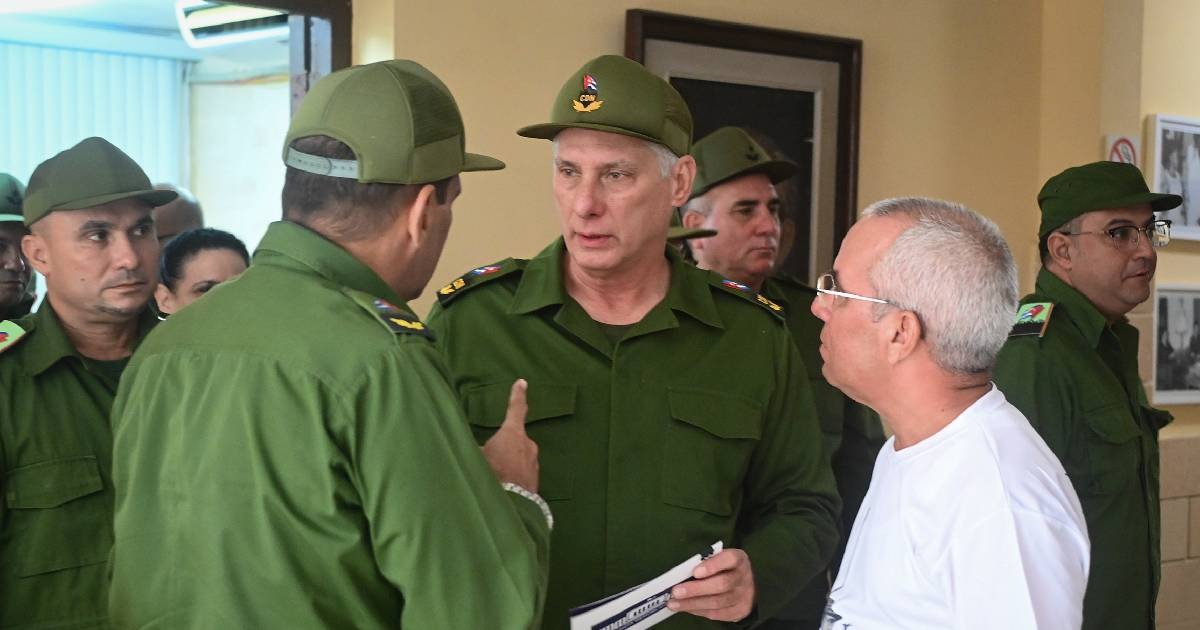
Cuban leader Miguel Díaz-Canel took part in the National Defense Day activities on Friday at the "Rampa" Zone Defense Council in Havana. He emphasized on social media platform X that the nation’s defense readiness remains a top priority.
Díaz-Canel's message was accompanied by photos featuring uniformed members of the Revolutionary Armed Forces (FAR) and a screen displaying a quote from Fidel Castro: "This Revolution belongs to the people and it is the people who must defend it!"
The Cuban president further emphasized, "Dignity and unity are the cornerstones for safeguarding our Homeland," in his online post.
Ongoing Defense Initiatives Under Scrutiny
This latest defense day is part of a series of weekly visits to Zone Defense Councils, a practice the regime has institutionalized throughout 2026 under the "War of the Entire People" doctrine. This strategy involves mobilizing civilians, militias, and local structures to maintain a prolonged defense against any potential external threat.
On January 12, 2026, Cuba’s Western, Central, and Eastern armies officially declared 2026 as the "Year of Defense Preparation." This involves weekly exercises, including ambush simulations, shooting drills, evacuations, and shelter preparations.
Previous visits include stops at the Casablanca Zone Defense Council (Regla) on September 4, Alamar Este in mid-September—where Díaz-Canel warned of ongoing aggression threats—and Capdevila-Altahabana (Boyeros) on September 18.
Rising Tensions with the United States
The backdrop of these intensified military preparations is the increasing tension with Washington. On September 22, Donald Trump labeled Cuba as a "completely failed state" at the UN General Assembly, announcing his administration's pursuit of a "fundamental change" on the island and predicting the regime's downfall.
In response, the Cuban delegation walked out during the US President's address. The following day, Secretary of State Marco Rubio did not dismiss the possibility of military action against Cuba, stating that the President has both the power and duty to act if national security is threatened, as reported in a press briefing in New York.
On the same day, Díaz-Canel criticized Trump's speech as "utterly arrogant, imperious, and interventionist," asserting that "Cuba's freedom was achieved on January 1, 1959."
Speculations and Military Movements
On Friday, CBS News reported that the US Army Reserve is considering deploying medical, logistics, engineering, and military police units to the Southern Command within 90 to 120 days. Although the internal document reviewed did not mention Cuba, and no deployment order has been issued, US officials have linked the planning to Cuba.
The Cuban regime has cited the capture of Nicolás Maduro by US forces in Venezuela on January 3, 2026, which resulted in the death of 32 Cuban bodyguards, as a central justification for ramping up their military preparedness.
In August, Díaz-Canel told Folha de São Paulo that "millions of Cubans would give their lives" for the revolution, and if captured, he would be "fighting, fighting."
Understanding Cuba's Military Strategies and Global Tensions
What is the "War of the Entire People" doctrine?
The "War of the Entire People" doctrine is a strategy employed by Cuba to involve civilians, militias, and local structures in a comprehensive defense plan, aiming to sustain a long-term resistance against potential external aggressions.
Why has Cuba declared 2026 as the "Year of Defense Preparation"?
Cuba has designated 2026 as the "Year of Defense Preparation" to enhance its military readiness through regular exercises such as ambush simulations, shooting drills, and evacuation procedures, amid escalating tensions with the United States.
How has the US responded to Cuba's defense preparations?
The United States, through statements by key political figures, has indicated a potential for military action if national security is at risk, and has been linked to military planning, although no direct orders regarding Cuba have been issued.