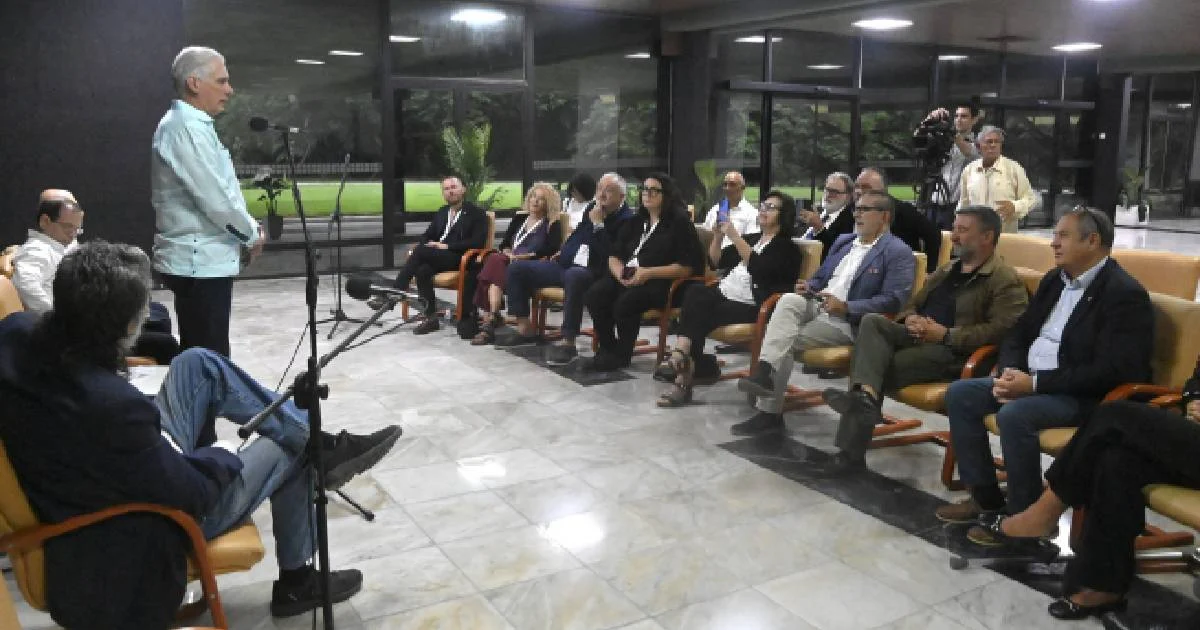
On Thursday evening, Cuban leader Miguel Díaz-Canel met with an Italian delegation spearheading the "Energy for Life, Let's Light Up Cuba" campaign. This solidarity-driven initiative successfully raised approximately $400,000 to fund the installation of photovoltaic solar panels at various institutions across the island.
The gathering in Havana brought together Díaz-Canel with members of the European Parliament, Italian parliamentarians, and representatives from civil society organizations involved in the solidarity movement with Cuba in Italy. The project was launched in mid-2024, as reported by the Cuban Presidency's digital portal.
The campaign was driven by the Italian Recreational Cultural Association (ARCI) alongside its international cooperation NGO, the Italian National Confederation of Labor, the Italy-Cuba National Friendship Association, and the National Association of Partisans, among other union organizations.
The funds collected were allocated to install solar panels in facilities within the food industry, agriculture, healthcare centers, and cultural institutions in Santiago de Cuba, Guantánamo, Granma, and Havana, with a focus on the eastern region of the country.
Díaz-Canel claimed to have personally witnessed the benefits of the initiative during his visits to these areas, highlighting the Casa de la Cultura in El Cobre, Santiago de Cuba, as a notable beneficiary.
During the reception of the delegation, the Cuban leader characterized the connection between the two nations as "truly endearing relationships" and expressed gratitude to the visitors for showcasing "enormous sensitivity and understanding of our challenges."
Seizing the opportunity, he criticized the United States, blaming it for a supposed international smear campaign. "We are condemned, we are put on the international stage, especially from a communicational perspective, as if we were the most terrible country in the universe," he remarked, attributing this portrayal to "the most powerful nation in the world," referring to Washington.
The meeting was moderated by Daniel Lorenzi, a leader of ARCI, and featured the presence of Abel Prieto Jiménez, president of Casa de las Américas, and Fernando González Llort, president of the Cuban Institute of Friendship with the Peoples.
"Ours is not campaign-based solidarity; it's essential solidarity, between peoples," emphasized Walter Massa, a member of ARCI, who announced intentions to continue advocating for the island upon returning to Europe.
The visit occurred amidst a severe energy crisis. Cuba has experienced eight nationwide blackouts so far this year, the most recent on September 18, with daily deficits exceeding 2,000 megawatts.
The Italian donation adds to a series of international shipments of solar systems received by the country in recent months. Recently, 200 containers containing 5,000 solar systems donated by China arrived in Cuba, while late July saw the arrival of a container with 45 three-kilowatt solar panel kits donated by the Argentine Movement of Solidarity with Cuba (MASC) at the Mariel port.
In April, the Spanish Agency for International Development Cooperation (Aecid) completed the delivery of 18 photovoltaic kits with a total capacity of 10,000 kW, designated for Cuban healthcare and social centers.
Collectively, these donations have yet to reverse the collapse of Cuba's electrical system, which is plagued by a fuel shortage, obsolete thermoelectric plants, decades of underinvestment, and government mismanagement.
FAQs About Cuba's Solar Energy Initiative
What was the purpose of the Italian delegation's fundraising campaign?
The Italian delegation's campaign aimed to raise funds to install photovoltaic solar panels in various Cuban institutions, supporting the island's energy needs.
Which areas in Cuba benefited from the solar panel installations?
The installations were focused on Santiago de Cuba, Guantánamo, Granma, and Havana, particularly emphasizing the eastern part of the country.
How has Cuba's energy crisis impacted the country recently?
Cuba has faced a severe energy crisis, marked by eight nationwide blackouts this year and daily energy deficits exceeding 2,000 megawatts.