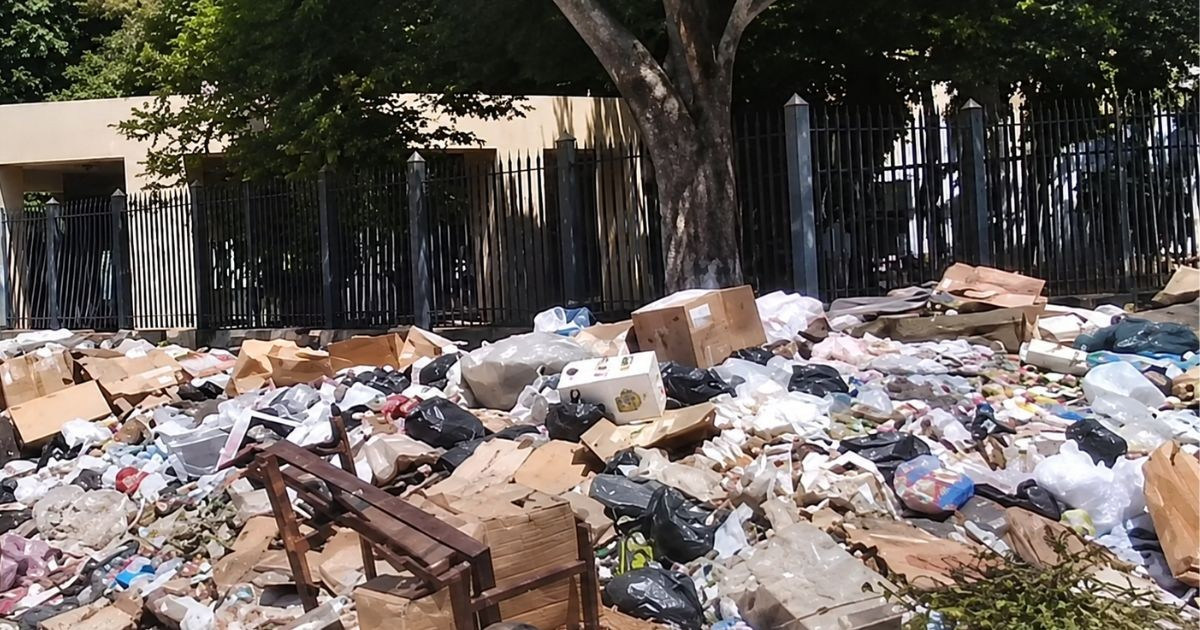
Cuban author José Poveda Cruz, hailing from Holguín, took to Facebook this past Friday to share a poignant piece titled "The Great Stench." In this reflection, he tackles the pervasive issue of garbage accumulation in Cuban streets and the unsettling acceptance of this situation by society.
Poveda Cruz begins his narrative with a stark observation: "I've spent recent days observing the city's dumpsters, an activity not recommended for those who still have hope in humanity." Back in July, he had already warned that "even the most basic needs seem like luxury items" in Cuba.
Garbage as the New Urban Landmark
The scenes he describes are far from rare; piles of waste are found on sidewalks, street corners, near trees, and in front of homes. "Take a step, there's trash. Another step, more garbage. Turn a corner, and there's yet another pile, as if the city has chosen to replace its monuments with trash heaps," the author notes.
What disturbs him most is not the filth itself, but the apathy surrounding it: "Trash has reached that sublime moment of social acceptance where it ceases to be a problem and becomes part of the landscape."
Historical Context and Moral Critique
To underscore his point, Poveda Cruz draws a historical parallel with the Great Stink of London in 1858, when the Thames River became a massive sewer, its stench reaching the British Parliament. The solution was the construction of an extensive sewer system designed by engineer Joseph Bazalgette. In stark contrast, Poveda Cruz points out, "The English, faced with such a stench, didn't launch a campaign to teach people to get used to the smell. They built sewers."
Meanwhile, Cuba has opted for a different approach: "And we, in the meantime, have discovered a much cheaper solution: getting used to it. Because habit is the sewer system of the poor." Under this logic, trash piles gain permanence: "They have their corner, their schedule, their neighbors, and even a certain job stability: new contributions arrive daily."
The Deeper Moral Decay
At its core, the text delves into a moral decline: "Perhaps the true Great Stench is not from a pile of waste, but the one that begins when the moral sense gets accustomed." He elaborates, "A society doesn't start to regress when the first dumpsters appear. It starts to regress when someone walks by, looks at them, shrugs, and keeps walking. And eventually, they don't even look."
This essay comes at a time when the solid waste crisis in Cuba has reached a critical stage. In Havana, as of February 2026, only 44 out of 106 garbage trucks were operational—about 41.5% of the fleet—while the capital generates between 24,000 and 30,000 cubic meters of waste daily. In response to this collapse, Prime Minister Manuel Marrero called for a massive cleanup effort in February, following an admission in late 2025 of institutional failure in addressing the crisis.
Holguín, the writer's hometown, holds symbolic weight: once celebrated as one of Cuba's cleanest cities, it has lost this distinction entirely. Throughout 2026, reports have surfaced of burning trash piles in neighborhoods, blocked roads, and rivers turned into dumps. Just this past Wednesday, a massive garbage pile next to train tracks in Las Tunas sparked outrage on social media.
Poveda Cruz's piece adds to a growing chorus in 2026 condemning urban decay and the health risks posed by public garbage dumps. In August, poet Juan Carlos García Guridi declared that Cuba had become "a country of garbage."
The author concludes with a statement that serves as both personal defiance and a collective call to action: "For now, at least, I have that small luxury left. The luxury of being outraged."
Understanding Cuba's Garbage Crisis
What is the "Great Stench" in Cuba?
The "Great Stench" refers to the pervasive issue of garbage accumulation in Cuban cities, notably highlighted by writer José Poveda Cruz as a symbol of societal neglect and moral decay.
How does Poveda Cruz compare Cuba's trash problem to historical events?
Poveda Cruz compares Cuba's trash problem to the Great Stink of London in 1858, emphasizing how London addressed their crisis by building a sewer system, whereas Cuba has resigned to getting used to the problem.
What is the current situation of waste management in Havana?
As of February 2026, only 41.5% of Havana's garbage trucks are operational, with the city producing between 24,000 and 30,000 cubic meters of waste daily, leading to a significant waste management crisis.