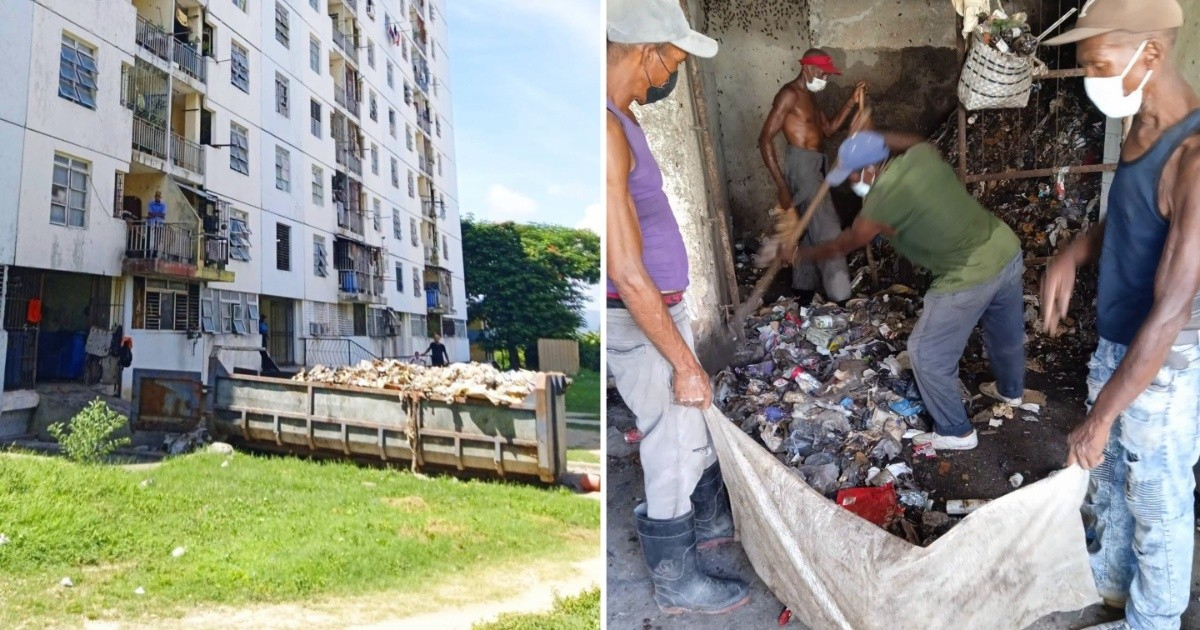
A Facebook post on Wednesday night achieved what months of resident complaints could not: prompting authorities in Santiago de Cuba to take action on a 12-story building in the Antonio Maceo area, where hundreds of families were living under dire sanitary conditions without reliable access to water or electricity.
In the early hours of Thursday, a multidisciplinary team comprised of Housing and Community Services, power line workers from the Electric Company, local municipal and district authorities, and residents of the building began addressing the issues.
Aris Arias Batalla, the provincial head of Operations and Relief for the Red Cross in Santiago de Cuba, shared updates on his Facebook profile. The night before, he had posted what he termed "10 mg of reflection" on the building's situation.
The efforts included clearing accumulated solid waste from the building's chute—where plastic containers had been buried in trash reaching the ceiling—removing the electrical transformer for inspection, maintenance, and oil refilling, and reorganizing the Residents' Board, which had been inactive due to internal conflicts.
Once the electricity was restored via the transformer reconnection, residents could again use the pump and turbine switches to supply drinking water to the upper floors.
Arias Batalla acknowledged in his follow-up post that the situation was not accidental: "There was indeed procrastination, administrative, and governmental negligence by all directors of the aforementioned agencies, but let's start fresh."
He also emphasized shared responsibility: "The community must and should contribute to the building's hygiene and beautification. Everyone has their part to play in reversing the current situation and context."
Reactions from citizens in the comments highlighted a widespread belief that authorities only act under social media pressure.
"It seems that if issues aren't reported on social media, they don't get resolved," wrote one user. Another was more direct: "Did it take an online complaint for the residents' demands to be heard? Do we need to wait for a complaint to act on what's overdue?"
A third commentator welcomed the intervention but cautioned that similar buildings still lack attention: "I hope the eight-story buildings at Jota get the same visibility and solutions to the many issues here that have been known since May by the Santiago de Cuba Electric Company, the secretary, and the governor, yet nothing is resolved."
"We hope the building's vital signs improve over time so the 12-story structure becomes as comfortable, beautiful, and hygienic as it was years ago," Arias Batalla remarked, whose post accomplished in one night what institutional channels hadn't resolved in months.
This case fits into a documented pattern of deterioration in multifamily buildings across the city. Earlier this month, residents of the 18-story buildings on Garzón reported nearly 40 hours without electricity, halting elevators and water turbines. In San Pedrito, residents have spent six years reporting an apartment filled with trash, rats, and cockroaches without any action from authorities.
The national housing deficit exceeds 929,000 homes, with approximately 35% of Cuba's housing stock in poor or mediocre condition, according to 2026 data. Only 5,493 homes were built nationwide in 2025, a 26% decrease from the previous year, as per figures from the National Office of Statistics and Information cited by IPS.
Addressing Building Deterioration in Santiago de Cuba
What triggered the intervention in the Santiago de Cuba building?
The intervention was prompted by a Facebook post highlighting the critical living conditions in the building, which led to action from local authorities.
What measures were taken to address the building's issues?
Measures included clearing waste, inspecting and maintaining the electrical transformer, and reorganizing the Residents' Board to restore sanitation and utility services.
How does this case reflect broader housing issues in Cuba?
This case is part of a larger pattern of neglect and deterioration in Cuba's multifamily buildings, highlighting the national housing deficit and poor infrastructure conditions.