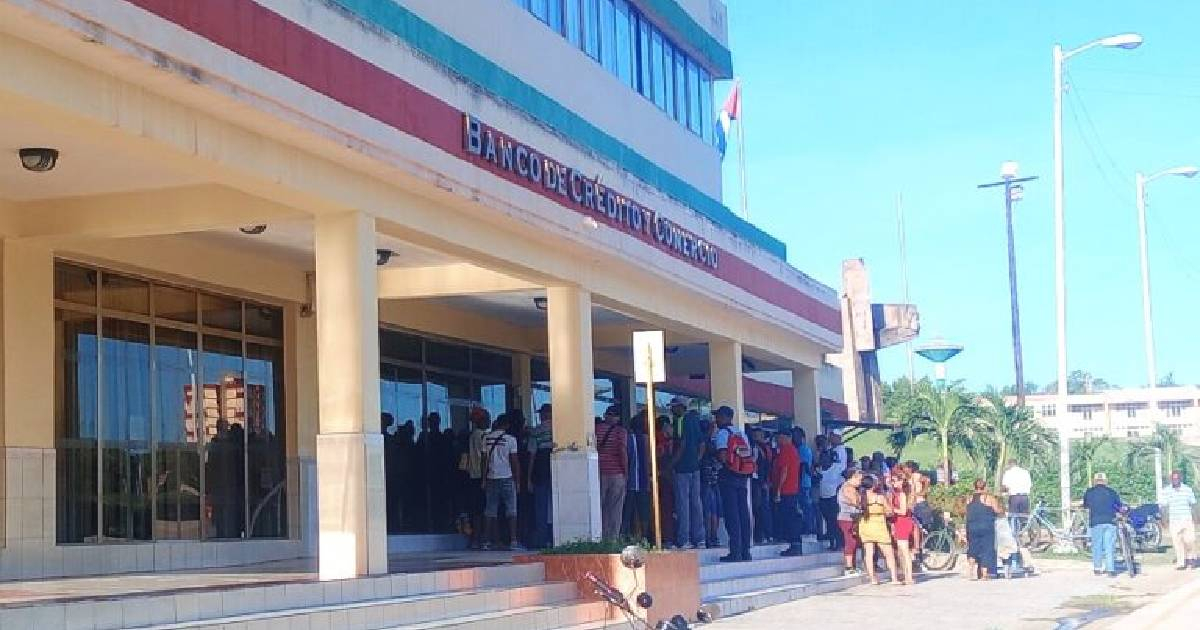
Employees from the Banco Popular de Ahorro (BPA) and Banco de Crédito y Comercio (BANDEC) have been apprehended in Santiago de Cuba. They were reportedly involved in a scheme where cash was exchanged for electronic transfers, charging commissions ranging from 30% to 50%, as revealed by the pro-government Facebook page, Héroes del Moncada, on Thursday.
The Ministry of the Interior (MININT) conducted the operation over several months, leading to the arrest of individuals operating at ATMs. The implicated bank branches include BPA's number 8312 and BANDEC's number 8391, located on Santo Tomás between Aguilera and Heredia.
According to the official report, bank employees colluded with self-employed workers (TCPs) to facilitate these transactions. They used multiple bank cards and identification cards belonging to clients to carry out illegal operations, pocketing cash from these activities.
The operation resulted in the seizure of a significant amount of cash, bill counting machines, magnetic cards, and notebooks documenting the illicit transactions.
This issue is not new to the city. In May, the Revolutionary National Police arrested individuals at ATMs near Santiago's train terminal for charging between 35% and 50% in interest. In June, authorities seized 380,000 pesos from a suspected money changer who charged a 20% fee. By July, reports indicated that only 600 pesos in cash were received from a 1,000-peso transfer.
The public's reaction to the MININT-linked post was largely critical. Rather than praising the operation, many users pointed to the underlying problem of cash shortages. "Yes, but if we address the root issue, this isn't the solution. The solution is ensuring everyone can withdraw their desired amount from ATMs or banks. Once that happens, this type of business will naturally end," one commenter noted.
Another agreed: "That's great... however, the root issue lies in the lack of available cash. If banks and ATMs were always well-stocked, this problem would vanish."
Some comments questioned the operation's effectiveness. "Let's see, geniuses... Tell me, what did this operation solve? Can people now withdraw cash, or are they unable to even at a 30-50% interest rate? Now you have more prisoners to feed (more expense for the State) and ATMs still without money," wrote one user.
Another went further, questioning the possible selective nature of the arrests: "They catch those who aren't frontmen for leaders to eliminate competition and set an example... The best business isn't selling more and cheaper, but eliminating your competition."
The regime has attempted to alleviate the liquidity crisis by issuing 10,000 and 20,000 peso bills since September 16, removing the 5,000-peso cash payment cap between economic actors, and extending pensions through micro-enterprises. However, one netizen highlighted the unresolved contradiction: "Simple, if there was money in banks and ATMs, nobody would profit from money at a percentage. The question is: if the population has no money, where do those running this business get theirs?"
Understanding the Cash Shortage Crisis in Cuba
What were the employees of BPA and BANDEC doing?
Employees were involved in exchanging cash for electronic transfers while charging high commissions of 30% to 50%.
What did the operation by MININT uncover?
The operation led to the arrest of bank employees and individuals at ATMs, and the seizure of cash, bill counting machines, magnetic cards, and transaction records.
Why is there criticism of the operation?
Critics argue that the operation does not address the root cause of the problem, which is the severe shortage of cash in the economy.