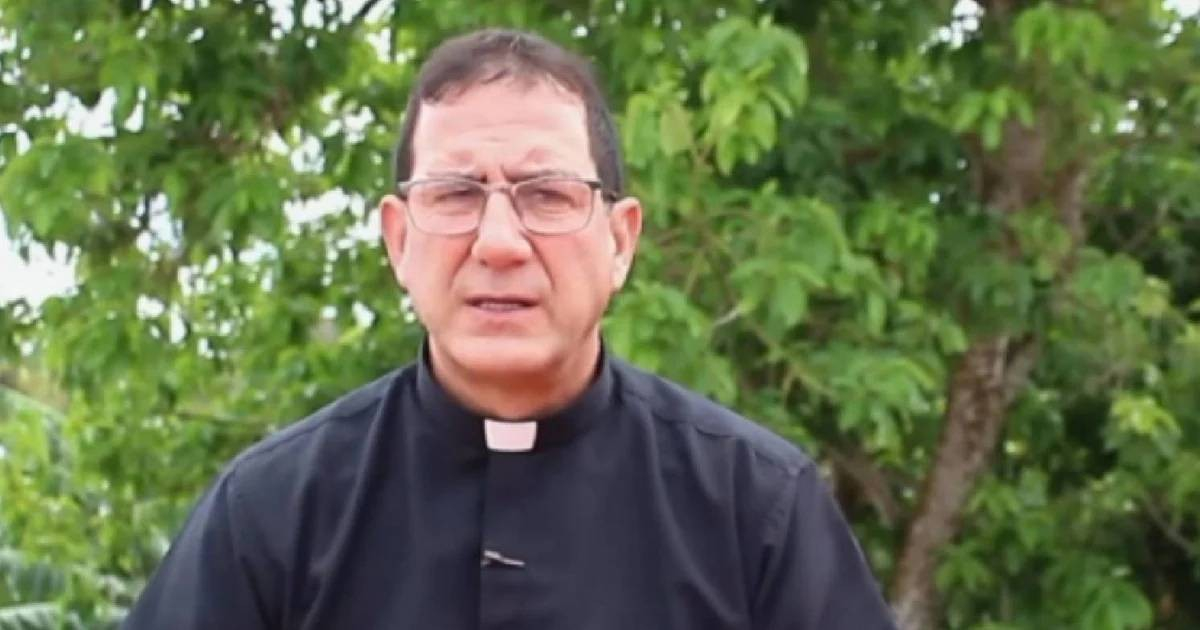
Father Alberto Reyes Pías, the parish priest of Esmeralda, Camagüey, and one of the most outspoken religious critics of the Cuban regime, recently shared the 176th installment of his weekly Facebook column, "I've Been Thinking." In this piece, titled "The Unsettling Neighbor," he explores the historical and political dynamics between the Catholic Church and the Cuban dictatorship from 1959 to the present day.
The column begins by recalling the anniversary of the expulsion of priests and religious figures aboard the Spanish ship Covadonga on September 17, 1961. This event marked a significant moment when Fidel Castro's government forced 136 religious individuals to depart to Spain.
Reyes highlights that between 1959 and 1961, the government instigated a massive exodus of clergy: from an initial count of approximately 800 priests and 2,000 nuns, only about 200 of each remained on the island. "This nation fought against Batista to restore democracy and freedom, and the Church was a part of that struggle," the priest notes, remembering how Monsignor Enrique Pérez Serantes, the Archbishop of Santiago de Cuba, saved Fidel Castro's life after the Moncada Barracks assault.
The Church's Persistent Stand
Reyes points out that the Church was among the first institutions to warn of the Revolution's totalitarian shift through the pastoral letter "Rome or Moscow," a stance that gave it a lasting identity as a "troublesome neighbor."
He meticulously lists the reasons this position is unsettling for the regime: "The Church is bothersome because, in a society driven to deceit, duplicity, and betrayal, it has consistently provided a space for free expression, a sanctuary against fear, and a place to exist."
A Voice Against Oppression
He also emphasizes that the Church has consistently raised its voice against the people's suffering, the injustice faced by political prisoners, the isolation of prisoners' families, and the lack of freedom and opportunities on the island.
One of the most striking parts of the text involves a denunciation of the Office of Religious Affairs (OAAR), which, since 1985, has been part of the Communist Party's Central Committee. This office controls permissions for religious activities, temple repairs, registration of groups, and the entry or expulsion of missionaries.
"It is the Office that spies on the Church's activities, files complaints with bishops and religious superiors about priests whose voices it wishes to silence, and has attempted to infiltrate seminaries with agents feigning a religious vocation," writes Reyes.
He concludes with a powerful assertion summarizing his central thesis: "The Church, against which this people were turned, has ultimately become not only their refuge but also their defender, the hand that aids them, and the voice of their hope."
The post followed an interview Reyes gave to CyberCuba, where he stated that Cuba is "infinitely worse" than during the Special Period due to a complete absence of hope, and any dialogue with the regime must center on how and when the rulers will relinquish power.
Father Reyes has faced systematic pressure from the State Security: in January, he was summoned alongside Father Castor José Álvarez Devesa in Camagüey. Reyes described the summons as "intimidation" meant to issue a warning for their public criticisms.
Cuban troubadour Raúl Torres, known for his songs glorifying Fidel and Raúl Castro and his unwavering loyalty to the regime, publicly attacked the Camagüey priest in a strongly-worded letter in June.
Understanding the Church-State Dynamics in Cuba
What event marked the beginning of the Church's conflict with the Cuban regime?
The conflict began with the expulsion of priests and religious figures aboard the Covadonga on September 17, 1961, orchestrated by Fidel Castro's government.
Why is the Church considered a "troublesome neighbor" by the regime?
The Church is seen as troublesome because it provides a space for free expression, acts as a refuge against fear, and consistently opposes the regime's injustices and lack of freedom.
What role does the Office of Religious Affairs play in Cuba?
The Office of Religious Affairs, under the Communist Party's Central Committee, controls religious activity permissions, temple repairs, group registration, and missionary movements, and it seeks to suppress dissent within the Church.