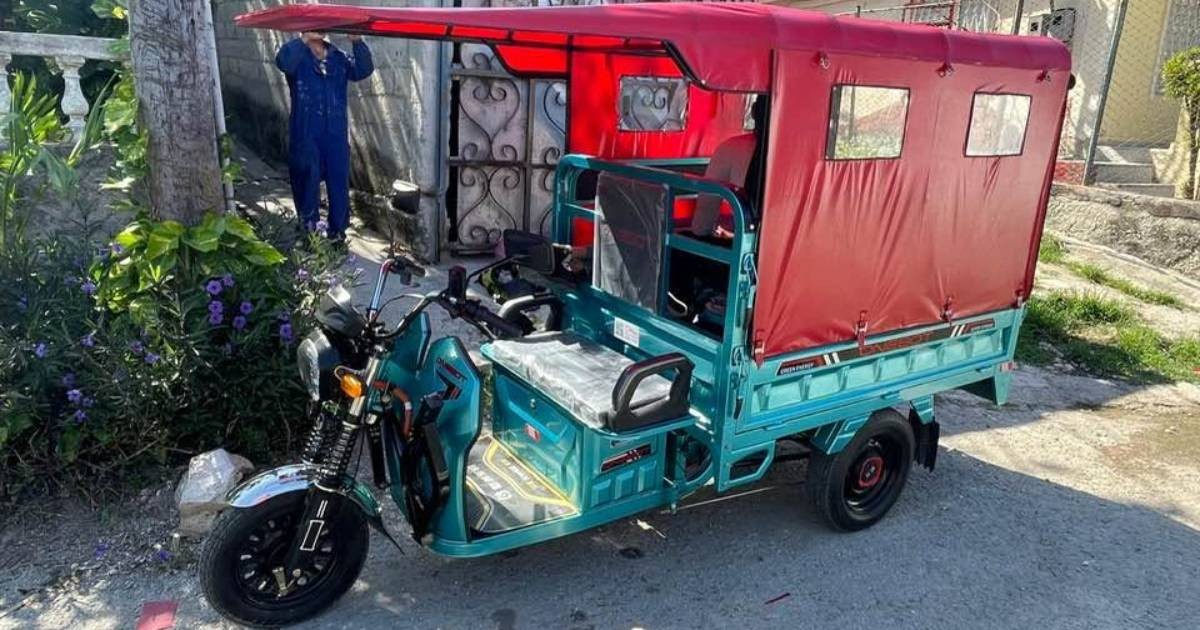
The Cuban Ministry of Transportation announced on Thursday that by the end of July, 1,912 individuals with electric vehicles had received authorization to transport passengers and cargo. This development comes after this year's relaxation of requirements, aimed at addressing the country's ongoing transportation crisis.
Details shared through an official Facebook post explain that the new policy stems from Instruction No. 1, issued on February 18. This directive temporarily eases the granting of the Transportation Operation License (LOT) for individuals operating electric tricycles, motorcycles, and mopeds, including motorized pedicabs.
According to the statement, this decision has allowed the integration of vehicles previously unable to join the formal system, even those without registration plates, provided owners could verify legal ownership.
For rented vehicles, the Ministry specified that presenting the owner's authorization suffices to operate the transport. Tricycle operators need only a driver's license of category “A” or “A-1,” depending on the vehicle type.
Furthermore, on June 30, Instruction No. 3 allowed for exceptional authorization of drivers lacking the three years of experience typically required under Law 109.
The ministry reported a surge of 1,280 new vehicles since these regulations took effect, with significant impacts noted in Havana, Matanzas, and Cienfuegos.
Officials assert that this relaxation has enabled coverage of previously underserved passenger routes and the creation of new ones. Additionally, in certain regions, these vehicles have been used for transporting small cargo loads.
The Ministry highlighted that these initiatives have also facilitated connections between the state and private sectors in certain transport services.
Overall, the nation now boasts 10,466 self-employed individuals operating electric and animal-drawn transportation.
Official information indicates some of these workers are involved in transporting patients within the healthcare system, though specifics on the number of transporters or regions involved were not provided.
The publication presents these efforts as responses to fuel shortages, and the scarcity of parts, tires, and batteries, indirectly acknowledging the state-run transport system's failure to meet public mobility needs.
This situation underscores how the regime has been compelled to allow private and alternative solutions for moving people and goods, as state routes remain congested or severely limited.
In response to the publication, several users advocated for making these licenses permanent if conditions are met, rather than temporary.
Others criticized the cumbersome bureaucracy, long waits, numerous requirements, and region-specific obstacles that persist despite the rhetoric of flexibility.
There were also complaints about the extensive requirements for obtaining an operational license, slow processes in provinces like Pinar del Río, and barriers such as needing the owner or a notarial proxy to complete certain transactions.
Some comments called for expanding the categories of valid licenses for driving tricycles, while others questioned the operational costs and economic conditions placed on drivers.
The current easing of regulations continues measures that were hinted at earlier this year.
In February, authorities announced they would issue licenses for transporting passengers on unregistered electric motorcycles and tricycles, initially presented as a temporary solution to the acute transportation crisis.
In subsequent weeks, the shortage of buses and gasoline made these vehicles one of the few viable mobility options for thousands, especially in the capital, turning electric tricycles into crucial lifelines amid the collapse of the state-run system.
However, the sector's growth has also led to tensions. In Matanzas, for instance, rising fares prompted public outcry before authorities stepped in to reorganize the service. Reports highlighted how electric tricycle fares doubled overnight, prompting authorities to reduce prices following user protests.
Understanding Cuba's New Electric Transport Policies
What changes have been made to Cuba's transportation licensing?
Cuba has eased the requirements for obtaining a Transportation Operation License for electric vehicles, allowing more individuals to legally transport passengers and cargo.
How has the transportation crisis in Cuba influenced new regulations?
The severe transportation crisis, marked by shortages of fuel and parts, has forced the Cuban government to introduce private and alternative solutions, including the authorization of electric vehicles for public transport.
What impact has the new policy had on Cuban transportation?
Since the policy's implementation, there has been a notable increase in the number of electric vehicles on the road, particularly in Havana, Matanzas, and Cienfuegos, helping alleviate some of the transport shortages.
Are there any criticisms of the new licensing process?
Yes, many individuals have criticized the process as still being cumbersome with bureaucratic hurdles, long waiting times, and varied regional obstacles despite claims of flexibility.