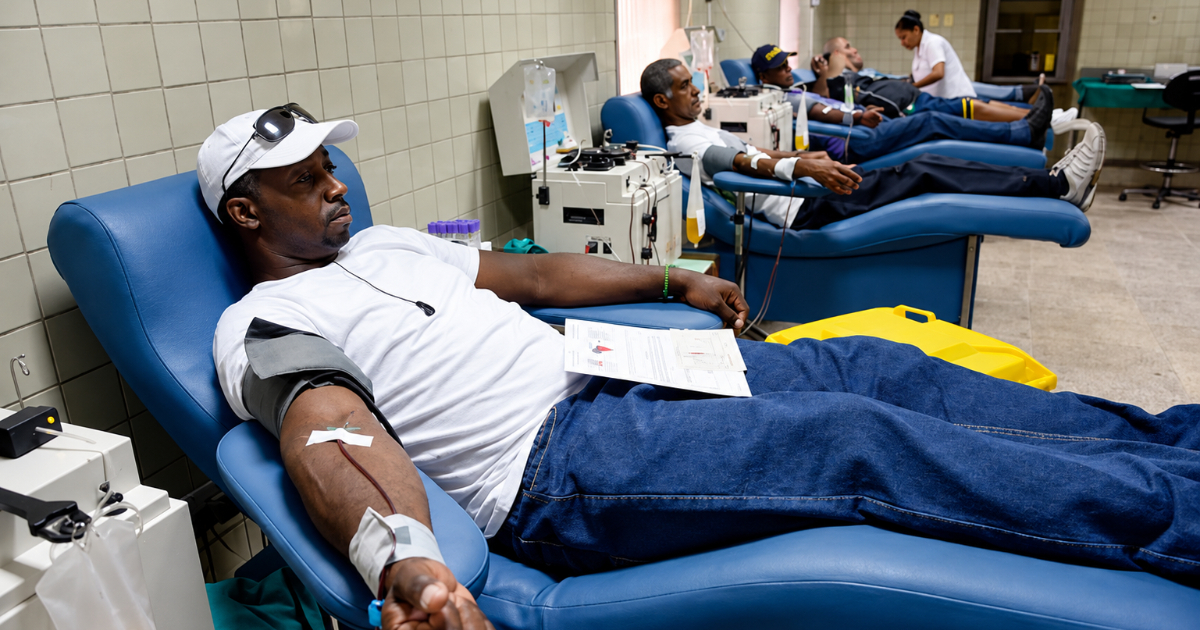
As they approach their 66th anniversary, Cuba's Committees for the Defense of the Revolution (CDR) continue their longstanding practice of blood collection.
This week, Granma reported on CDR activities in Holguín, emphasizing the "promotion of blood donations" and praising the enthusiastic participation of CDR members in responding to calls for blood bank visits.
It is notably significant that blood collection is mentioned alongside one of CDR's historical missions: the so-called "revolutionary popular vigilance."
Both tasks have been integral to the organization since its inception. Much has been documented about CDR's role in neighborhood surveillance, reporting on residents, and assisting state security operations.
Less publicized is their over six-decade involvement in systematically recruiting blood donors among the populace.
From Neighborhood Watch to Blood Collection
The CDR was founded by dictator Fidel Castro on September 28, 1960. Just months later, they were already participating in blood donation campaigns.
Historical accounts place the start of this activity in January 1961, and when Cuba's transfusion medicine program began in 1962, the CDR assumed a central role in promoting and securing blood donors.
During the October Missile Crisis of that year, their mobilization resulted in approximately 8,000 blood extractions in Havana within just 72 hours.
A pivotal moment occurred after the 1970 Peru earthquake. Cuba sent part of its plasma reserves, and Fidel Castro launched a campaign to replenish them and aid the victims. In just ten days, 104,594 donations were made.
'Voluntary' Donations with a Target
Over the years, a distinct characteristic solidified: while donations are officially voluntary, they are organized with specific quotas that regions and CDR structures must meet.
For instance, in 2006, the Granma CDR celebrated achieving 35,000 extractions, being the first in the country to fulfill their "yearly commitment" during that "emulation year."
The article’s title captured the contradiction: "Committees for the Defense of the Revolution in Granma Achieve Annual Plan for Voluntary Blood Donations."
By 2017, Granma boasted 50 consecutive months of meeting the Voluntary Blood Donation Plan. Specific targets were set for provinces and municipalities: Pinar del Río needed 1,833 monthly donations, while Cienfuegos required 1,125.
These goals even extended to local health structures. In 2020, the Esmeralda polyclinic in Camagüey was assigned a quarterly plan of 68 donations, with the CDR's Municipal Direction participating in the recruitment efforts.
The Hidden Cost of Blood Donations
There is another, less formal side to this narrative.
For years, many Cubans have shared experiences of having to find a relative, friend, or third party to donate blood before undergoing certain surgeries.
Recent testimonies confirm the practice persists. In June 2025, the state-run Escambray reported that in Sancti Spíritus, as in other Cuban provinces, blood transfusions increasingly relied on luck or the patient's financial resources.
Earlier, in April of that year, the independent outlet 14ymedio highlighted that shortages in blood banks had even led to an informal market, extending to social media, where people offered donations for 5,000 to 7,000 Cuban pesos.
While officially, providing a donor is not a general requirement for surgery, these accounts and hospital practices point to a real scarcity. Cuba's blood donations dropped from 690,450 in 1990 to 254,845 in 2023, according to health yearbooks.
Economic Incentives Behind Blood Donations
There's also an economic aspect that adds another layer to this story.
A Ministry of Public Health document for 2021-2025 outlined two distinct indicators: the "annual blood donation plan" and the "annual plasma donation plan for industry," both required to reach 100% for a favorable evaluation.
For decades, Cuba developed an industry for plasma fractionation and hemoderivative production.
Archivo Cuba, led by researcher María Werlau, estimated using international trade statistics that from 1995 to 2019, Cuba exported $1.323 billion in a category that includes blood, plasma, blood components, and medicinal derivatives.
It's important to note that this classification is broad, and there's no direct evidence that these revenues came from Cuban donor bags. Additionally, no public evidence tracks a CDR-collected donation to a subsequently exported product.
However, the state's economic interest in plasma is documented. In 2025, BioCubaFarma sought foreign investment to build a plasmapheresis center to obtain and commercialize plasma, with sales expected to recoup the investment.
The Persistent Demand for Blood
The story remains largely unchanged even today.
In July 2026, a neighborhood in Holguín aimed for 100 blood donations as a "commitment to Fidel" for his centennial. Local press even tracked how many were needed to "meet the goal."
Now, as the CDR approaches its 66th anniversary, Granma again highlights that Holguín is "promoting" donations and calling on CDR members to visit blood banks.
In Pinar del Río, La Palma was recently recognized as a CDR Vanguard after achieving 102% of its blood donation plan, among other indicators.
Sixty-six years have passed since those first campaigns. Cuba has changed, the CDR has aged and lost much of its former mobilization power, while the country faces a severe decline in donations.
Yet, the mechanism retains something essential from its origins: mobilizing donors, rallying the community, setting a goal, and achieving it.
At 66, the CDR still calls for blood.
The Complexities of Blood Donation in Cuba
Why are blood donations in Cuba considered "voluntary" yet structured around targets?
Although officially labeled as voluntary, blood donations in Cuba are organized with specific targets for regions and CDR structures to meet, creating a contradiction between voluntary donation and mandated quotas.
What economic factors influence Cuba's blood donation practices?
Cuba developed a plasma fractionation and hemoderivative industry, with economic incentives to meet donation targets. This industry has been a source of export revenue, adding an economic dimension to the donation system.
How has the role of the CDR in blood donations changed over time?
Initially focused on emergency responses, the CDR's role in blood donations has evolved into a routine activity with structured targets, despite a decline in their mobilization capacity and overall donations.