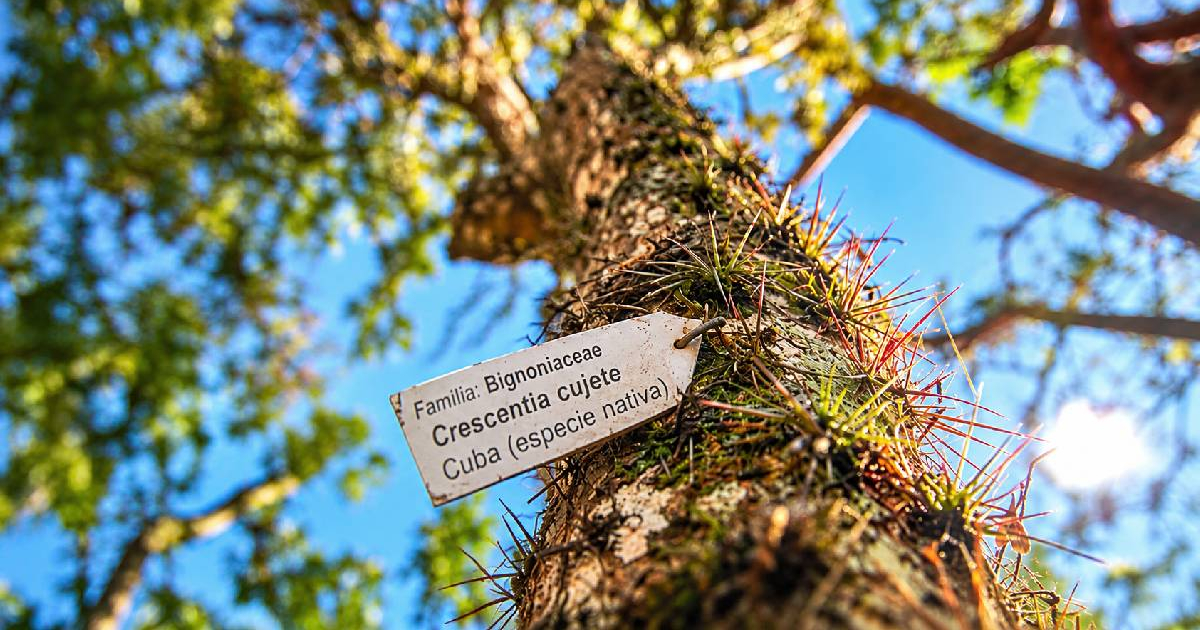
Cuba has released the second edition of the Catalog of Cuban Plants, marking an unprecedented achievement in the nation’s history with a complete inventory of its vascular and non-vascular flora, documenting a total of 8,392 plant taxa.
According to a press release from the Cuban Plant Specialist Group of the International Union for Conservation of Nature's (IUCN) Species Survival Commission, this work was created out of the need for a unified taxonomic standard to guide the study and conservation efforts of the nation's flora.
The catalog details 349 families, 2,073 genera, and 8,232 species, significantly expanding on the previous edition, which only included vascular plants, as reported by the state-run media outlet, Cubadebate.
Of the total 8,392 taxa, 6,961 are native, with 3,019 being endemic, representing 43.4% of the native taxa of the archipelago.
The GEPC/IUCN note highlights that this proportion underscores the unique nature of the archipelago’s flora, cautioning that many of these endemics might be underestimated if classified as synonyms of more widely distributed species. This is particularly important from a conservation perspective, as many of these plants have small populations and limited distribution areas.
In addition to the native taxa, the catalog also notes 1,431 exotic taxa, with 725 naturalized within Cuban territory.
A notable addition to this edition is the first-time inclusion of non-vascular plant inventories: 888 taxa of hornworts, liverworts, and mosses, complementing the 7,504 vascular plant taxa already documented.
Furthermore, the catalog provides detailed information for each of Cuba’s 15 provinces and the special municipality of Isla de la Juventud. The eastern region of the country, particularly Guantánamo, Santiago de Cuba, and Holguín, stands out for its rich floral diversity, hosting the largest number of both native and naturalized vascular taxa.
Additionally, the catalog introduces three specific inventories: exclusively cultivated plants, sparsely cultivated plants, and plant genetic resources for food and agriculture preserved outside their natural habitat in Cuban institutions.
This publication comes in a concerning context: a 2021 study declared 22 Cuban plant species extinct and reported 772 critically endangered, 512 endangered, and 396 vulnerable, while previous research warned that nearly half of Cuba’s flora is at risk of disappearing.
The first edition of the catalog, which focused solely on vascular plants, recorded 254 families, 1,724 genera, 7,088 species, and 7,251 taxa. The new version significantly expands this inventory by including bryophytes and other previously absent plant groups.
The Cuban Plant Specialist Group, established in 2003 and based at the National Botanical Garden of the University of Havana, had 68 active members in 2023 and is the body responsible for coordinating the evaluation and monitoring of the conservation status of the archipelago’s flora for the IUCN.
Understanding Cuba's Botanical Diversity
What is the significance of the second edition of the Catalog of Cuban Plants?
The second edition of the Catalog of Cuban Plants is significant because it provides a comprehensive inventory of Cuba's flora, including both vascular and non-vascular plants, which is crucial for conservation efforts and scientific studies.
How many plant taxa are documented in the new catalog?
The new catalog documents a total of 8,392 plant taxa, which includes 349 families, 2,073 genera, and 8,232 species.
Why is the inclusion of non-vascular plants in the catalog important?
The inclusion of non-vascular plants, such as hornworts, liverworts, and mosses, is important because it provides a more complete picture of Cuba's biodiversity and highlights the need to conserve all plant groups.