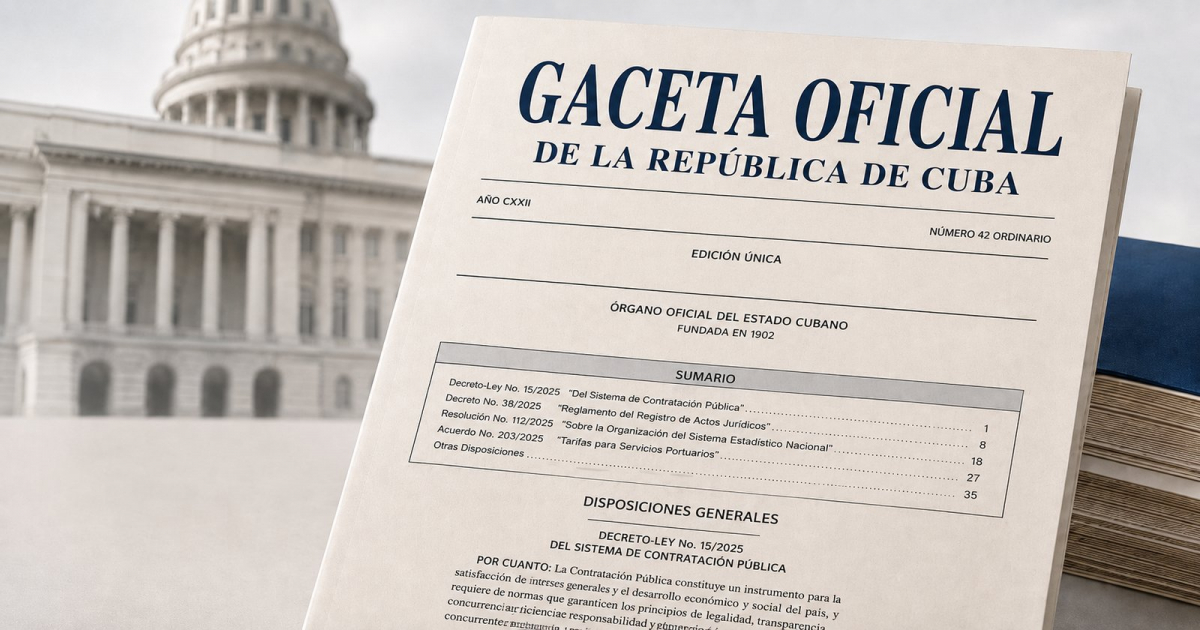
The Cuban Cabinet has released the revised version of Decree 52, a regulation focused on sustainable soil management and fertilizer use, as published in the Official Gazette No. 18 Special Edition of 2026, from pages 13 to 34.
This regulation is not a completely new decree but rather an update of the original Decree 52 from September 1, 2021. It follows the directive in the Second Final Provision of Decree 172, issued on August 19, 2026, which mandated a review, update, and alignment of the regulation.
Signed by Prime Minister Manuel Marrero Cruz on behalf of the Cabinet, the document regulates Decree-Law 50, titled "On Conservation, Improvement, and Sustainable Management of Soils and Fertilizer Use," which was endorsed by the Council of State on August 6, 2021.
Sustainable Soil Management: A National Priority
The decree acknowledges that soil is a vital natural resource for agricultural production and biodiversity support. It highlights soil degradation as a significant environmental issue within the national environmental strategy.
Spanning 21 areas, the regulation outlines the procedures for practical application.
Key Elements of the Updated Decree 52
The revised Decree 52 introduces several key provisions:
- Establishes and governs the National Soil and Fertilizer System, led by the Director of Soils and Fertilizers of the Ministry of Agriculture, to handle planning, control, and inter-agency coordination.
- Regulates state funding aimed at offsetting costs for soil conservation and improvement, along with financial incentives and mechanisms for sustainable management.
- Creates the Central Fertilizer Registry for the registration of mineral, organic, organo-mineral, biological fertilizers, correctors, stimulants, and amendments.
- Oversees land use change, restitution for such changes, topsoil management, controlled fire use, and violations.
This regulation applies to individuals and legal entities—owners, usufructuaries, or landholders—engaged in agricultural, forestry, sugarcane, fruit tree activities, or in protected areas.
Context of Broader Agricultural Reforms
This update is part of a larger set of agricultural reforms approved by the Cuban government in 2026, which also includes Decree 175 on agricultural land ownership and use, and Law 185 on Agricultural and Forestry Land, sanctioned by the National Assembly on July 29, 2026.
The backdrop for these measures is the dire condition of Cuban soils. According to the Cuban Soil Institute, cited by the United Nations Food and Agriculture Organization (FAO), over 75% of the country's agricultural land faces productivity constraints, with widespread issues of erosion, salinization, compaction, and fertility loss.
Frequently Asked Questions about Cuba's Soil Conservation Measures
What is the main purpose of the updated Decree 52?
The main purpose is to enhance the sustainable management of soils and regulate fertilizer use to address environmental issues and improve agricultural productivity.
Who is responsible for overseeing the National Soil and Fertilizer System?
The system is overseen by the Director of Soils and Fertilizers within the Ministry of Agriculture, ensuring planning, control, and coordination among institutions.
What are some of the challenges facing Cuban agricultural soils?
Cuban soils are challenged by productivity limitations due to erosion, salinization, compaction, and loss of fertility, affecting more than 75% of the country's agricultural land.