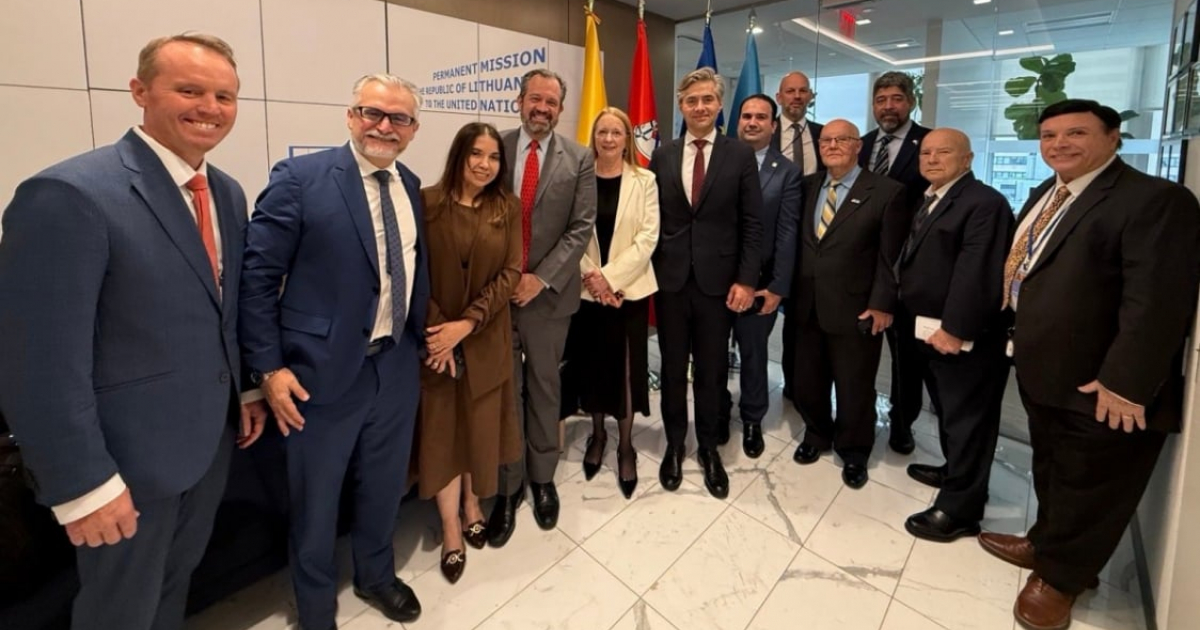
On Tuesday, Cuban opposition leaders in exile held a meeting with Lithuanian Foreign Minister Kęstutis Budrys, along with diplomats from Costa Rica and the United States. The gathering aimed to establish an international coalition of democratic nations dedicated to supporting Cuba's transition, as reported by Martí Noticias.
This significant meeting took place at the Permanent Mission of Lithuania to the United Nations in New York, coinciding with President Donald Trump's address to the 81st United Nations General Assembly. During his speech, Trump described Cuba as a "completely failed state" and predicted the regime's eventual collapse. In response, the Cuban regime's diplomatic delegation exited the assembly hall in protest.
Historic Coalition Formation
Leaders and members of the Cuban Resistance Assembly (ARC), a coalition of over 30 opposition groups, were key participants at the Lithuanian venue, joined by human rights activists. Orlando Gutiérrez-Boronat, the ARC's general coordinator, referred to the meeting as a "seed meeting" and emphasized its groundbreaking nature, stating, "This gathering is historic because, for the first time, a group of democratic nations is coming together to discuss how to support the Cuban people."
Gutiérrez-Boronat also highlighted the shift in the diplomatic landscape, noting, "The Castro regime can no longer claim it's merely a confrontation with the United States. It's a community of nations advocating for the Cuban people's natural and historical rights to self-determination."
International Endorsement for Transition
The delegations from Lithuania, Costa Rica, and the United States expressed their approval of formalizing this international coalition, aimed at actively backing democratic transition and human rights on the island. Foreign Minister Budrys confirmed the meeting on his social media account, expressing Lithuania's steadfast support for the Cuban people's quest for freedom and democracy. He condemned the regime's repression and its support for Russia's war in Ukraine, pledging continued backing for Cuban civil society and human rights defenders.
Lithuania's Role and Future Prospects
Mexican lawyer René Bolio, another participant, emphasized Lithuania's strategic experience: "Lithuania has extensive expertise in transitioning from communism to freedom and is willing to share that knowledge, in addition to documenting what's happening in Cuba today. The meeting was highly successful as we agreed to form a support group for Cuban transition and liberation. It's the beginning of an international alliance to assist the Cuban people."
A focal point of the agenda was Lithuania's upcoming role as it assumes the rotating presidency of the European Union Council in the first half of 2027. Participants urged the Lithuanian government to advocate from this position for the permanent freezing of European funds to the Cuban regime, arguing that a government responsible for crimes against humanity and sending mercenaries to fight alongside Russia in Ukraine does not deserve EU funding.
This argument gains further weight in light of terrorism charges brought by the Lithuanian prosecutor in January 2026 against three Cuban citizens accused of sabotage linked to the Russian GRU against military equipment bound for Ukraine.
Regional Support and Future Plans
Former Cuban political prisoner Luis Zúñiga appreciated the reception of the proposal, stating, "Lithuania's role will be crucial. The idea of creating a coalition of nations for a free Cuba has been warmly received; they loved the initiative. We explained the substantial support this cause has already garnered across Latin America, where our secretary-general has been welcomed by most regional presidents."
Costa Rica, which severed diplomatic ties with Cuba in March 2026, with its Foreign Minister Manuel Tovar recently reaffirming the break as "complete," actively participated in the meeting as part of this emerging democratic front.
Academic Daniel Pedreira outlined the ARC's role in planning the transition through the "National Salvation Plan," a roadmap for the first 24 months following political change in Cuba, encompassing governance, market economy, transitional justice, and free elections.
Understanding the International Efforts for Cuban Democracy
Why did the Cuban regime's delegation leave the UN assembly?
The Cuban regime's delegation left the UN assembly in protest during President Trump's speech, where he labeled Cuba as a "completely failed state" and predicted the regime's downfall.
What role does Lithuania plan to play in supporting Cuban democracy?
Lithuania plans to leverage its experience transitioning from communism and its upcoming presidency of the EU Council to advocate for the permanent freezing of EU funds to the Cuban regime and support Cuban civil society and human rights defenders.
How does the "National Salvation Plan" aim to transition Cuba?
The "National Salvation Plan" is a roadmap for the first 24 months following a political change in Cuba, focusing on governance, market economy, transitional justice, and free elections to ensure a smooth transition to democracy.