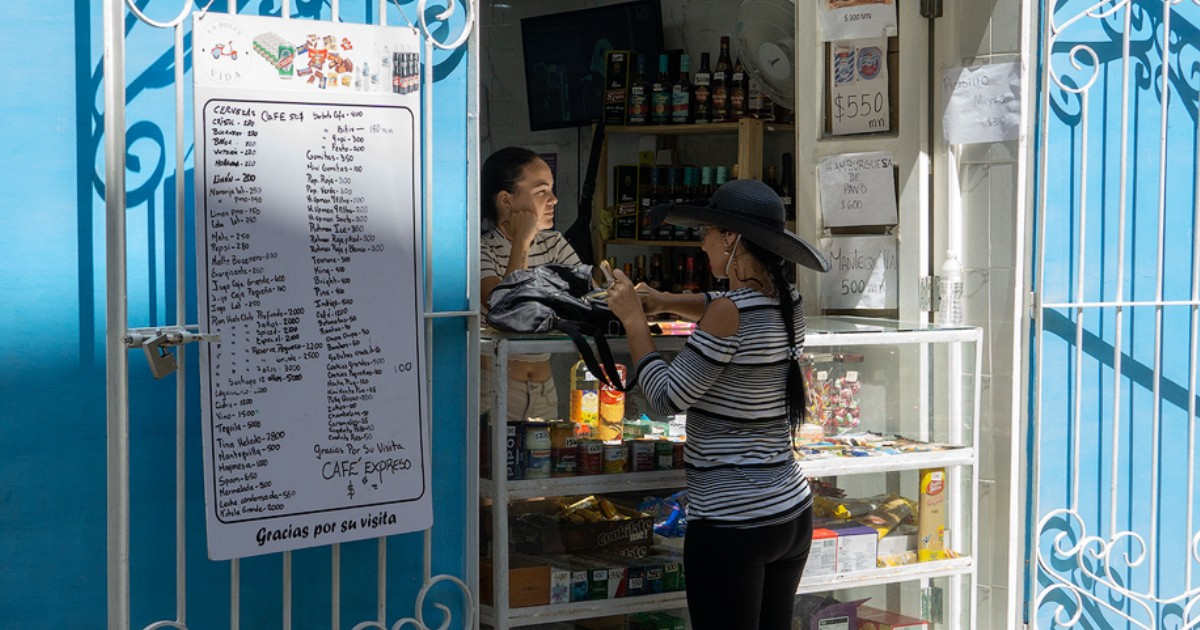
Dalma Rosell Marrero, a resident of the Guiteras neighborhood in Havana del Este, took to Facebook to reveal an alarming list of food prices that highlights Cuba's worsening food crisis: a pound of chicken priced at 800 pesos, six eggs costing 960 pesos, and a bag of yellow milk reaching as high as 5,500 pesos.
Rosell Marrero points fingers at a recent decision made during an extraordinary session of the National Assembly, where the removal of price caps was approved, allowing sellers to set product prices at their discretion.
"Folks, we need to put a STOP quickly because I don't know where we are headed. Here in the small businesses, a pound of chicken is 800 pesos," she wrote, explaining her delay in posting due to a national power outage.
The detailed list starkly illustrates the collapse of purchasing power for Cubans: ground MDM meat ranges from 550 to 600 pesos per pound; white sugar is 500 pesos; imported rice costs 350 pesos; onions are priced at 1,200 pesos; cucumbers at 600 pesos; a bottle of oil ranges from 3,800 to 4,000 pesos; and a liter of probiotic yogurt varies between 2,750 and 4,000 pesos depending on the store.
Background of Economic Reforms
This price surge is rooted in the economic reform package approved in June 2026, which included 176 measures, among them the widespread liberalization of prices. The Ministry of Finance and Prices' Resolution 150/2026 specifically lifted price caps on items like cut chicken, edible oils, powdered milk, pasta, and sausages.
Prime Minister Manuel Marrero Cruz addressed parliament, stating that the government "will no longer approve capped prices" and that price setting would be decentralized to companies and local governments.
Impact on Vulnerable Families
The author of the post directly attributes the chaos to this decision: "In this country, despite the informal market, there have always been capped prices. But since they decided in the last Assembly to lift capped prices and let anyone set their own prices, things have gone from bad to worse."
Rosell Marrero emphasizes that the most painful impact is felt by the most vulnerable families: "How are mothers with children with rare diseases and disabilities supposed to maintain adequate nutrition for our children? How long will this abuse continue? It's a total lack of respect."
Comments on the post echo the same desperation. One user shared the anguish of telling their child to "wet their lips" while trying to scrape together enough money to eat, estimating that at least 5,000 pesos a day are needed to survive: "For those without a business, may God help us."
The stark figures sharply contrast with the actual earnings of the majority of Cubans. The cost of living in Havana for a small family exceeds 205,000 pesos per month, whereas the minimum wage is merely 3,210 pesos monthly, and the average state salary is around 7,000 pesos.
According to the National Office of Statistics and Information, official year-on-year inflation reached 25.19% in August 2026, with food and non-alcoholic beverages being the main drivers of the increase—rising by 36.01% year-on-year in the same month.
A recent analysis by Infobae indicates that inflation in Cuba hit 25%, and the regime has started circulating bills of up to 20,000 pesos, further signaling the monetary deterioration gripping the island.
Understanding Cuba's Economic Challenges
Why have food prices in Cuba escalated so dramatically?
The dramatic rise in food prices in Cuba is primarily due to the removal of price caps, allowing sellers to set prices freely. This was part of a broader economic reform to liberalize prices.
How are Cuban families coping with these high prices?
Many Cuban families are struggling to cope with the high prices, with some estimating the need for at least 5,000 pesos a day to survive. The situation is particularly dire for vulnerable families with special needs children.
What measures has the Cuban government taken regarding price control?
The Cuban government has decided not to approve capped prices anymore, opting to decentralize price setting to companies and local governments as part of its economic reforms.