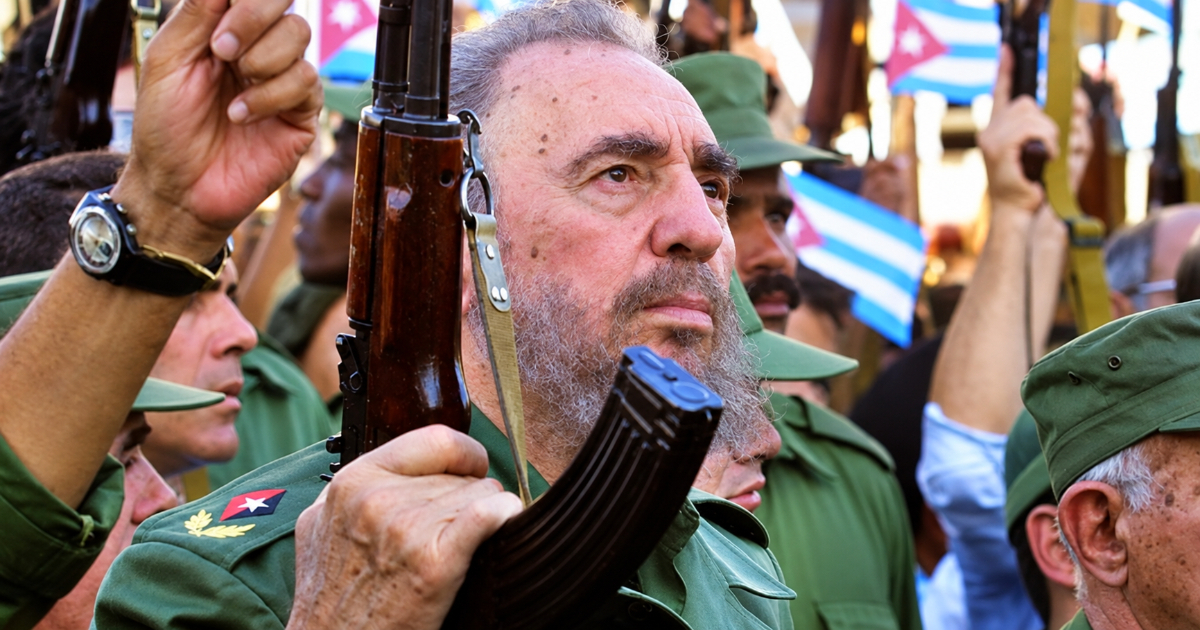
On International Peace Day, the official Cuban newspaper Granma painted a carefully curated portrait of Fidel Castro: one of a statesman devoted to avoiding wars, advocating for disarmament, and believing that preserving peace was "the most sacred duty of all human beings." This image, however, only tells part of the story.
Fidel's Dual Image: Peace Advocate or Military Strategist?
Granma's article, titled "Fidel and Peace as a Sacred Right," links several of Castro's statements on peace and international coexistence. The quotes are genuine and part of his political rhetoric. Yet, what's omitted is the side of Castro who rose to power through armed rebellion, promoted guerrilla warfare as a revolutionary pathway for Latin America, and supported armed movements beyond Cuba.
In the idealized depiction by the official press—accompanied by an elaborate illustration by Ernesto Rancaño—the strategist who contemplated nuclear escalation during the Cuban Missile Crisis, sent Cuban troops to African wars, and built a militarized society in Cuba is conspicuously absent. Granma's narrative problem lies not in what's said, but in what's left unsaid.
The 1962 Nuclear Gamble
One of Granma’s highlighted moments comes from 1962, when Castro received the Lenin Peace Prize and spoke about the need to save humanity from "apocalyptic destruction." However, this was the same year Castro penned a revealing letter to Nikita Khrushchev during the tense moments of the Cuban Missile Crisis. Convinced that an American invasion was imminent, Castro suggested that the Soviet Union should conduct a first-strike nuclear attack against the U.S. if Cuba was invaded.
This document, housed at the John F. Kennedy Presidential Library, underscores the paradox of Castro's legacy in 1962. While he spoke against nuclear catastrophe, his actions during the crisis brought the world perilously close to it.
The Realities of Guerrilla Warfare Advocacy
Fast forward to 1967, during the Organization of Latin American Solidarity (OLAS) conference in Havana, where Castro unequivocally dismissed the notion of peaceful power acquisition in Latin America. He championed guerrilla warfare as the primary method of revolutionary struggle, criticizing Venezuelan communists for considering electoral participation over armed conflict.
Castro’s rhetoric wasn’t limited to defending Cuba from potential U.S. invasion; it was a call to arms for political conquest across Latin America, entwining violence with his revolutionary ideology.
From Sierra Maestra to African Battlefields
The military facet of Castro’s policies extended beyond speeches. In 1975, Cuba launched a significant military intervention in Angola, known as Operation Carlota, supporting the MPLA in a conflict involving global powers and local factions. Cuban participation was framed as solidarity with African liberation movements against colonialism and apartheid, yet the scale of involvement contradicted the image of a nation solely defending its borders.
By the time Cuba, Angola, and South Africa reached peace agreements in 1988, roughly 50,000 Cuban troops had been withdrawn, reflecting a military projection far beyond Cuba’s geographic confines.
Cuban Troops as Soviet Leverage?
Declassified documents reveal the economic costs of these interventions and potential Soviet reimbursements. A 1976 U.S. State Department memo estimated Soviet military support to the MPLA at about $160 million, including Cuban costs possibly reimbursed by Moscow. This arrangement highlighted a symbiotic relationship where Cuba provided manpower while the USSR supplied resources and strategic support.
This dynamic allowed Castro to wield influence disproportionate to Cuba's size, aligning with Soviet interests without being a mere puppet.
The Internal Militarization of Cuba
The culture of militarization extended deeply into Cuban society. The government established the concept of "War of All the People," created Territorial Troop Militias, maintained compulsory military service, and integrated defense preparation into various societal sectors. This defensive posture was primarily deterrent, reflecting a nation perpetually ready to resist American invasion.
Real threats like the Bay of Pigs invasion and Operation Mongoose fueled this militarization narrative, but the constant portrayal of imminent danger also served as a tool for political mobilization and control.
Fidel Castro's Complex Legacy
The portrayal of Fidel Castro in Granma on International Peace Day is one of selective memory. It highlights his calls for peace while omitting his advocacy for armed struggle and military interventions. Castro’s legacy is indeed multifaceted, involving both diplomatic negotiations and aggressive military strategies.
Ultimately, the version of Castro celebrated by the official Cuban press disregards the complexities of his historical impact, presenting a sanitized narrative that omits significant aspects of his rule.
Understanding Fidel Castro's Legacy
What aspect of Fidel Castro's legacy does Granma highlight?
Granma highlights Fidel Castro's commitment to peace and disarmament, portraying him as a statesman dedicated to preserving peace and avoiding war.
What significant actions by Castro are omitted in Granma's portrayal?
Granma omits Fidel Castro's involvement in promoting guerrilla warfare, his role during the Cuban Missile Crisis advocating for nuclear action, and Cuba's military interventions in Africa.
How did Fidel Castro influence military strategy in Cuba and abroad?
Castro influenced military strategy through advocating guerrilla warfare for Latin America, involvement in African conflicts, and militarizing Cuban society to prepare for potential invasions.
What was the nature of the relationship between Cuba and the Soviet Union during Castro's interventions in Africa?
The relationship was symbiotic, with Cuba providing troops and the Soviet Union supplying military resources, aligning their interests in Cold War contexts.