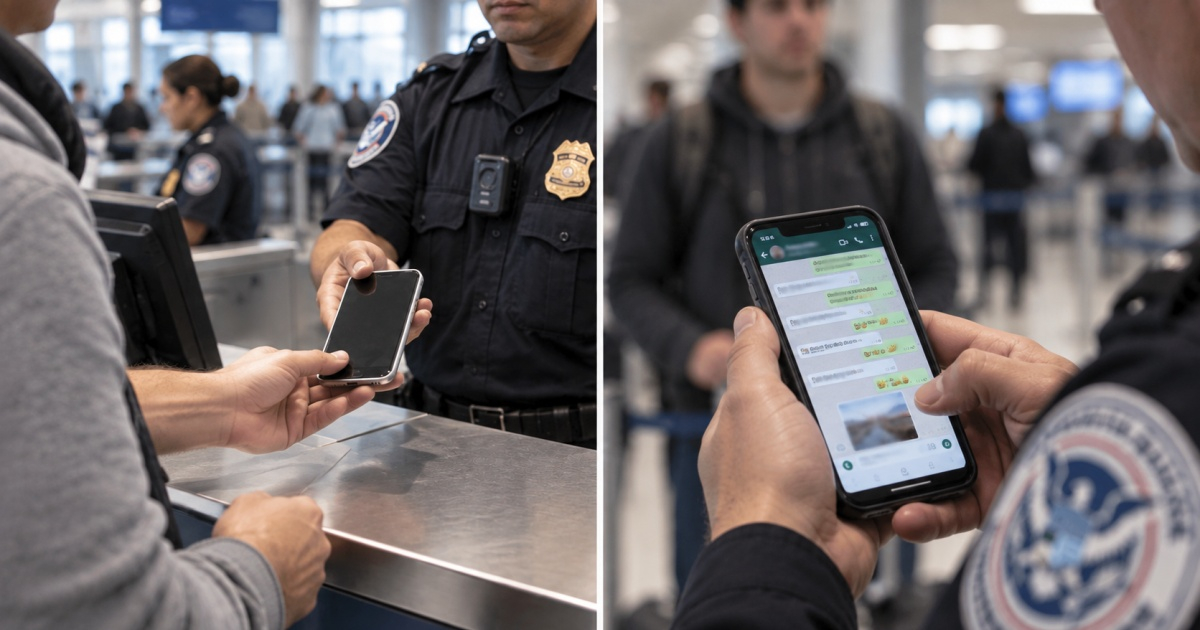
The Second Circuit Court of Appeals in the United States has ruled that federal agents can manually inspect the cell phones of travelers entering the country—via airports, land borders, or seaports—without needing a warrant, probable cause, or even individualized suspicion.
This decision, made in the case of United States v. Alisigwe, deems a manual phone inspection as a "routine border search" under the Fourth Amendment's border exception, equating the device to a traveler's ordinary luggage.
Understanding the Court's Ruling
Judge Steven Menashi, who wrote the majority opinion, was clear: "No suspicion is required before the government searches a traveler's cell phone at the border."
The court based its decision on the longstanding constitutional doctrine from the 18th century that acknowledges the sovereign right of the state to control who and what enters the country, a power deemed "reasonable" without the need for a warrant or probable cause. Menashi declined to apply the precedent set in Riley v. California (2014), where the Supreme Court mandated a warrant to search a phone during a routine police arrest, arguing that the border exception serves a different justification: the state's sovereign interest.
The ruling also dismissed the notion that the First Amendment alone necessitates an additional warrant requirement. This decision rebuffed the arguments from the Knight First Amendment Institute at Columbia University and the Reporters Committee for Freedom of the Press, which acted as amici curiae and cautioned that the ruling "leaves Americans' most sensitive information exposed to border searches without any suspicion whatsoever."
Privacy Concerns and Separate Opinion
Judge Eunice C. Lee concurred with the outcome but penned a separate opinion, challenging the notion that a cell phone should be treated like a suitcase.
Lee warned that "a suspicionless search could allow access to medical records, financial data, personal messages, and internet searches," highlighting that modern phones can store hundreds of gigabytes of photos, communications, and browsing history, which can reconstruct significant aspects of a person's life.
Scope and Application of the Ruling
The ruling directly impacts the jurisdiction of the Second Circuit, which includes New York, Connecticut, and Vermont, covering airports like JFK and LaGuardia.
The decision pertains only to basic or manual searches: an agent can browse the device’s content—photos, messages, contacts, locally stored files—without connecting it to external equipment. The Customs and Border Protection (CBP) policy distinguishes this from advanced forensic searches, which do require reasonable suspicion and supervisory approval.
Agents must also disable network connections before starting, exposing only locally downloaded content, not cloud-stored data.
The Case Behind the Decision
The ruling stemmed from the criminal proceedings against Chinwendu Alisigwe, a legal permanent resident who, between 2017 and 2020, opened 36 bank accounts with fake documents in the names of real people, channeling millions of dollars to China and the UK.
In February 2019, HSI and CBP agents detained him at JFK, demanded he unlock his phone, and photographed images containing names, birth dates, and Social Security numbers of victims. In 2021, during a second inspection, agents photographed a WhatsApp message where Alisigwe coordinated with an accomplice to receive stolen identity data.
He was sentenced to five years in prison, with an 18-point increase for a deliberate loss of at least $3,500,000 and two additional points for obstruction of justice.
Impact on Travelers
While this ruling doesn't automatically set a nationwide standard, as reported by La Opinión, no federal circuit has yet required a warrant for manual phone searches at the border.
Foreign visitors have less leeway to refuse; doing so could result in immigration consequences or increased scrutiny. In contrast, a U.S. citizen can refuse to provide their phone's passcode, and authorities must still allow them entry.
In fiscal year 2025, CBP conducted 55,318 electronic device searches, a 17.6% increase from the previous year, illustrating a steady upward trend that this ruling may accelerate.
This decision impacts anyone crossing the U.S. border. Stay updated on immigration policies, travelers' rights, and border changes in our U.S. Immigration section.
FAQs about Border Phone Searches
What does the Second Circuit Court's ruling allow?
It allows federal agents to manually inspect travelers' cell phones at the border without a warrant, probable cause, or individualized suspicion.
Are there any limitations to these phone searches?
The decision applies only to manual searches, where agents can browse content without connecting to external devices. Advanced forensic searches still require reasonable suspicion and approval.
How does this ruling affect U.S. citizens and foreign visitors differently?
U.S. citizens can refuse to unlock their phones, and authorities must still allow entry. Foreign visitors face potential immigration consequences or increased scrutiny if they refuse.