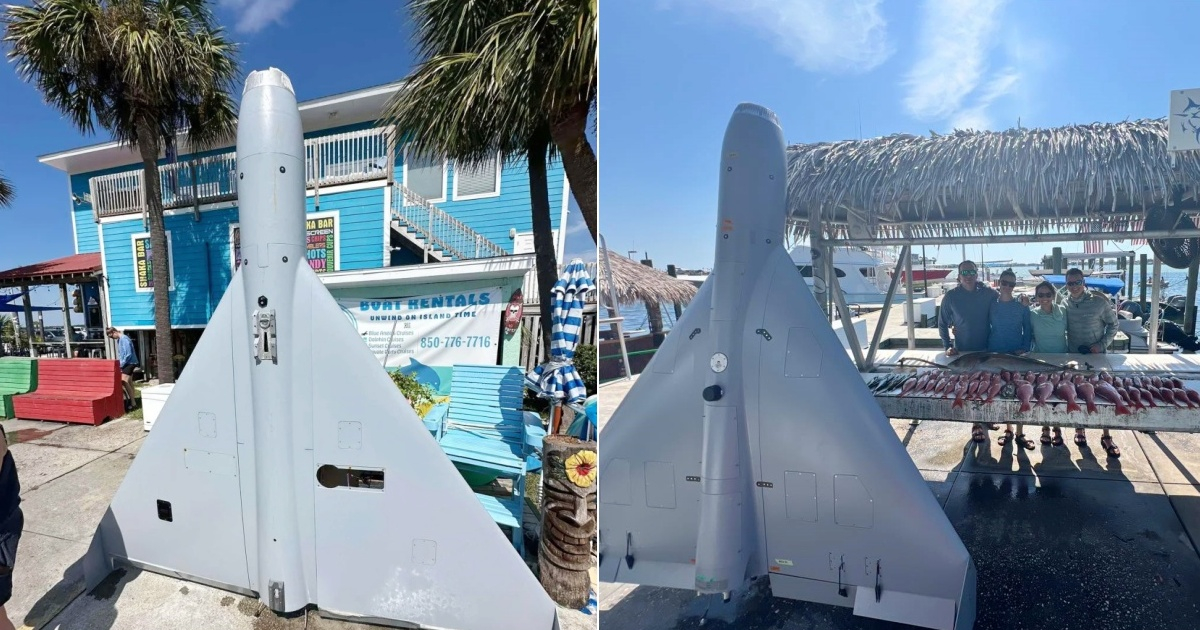
A fishing crew from Florida stumbled upon an unexpected find on Saturday while navigating the Gulf of Mexico—an American military drone adrift near Pensacola's shores. This unusual discovery was shared with the public through social media by Hot Spots Charters.
With a touch of humor, Captain Daniel Arsenault recounted the bizarre encounter. "We had a fantastic six-hour trip today with this team! If anyone's misplaced their drone, give Hot Spots a call!" he joked, posting a photo where the gray drone, complete with visible stabilizing fins, was prominently displayed beside their day's catch: red snappers, various fish, and squid.
The Unplanned Encounter
Arsenault elaborated to CNN that the drone's sighting was purely accidental: "We were heading out to sea and spotted it floating." Images depicted the drone missing its front section and rear propeller, occupying the entire bow of the boat.
In the comments section of Hot Spots Charters' Facebook post, the captain added with the same lighthearted tone, "The black SUVs came to retrieve their drone, all good!"
"Aren't those supposed to be catch-and-release only?" quipped a commenter sarcastically.
Identifying the Drone
The defense-focused website The War Zone speculated that the aircraft might be an FLM-136, the U.S. version of Iran's Shahed-136 drone. This model is produced by SpektreWorks, based in Arizona, under the LUCAS (Low-cost Uncrewed Combat Attack System) program. The FLM-136 is approximately 2.9 meters long, with a wingspan of 2.5 meters, weighing around 32 kilograms.
The original Shahed-136 is a single-use loitering munition with a delta-wing design and rear propeller, supplied by Iran to Russia since 2022. Moscow has extensively used it in Ukraine under the name Geran-2 to target energy infrastructure and cities.
A Test Gone Awry
The discovery wasn't a mere geographic coincidence. Eglin Air Force Base, home to the 96th Test Wing and a key U.S. weapons testing facility, is located in northwest Florida. A spokesperson from Eglin confirmed to The War Zone that on September 17—just three days before the find—a LUCAS drone "impacted the water during scheduled routine tests at Eglin AFB." "I can confirm we were conducting a test, and the test article fell," the spokesperson added.
Strategic Implications
This incident unfolds amidst heightened drone activity in the region. In June 2025, President Donald Trump signed an executive order to expedite the production and deployment of these systems, with the Department of Defense aiming to acquire 300,000 drones by 2027.
The Shahed model also bears a direct connection to Cuba. In July 2026, United Against a Nuclear Iran (UANI) showcased a Shahed-136 replica in Miami to highlight intelligence reports suggesting the Cuban regime had obtained over 300 drones from Russia and Iran since 2023, sparking significant political debate in the U.S.
Following this exhibition, Trump vowed to address the potential presence of Iranian drones in Cuba, while analysts debated whether Havana had the real capability to use these systems against the United States.
Key Insights on the U.S. Military Drone Discovery
What type of drone was found by the Florida fishermen?
The drone discovered is believed to be an FLM-136, the American version of the Iranian Shahed-136, manufactured under the LUCAS program by SpektreWorks in Arizona.
Where was the military drone found?
The drone was found floating near the coast of Pensacola, Florida, in the Gulf of Mexico.
What connection does the Shahed drone model have with Cuba?
Reports suggest that since 2023, Cuba has acquired over 300 drones from Iran and Russia, including the Shahed model, raising concerns in the U.S. about their potential use against American interests.