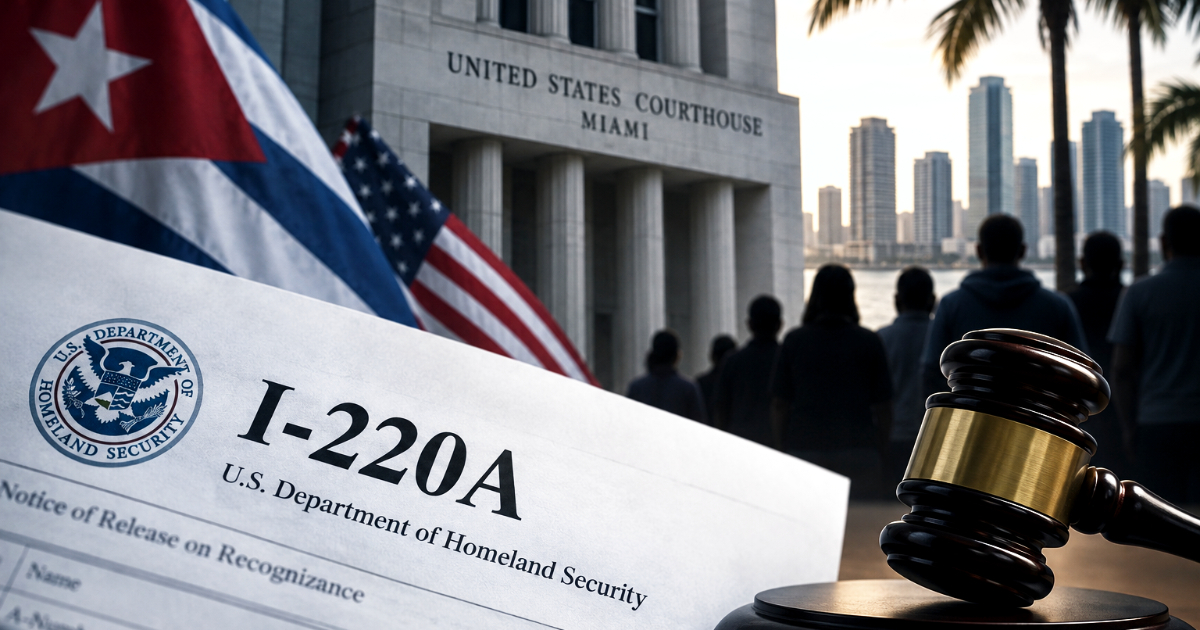
The case involving 992 Cubans holding I-220A forms continues to unfold in a federal court in Miami. However, there's still no ruling that recognizes this document as a parole or that automatically paves the way for residency under the Cuban Adjustment Act.
On September 10, U.S. District Judge Jacqueline Becerra dismissed the government's attempt to throw out the case, allowing the lawsuit, Bello-Rubio v. Noem, to proceed. Since then, several key developments have emerged, shedding light on the next steps in the legal proceedings.
The Revised Complaint and Its Implications
A significant update occurred on September 18 when the plaintiffs' attorneys submitted a second amended version of the lawsuit. Judge Becerra had previously instructed them to make this revision to explicitly address a crucial issue: under what authority were these Cubans initially detained before being released with an I-220A form?
This point of contention is critical as the plaintiffs challenge the manner in which they were processed and released by immigration authorities, seeking legal recognition of these circumstances as a parole. The government, however, argues that an I-220A does not equate to parole and that parole must be granted on an individual basis.
Potential Consolidation of Related Cases
Another development might impact the trajectory of this legal battle. Judge Becerra has asked the parties to consider combining Bello-Rubio with three other cases involving Cubans who received I-220A forms: Morejon, Echazabal-Verdecia, and Cabrera Mollinedo.
Both the plaintiffs' attorneys and the government have submitted their positions on this matter, and the decision now rests with the judge. It’s important to note that consolidating these cases doesn't imply a victory for the plaintiffs or a favorable decision for Cubans with I-220A forms. It is simply a procedural step to potentially streamline related legal issues.
Upcoming Deadlines and Key Dates
The case timeline has also been adjusted. Following the September 10 hearing, Becerra requested the government to address two additional issues: the plaintiffs' attempt to convert the lawsuit into a class action and a request for specific protections for the plaintiffs while the case is ongoing.
The government asked for more time to respond, and the plaintiffs did not object. As a result, Becerra extended the deadline to October 9, 2026. This date marks a critical juncture in the legal process.
The class action discussion is particularly noteworthy because, while the case started with 992 plaintiffs, their attorneys aim for a decision that could potentially benefit a much larger group of Cubans processed under similar circumstances. Becerra has yet to approve this request.
The Broader Implications for Cubans with I-220A Forms
At present, the legal status of Cubans with I-220A forms remains unchanged as a result of this case. The September 10 ruling was significant because it allowed the litigation to proceed despite the government's attempts to dismiss it.
However, Judge Becerra has not ruled that an I-220A is equivalent to parole, granted permanent residency to the 992 plaintiffs, or included all Cubans with this document in the process. The ongoing legal battle seeks to resolve these questions.
This case has sparked considerable interest because the outcome could affect many more individuals than those directly involved. The lawsuit's proponents estimate that between 500,000 and 600,000 Cubans might be in a similar immigration situation in the United States.
Furthermore, Bello-Rubio is not the only legal action in Florida regarding I-220A forms. Other lawsuits are raising similar issues about how immigration authorities processed and released Cubans who arrived at the border. This is why Judge Becerra has considered consolidating several of these cases.
Looking Ahead
The next significant date to watch is October 9, when the government must submit its arguments on the pending issues. Additionally, Judge Becerra's decision on whether to consolidate the four lawsuits is anticipated.
Following these developments, the court will continue to review the plaintiffs' requests and the government's arguments before addressing the central issue of this legal battle.
For thousands of Cubans with I-220A forms, the unresolved question remains whether the circumstances under which they were detained and subsequently released can be recognized as parole, allowing them to apply for residency under the Cuban Adjustment Act. As of now, that question remains unanswered.
Key Questions About the I-220A Case
What is the significance of the I-220A form in the lawsuit?
The I-220A form's significance lies in whether it can be legally recognized as a parole, impacting the residency status of the plaintiffs under the Cuban Adjustment Act.
What are the potential outcomes for the plaintiffs?
Potential outcomes include the recognition of the I-220A form as a parole, which could facilitate the path to residency for the plaintiffs, or a decision that maintains the status quo, requiring individuals to meet additional immigration requirements.