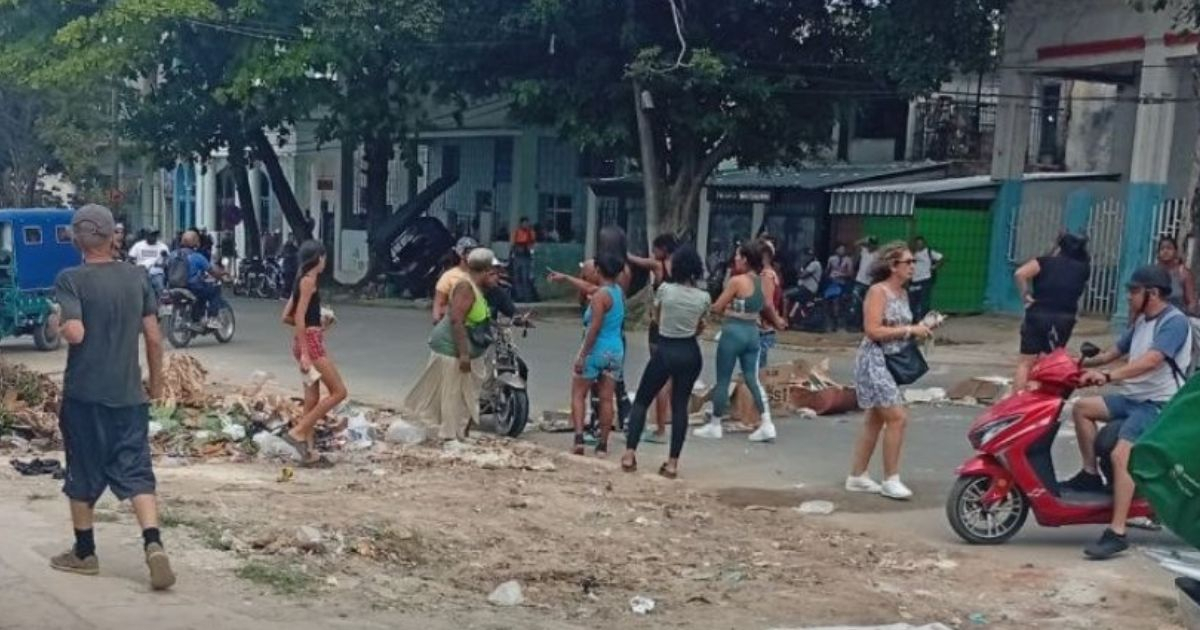
On Sunday, Cuban jurist René Fidel González García shared a political analysis from Santiago de Cuba on his Facebook page, suggesting a fundamental and irreversible disconnect between the Cuban regime and its citizens. According to him, this goes beyond a mere distancing—it is a profound disconnection.
González García, a Doctor in Legal Sciences and former professor at the University of Oriente—dismissed from his position in November 2016 in what he and human rights organizations described as political retaliation—asserts that the government "retains power while losing popular legitimacy." He argues that this process "began years ago and has been intermittent and irreversible."
"It seems as if they drift away from the people and the people from them; it might sound metaphorical, but it isn't. It's not just distancing as most might think; it's a disconnect," he writes. For the jurist, this distinction is crucial: it's not a gap that can be bridged but a deep-seated fracture.
The Disintegration of the State
One of the central themes of his analysis is the deliberate dismantling of the state. "The state is being rapidly disassembled, piece by piece. The goal is a minimal one. It's not a matter of theoretical choice. What remains of the old state structure—its logic, its conception, its goals and scope—seems cumbersome and costly, exhausting and dull, a labor trap," he argues.
Metaphor of Gulliver's Boots
To describe the current leaders, González García uses the metaphor of Gulliver's boots: "Incapable of handling power both materially and symbolically, of creating and reproducing it as the preceding political generation did, they try to concentrate it. It's not just that Gulliver's boots don't fit them; they weigh heavily on them. They look like clowns wearing them, yet their actual size is another matter." He warns that this reduced power is not less dangerous: "It's simply the power of dwarfs, their scale."
Political Indifference as a Strategy
The jurist accuses the regime of cultivating political indifference among those who remain on the island. "They rely on the hope that, exhausted by so much glory and misery, submerged in such daily survival and precariousness—you've normalized charcoal, but for others, it's firewood, wood from doors and windows, chairs and other furniture, not forgetting scabies and bedbugs—a growing majority of the minority who remain in Cuba will not only develop a syndrome of indifference and political amnesia […] but will cease to see them as the root of the problem […] because nothing interests them anymore, absolutely nothing: indifference is the new leisure."
Ongoing Criticism and Context
This publication is part of a series of critical statements González García has made throughout 2026. In July, he claimed that Cubans now have fewer freedoms than they did in 1953, under Batista's dictatorship. In August, he directly challenged the Communist Party, questioning whether its members would support "the process of restoring capitalism," and introduced the term "political indigence" to describe the exclusion faced by the majority. On September 11, he posted about the "historical betrayal" of the Cuban people, mentioning "children sleeping hungry, emaciated" and "elderly sleeping without dreams."
The backdrop for his writings is an unprecedented structural crisis: extreme poverty afflicts 94% of Cubans, according to the Cuban Observatory of Human Rights, an increase of nine points since 2025, while the Economic Commission for Latin America and the Caribbean (ECLAC) projects a 6.5% GDP decline in 2026. Prisoners Defenders documented 1,339 political prisoners in its September report, marking a grim historic record.
"Just as they need a small power and a small state, they also need a small, diminutive, and trivialized populace. No longer do they wish for a great feline, but a kitten, gray like all gray cats, but a kitten, perhaps believing that this might change something without them having to change," concludes González García.
Key Insights on Cuba's Political Disconnection
What does René Fidel González García mean by "disconnection" between the Cuban government and its citizens?
González García refers to a fundamental breakdown in the relationship between the government and the people, which he describes not merely as a distancing but as a profound and irreversible disconnection.
How does González García describe the dismantling of the Cuban state?
He argues that the state is being rapidly dismantled, piece by piece, to create a minimal state structure. This is seen as a necessity because the existing state framework is viewed as cumbersome and costly.
What metaphor does González García use to describe the current Cuban leaders?
He uses the metaphor of Gulliver's boots to illustrate how the current leaders are incapable of handling power effectively, making them appear inadequate and clownish.
What is the strategy of political indifference mentioned by González García?
He claims that the regime is fostering political indifference among the population, hoping that as people become more focused on daily survival, they will lose interest in the regime's role in their problems.