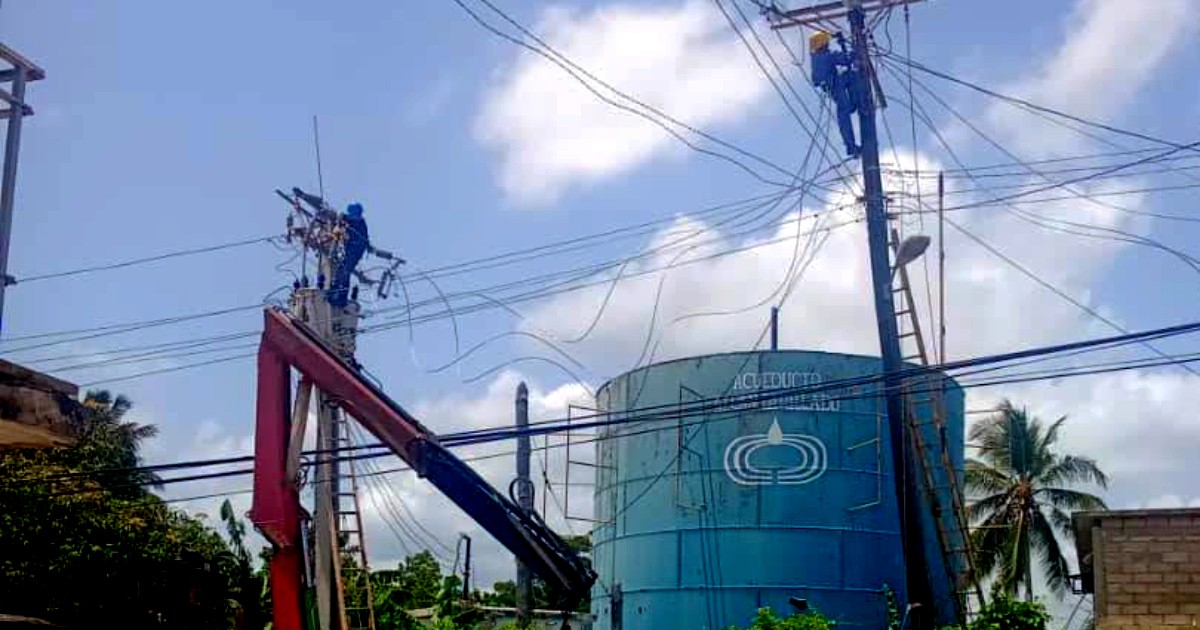
A team of electrical line workers from Unión de Reyes and Jagüey Grande municipalities has successfully completed a 13-kilovolt line installation in Matanzas city. This project aims to ensure water pumping for over 36,000 residents in the city's upper and middle areas, as reported by state journalist José Miguel Solís on social media this past weekend.
While this achievement is highlighted as a significant accomplishment, it starkly underlines the severity of the problem: those 36,000 beneficiaries only constitute a mere 15% of the more than 240,000 Matanzas residents grappling with severe water supply issues, as per official statistics. During the worst periods of 2026, this number surpassed 300,000 affected individuals in the province.
The infrastructure allows the Pedraja and Hormigón tanks to be refilled even during blackouts, benefiting neighborhoods like Los Mangos, Lozano, El Naranjal, and Kilometer 101. Liván Morales, head of the brigade, explained, "Initially, we worked on the dual power supply for the Faustino Pérez Provincial Hospital, and from that connection, the line was extended to supply centers, with the poles and all necessary wiring to ensure a completely secure supply."
The Energy Crisis and Its Impact on Water Supply
The intertwined nature of the energy crisis and water scarcity in Cuba is deeply systemic. According to Antonio Rodríguez Rodríguez, president of the National Institute of Hydraulic Resources, 87% of the water supply system relies on the National Electric System (SEN). When the power fails, water pumping halts, despite available reserves. Out of 480 crucial pumping stations, only 135 are safeguarded against outages.
The completion of the line workers' project coincided with the SEN's recovery after its eighth total disconnection of the year, on September 18, highlighting the fragile state of the electrical system that underpins water access in Cuba.
Health Implications of the Water Crisis
The health ramifications of this crisis are significant and well-documented. In February 2025, fecal coliforms were detected in the Bello supply source, serving areas like El Naranjal, Matanzas Este, and Versalles. In March 2026, health authorities again advised the public to boil and chlorinate water. Between April and May, a hepatitis A outbreak was confirmed in the Versalles neighborhood, with 18 active cases, and in June, seven new cases and 49 suspects were reported within a week.
The U.S. Embassy in Havana issued health warnings about digestive diseases linked to the deteriorating water and electricity conditions, and the UN estimated in September 2026 that around 3.5 million Cubans lack regular access to safe drinking water.
Faced with this scenario, the official source reporting on the line workers chose to deflect responsibility to the residents: "Now it is up to the residents of the upper and middle areas of the Yumurian city to use water rationally," wrote Solís, ignoring that the crisis results from a collapsed system due to decades of neglect and reliance on an increasingly unreliable electrical network.
The brigade, which will continue to install isolators to protect hospitals and supply centers, faces a challenge far beyond its capabilities: in Matanzas, over 200,000 people will still lack guaranteed potable water even after this intervention ends.
Understanding the Water and Energy Crisis in Matanzas
What is the impact of the new infrastructure on Matanzas residents without water?
The new infrastructure benefits only about 15% of Matanzas residents lacking water, aiding over 36,000 people amidst a crisis affecting more than 240,000 individuals.
How does the energy crisis affect water supply in Cuba?
The energy crisis heavily impacts water supply because 87% of the system depends on the national electric grid. Power outages halt water pumping, despite available resources.
What health issues have arisen from the water crisis in Cuba?
The water crisis has led to severe health problems, including outbreaks of hepatitis A and the presence of fecal coliforms in water sources, prompting health warnings from authorities.