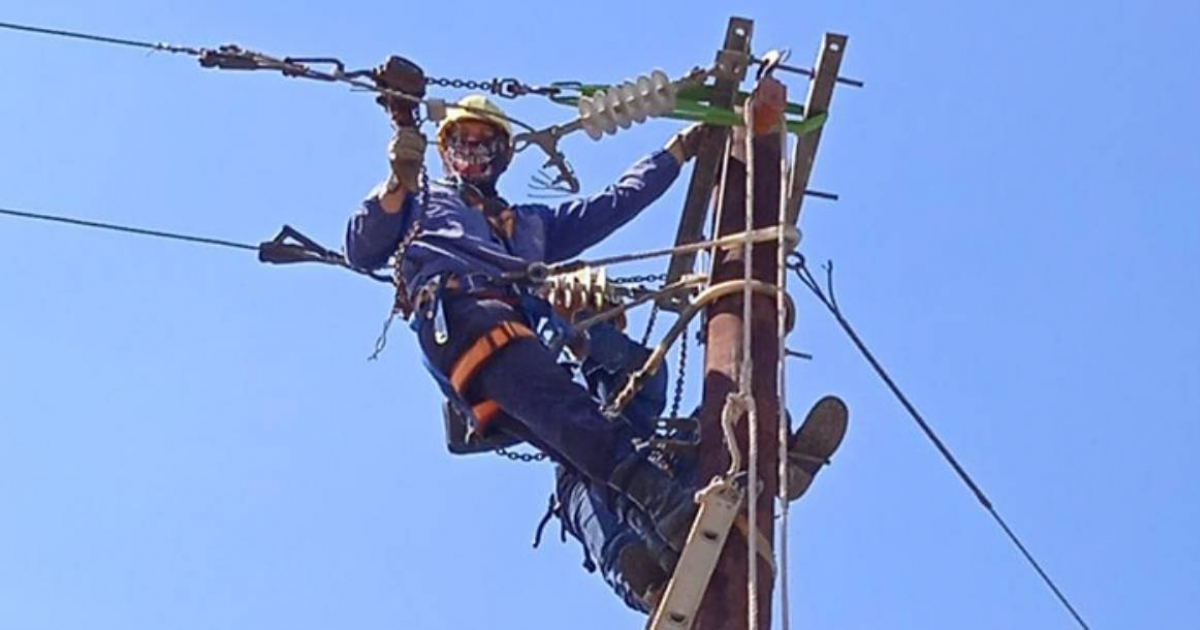
The Electric Union (UNE) announced on its official Facebook page this Saturday that the National Electric System (SEN) is now "connected throughout the entire country." However, they failed to clarify that reconnecting the transmission system does not equate to the restoration of electricity in homes.
This statement followed the eighth total blackout of the SEN in 2026, which occurred on the afternoon of Friday, September 18. The blackout was triggered by the successive failure of two 220 kV transmission lines—Matanzas-Cienfuegos and Matanzas-Santa Clara—leaving millions of people across the island without power.
The response from Cubans on social media was swift and pointed, with numerous residents from various provinces debunking the official optimism with sarcasm and frustration.
"What country? Because where I live, there hasn't been electricity since yesterday afternoon," one social media user remarked on the UNE post, capturing the widespread sentiment.
Other users were equally blunt: "I just found out I don't live in Cuba," one person noted, while another summed up the contradiction with three words: "Connected, but powerless."
Complaints emanated from Guantánamo, Las Tunas, Ciego de Ávila, Pinar del Río, Matanzas, Villa Clara, Sancti Spíritus, Granma, Artemisa, and Havana. Some citizens reported enduring over 34 hours or even days without electricity.
"In what country could it be, another one perhaps, because ours is the land of fantasy," another user concluded, encapsulating the chasm between the official statement and the reality experienced by millions of Cubans.
The situation in the capital was telling: Havana's recovery barely reached 44.2% by Saturday morning, with only 126 of 286 distribution circuits active and few of the main water pumping systems operational.
The situation worsened due to a new malfunction at the Antonio Guiteras Thermoelectric Plant, the largest in the country, located in Matanzas. The collapse of the SEN caused damage to the economizer of its boiler, with "several punctures in the steam generator," as described by the plant's director, Román Pérez Castañeda.
Cooling the boiler takes nearly 72 hours, meaning repair crews wouldn't be able to intervene until the afternoon of Monday, September 21.
The Guiteras plant has experienced at least 17 unscheduled outages thus far in 2026, making it one of the weakest links in a structurally deteriorating power system.
Instead of accepting responsibility for this decline, the UNE characterized the efforts of its workers as conducted "amidst a genocidal blockade that prevents the arrival of spare parts, technology, and fuel," shifting blame to the U.S. embargo.
However, the crisis primarily stems from decades of mismanagement and neglect of infrastructure. The Minister of Energy and Mines, Vicente de la O Levy, admitted in May 2026 that Cuba had "absolutely no fuel, no diesel" for power generation.
Recent months have seen maximum generation deficits exceeding 2,000 MW on multiple days, against a demand close to 3,100 MW—a gap that no Facebook announcement can bridge.
Understanding the Cuban Power Crisis
What caused the recent nationwide blackout in Cuba?
The blackout was triggered by the failure of two major transmission lines, Matanzas-Cienfuegos and Matanzas-Santa Clara, which are part of the National Electric System (SEN).
How did Cubans react to the UNE's announcement on social media?
Cubans responded with skepticism and irony, pointing out that despite the official statement, many regions remained without power.
What are the main challenges faced by the Cuban power system?
The Cuban power system is plagued by structural deterioration, frequent outages, and a lack of fuel and resources, exacerbated by decades of poor management.