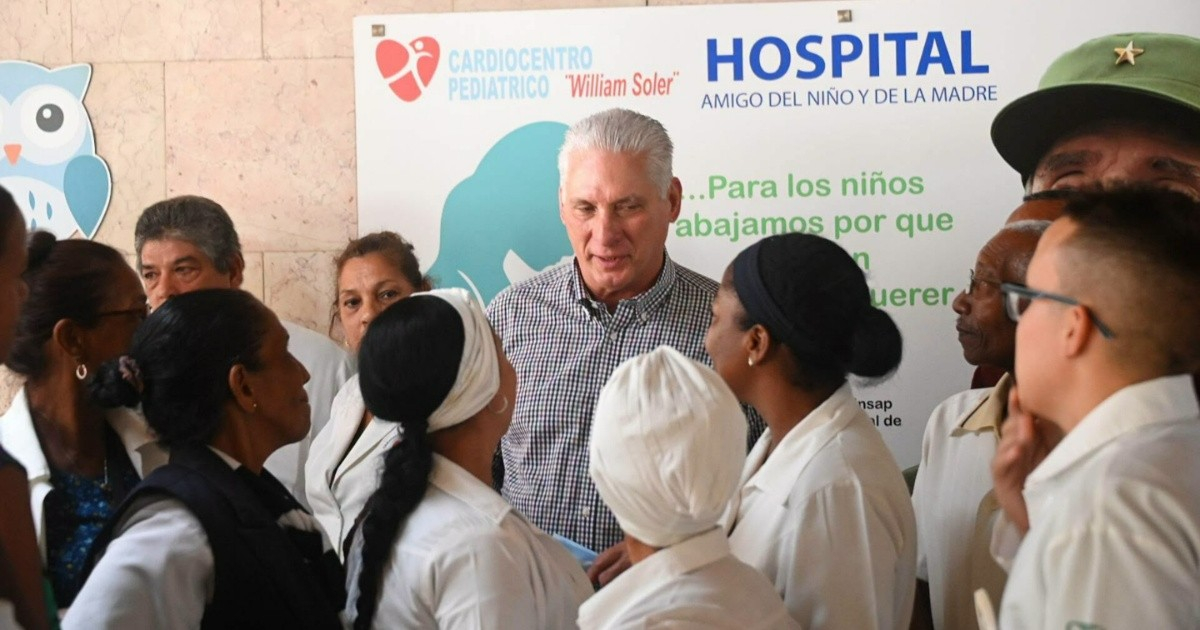
On Saturday, Cuban leader Miguel Díaz-Canel toured the Pediatric Cardiocenter William Soler in Havana. The official account of the Cuban Presidency shared the visit with the message "an excellent team" and photos showing Díaz-Canel surrounded by medical staff in white coats and surgical scrubs.
According to the official report, Díaz-Canel praised the center as a national and international benchmark, applauding the staff for "overcoming limitations" to provide specialized care for children with heart conditions. The regime described the visit as part of "a work system to help address challenges and recognize the daily heroism of healthcare personnel."
However, the reaction from many Cubans was one of skepticism. "Besides being propaganda, what do these visits solve amid all the hardships faced by the Cuban population?" commented one user on the official Facebook post. Another simply wrote, "Bread and Circuses." A third pointed out what Díaz-Canel did not see: "And they didn’t go to the emergency room to see how they have to handle dehydrated pediatric patients."
Hospital Conditions: A Stark Reality
The gap between the projected image and the documented reality of the hospital is stark. In August 2026, just a month before this visit, photos circulated showing William Soler Hospital with broken bathrooms, lidless toilets, waterlogged floors filled with trash, and rusted sinks.
By October 2025, parents and families had already reported the center as "completely collapsed," with overcrowded emergencies, staffing shortages, and a lack of supplies.
In March 2026, international media reported that doctors at William Soler had to prioritize children at the highest risk because resources were insufficient for all. The Cuban Ministry of Health acknowledged that over 96,000 Cubans, including more than 11,000 children, were on waiting lists for surgeries.
The situation became so dire that in August 2026, a campaign in Spain raised more than 12,000 euros to supply electricity to the hospital, highlighting the center's reliance on external support to operate.
The Impact of the U.S. Embargo
During the visit, the cardiocenter's director, Dr. Eugenio Selman-Houssein Sosa, highlighted that the hospital is labeled as a "denied hospital" for purchasing medical supplies and equipment made in the United States. He noted that they are even questioned if the medications are for Cuban or foreign children, with prohibitions for the former. "If anyone wants to know what the embargo is like, come to the Pediatric Cardiocenter William Soler; we will show you," he asserted.
This visit follows a repeated pattern throughout 2026: Díaz-Canel visiting flagship hospitals — such as Frank País, González Coro, and the Institute of Neurology — to portray the achievements of the healthcare system, while the majority of the country's hospitals face medicine shortages, frequent blackouts, and widespread deterioration. Each visit has sparked similar accusations of propaganda and staging.
Understanding the Challenges of Cuban Healthcare
What issues are faced by Cuban hospitals like William Soler?
Cuban hospitals, including William Soler, deal with overcrowding, shortages of medical staff and supplies, deteriorating infrastructure, and reliance on external support for basic needs like electricity.
How does the U.S. embargo affect Cuban healthcare?
The U.S. embargo limits Cuba's ability to purchase medical supplies and equipment from American manufacturers, which exacerbates shortages and affects the quality of care in Cuban hospitals.
What is the Cuban public's reaction to Díaz-Canel's hospital visits?
Many Cubans view these visits skeptically, questioning their effectiveness and seeing them as mere propaganda amidst the ongoing struggles faced by the healthcare system and the population.