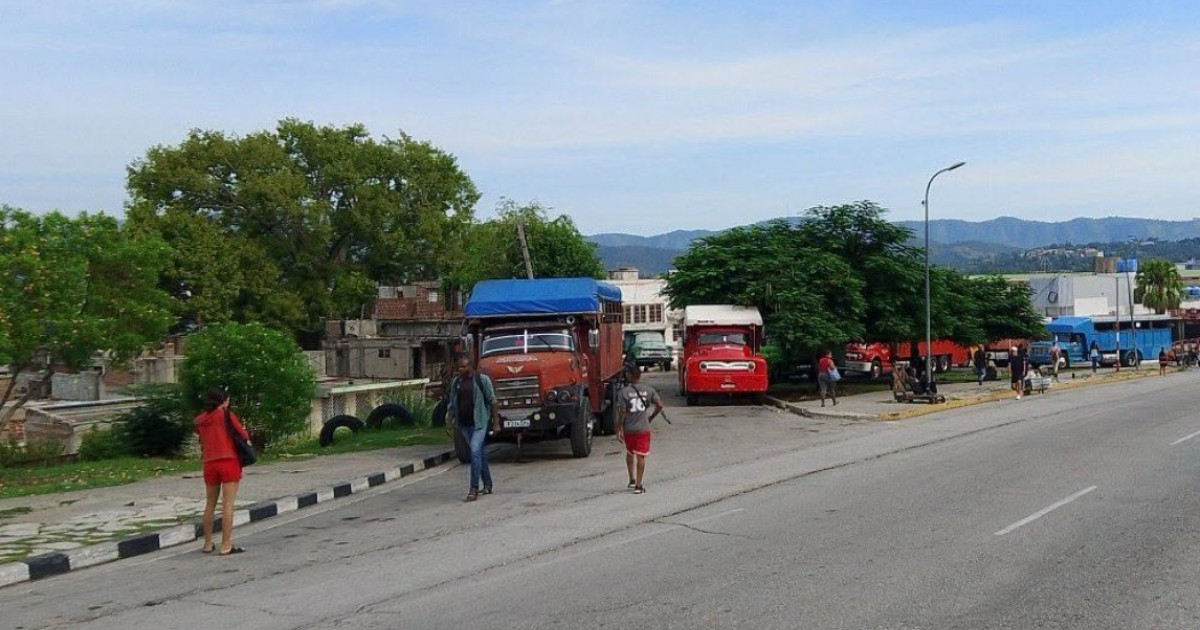
In Santiago de Cuba, a long line of private buses and trucks wait to transport passengers, yet the majority of locals find these services financially out of reach. With fares exceeding a thousand pesos per ride, many are left wondering why the state-run transportation is nowhere to be found.
The newspaper Sierra Maestra painted a vivid picture of this issue at the intermunicipal terminal on Calle 4. A Facebook post shared by the publication captured the frustration of several users who decried the exorbitant fees charged by private transport operators.
"I haven't found anyone charging less than a thousand pesos," lamented a woman trying to travel to Palma Soriano. Despite finding a few vehicles headed her way, all were priced similarly, with no room for negotiation.
Another traveler pointed out that the charges are fixed per destination, regardless of the distance traveled. "You pay for the full route, not by the distance; even if you just want to go to La República—about four kilometers from the city—you have to pay whatever they demand," he explained.
Unable to afford the fare, he chose to walk, highlighting that the problem is not only the lack of options: "It's the sky-high prices, overcrowding, and even mistreatment."
The online post sparked a heated debate, with the majority blaming the Cuban government for the transportation crisis. One recurring question was: "There's much criticism of the private sector, but where is the state-run competition?"
Many users criticized the regime. "Public transportation is the government's responsibility; they should provide buses at reasonable prices to solve the problem," one commentator argued.
Another pointed out an interesting contradiction: "The trucks are privately owned, but the buses are leased, meaning they belong to the government. The management done by the lessee could be handled by the government, but it seems they're avoiding responsibility."
One user defended the private operators. "This is the government's fault for not subsidizing the fares. The truckers charge the bare minimum just to cover maintenance and fuel costs, something the state doesn't supply at a reduced price."
The rejection of the official narrative was clear. "It's not a lack of oil; it's not the blockade; it's the absence of a government that cares for its people," another user wrote.
Another commenter condemned the state's neglect: "This is the state of Cuba; they've left everything to the private sector, and now the Santiago de Cuba provincial government provides no transportation."
The consensus was clear: "The system itself has caused this crisis."
Passenger transportation in Cuba is experiencing one of its worst downturns in decades, with stalled routes, fuel shortages, and a deteriorating vehicle fleet that has suffered years of neglect.
Between January and September 2025, state-run services saw a dramatic 93% decrease, plummeting from transporting 40.2 million passengers to just 900,000, according to the National Office of Statistics and Information.
In response, the Ministry of Transportation implemented further cuts on June 18, reducing bus, train, and ferry frequencies nationwide.
Prime Minister Manuel Marrero Cruz blamed the United States for an "energy blockade" causing the crisis and vowed that the government would continue to "explore alternatives," but Cubans largely reject this narrative, pointing directly at the regime's management.
In Santiago de Cuba, using private transport to commute can cost up to 5,000 pesos a month, while interprovincial journeys from the city range from 15,000 to 35,000 pesos in the informal market.
Cuba's Transportation Crisis: Key Questions Answered
What is causing the high cost of private transportation in Cuba?
Private transportation costs are driven by a lack of state-run competition, high maintenance and fuel costs, and the absence of government subsidies for fares.
How has the Cuban government responded to the transportation crisis?
The Cuban government has implemented service cuts nationwide and has blamed external factors, such as an alleged U.S. energy blockade, for the crisis.
What impact has the transportation crisis had on Cuban citizens?
The crisis has led to increased costs for commuting and travel, forcing many to walk or forgo travel altogether due to unaffordable fares.