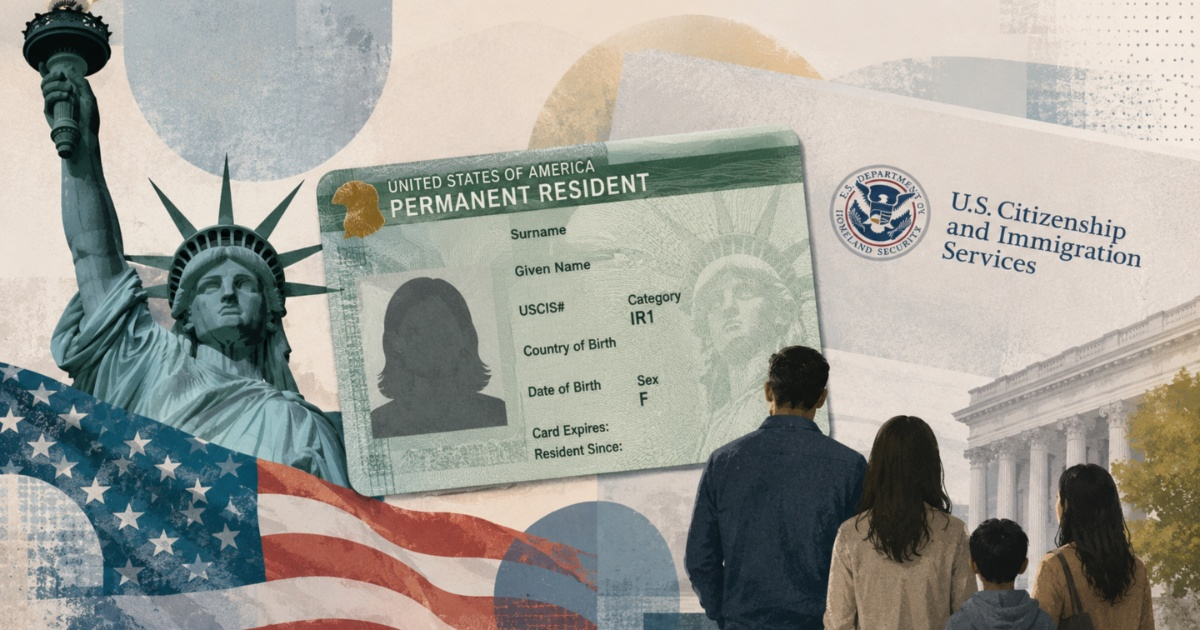
The Trump administration has reintroduced a public charge rule effective this Friday, expanding the criteria under which the United States Citizenship and Immigration Services (USCIS) can deny permanent residency to immigrants who have utilized government benefits. This move has caused alarm within the Latino community; however, it is less concerning for the majority of Cubans, contrary to widespread fears.
As of September 18th, USCIS officers will scrutinize "each and every" government benefit received by green card applicants, according to the agency’s official statement.
The list of benefits now considered is significantly broader than before, including food stamps (SNAP), Medicaid, housing vouchers, college financial aid, and other means-tested programs.
Previously, the rule in effect since 2022 only factored in public cash assistance for income maintenance or long-term institutionalization at government expense.
Reports from Telemundo suggest that around 950,000 individuals might forgo government assistance as a direct result of this policy.
This measure marks a reinstatement of a policy initially enforced by Trump in February 2020 during his first term, later revoked by the Biden administration.
The government asserts that it is "reaffirming the self-sufficiency requirement, safeguarding public resources, and ending policies that encouraged dependency at the expense of hardworking American taxpayers."
Impact on Cuban Immigrants
For most Cubans applying for residency under the Cuban Adjustment Act (CAA), the answer is straightforward: this rule does not impact them.
The CAA, enacted by Congress in 1966, includes a statutory exemption for the public charge inadmissibility ground. As a congressional law, no executive administrative rule can override it, which was explicitly reaffirmed in the Federal Register in July 2026.
Immigration attorney Willy Allen III elaborated: "If I am Cuban, I rely on the Cuban Adjustment Act and have received some assistance, I need not worry. It does not matter. It’s irrelevant. Because it’s an exception. And it remains an exception."
Practically speaking, a Cuban who has received SNAP, Medicaid, or housing subsidies while awaiting status adjustment under the CAA cannot be denied residency for that reason.
Who Should Be Concerned
The situation is different for Cubans who do not adjust under the CAA: those with a Form I-220A with unresolved status before the Board of Immigration Appeals, or those applying for residency through family, employment, or other standard pathways, are subject to the new evaluation.
In these cases, USCIS will evaluate the "totality of circumstances" considering five factors: age, health, family status, assets and resources, and education and skills.
If an officer determines the applicant is inadmissible solely due to the likelihood of becoming a public charge, they may offer the option to pay a bond via Form I-945, with a minimum amount of $1,000, calculated based on potential benefits received over the next five years.
Willy Allen III cautioned that the actual reach of the rule remains uncertain: "This change is new, so I cannot say 100% how they will apply it. But knowing this government, I suspect they will likely push this rule to the limit to deny as many cases as possible."
Besides the CAA beneficiaries, those exempt from the rule include asylum seekers, refugees, Temporary Protected Status (TPS) applicants, victims of human trafficking and crimes, and special immigrant juveniles.
The new rule applies exclusively to status adjustment applications filed from this Friday onward; those submitted before this date are assessed under the previous 2022 criteria, even if still pending resolution.
Understanding the Public Charge Rule
What is the public charge rule?
The public charge rule is a policy that allows immigration authorities to deny permanent residency to individuals deemed likely to become dependent on government assistance.
Who is exempt from the public charge rule?
Exempt individuals include Cuban Adjustment Act beneficiaries, asylum seekers, refugees, Temporary Protected Status applicants, victims of trafficking and crimes, and special immigrant juveniles.
How does the rule affect Cuban immigrants?
Most Cuban immigrants applying for residency through the Cuban Adjustment Act are exempt from the rule, but those not under the Act must comply with the new evaluation criteria.