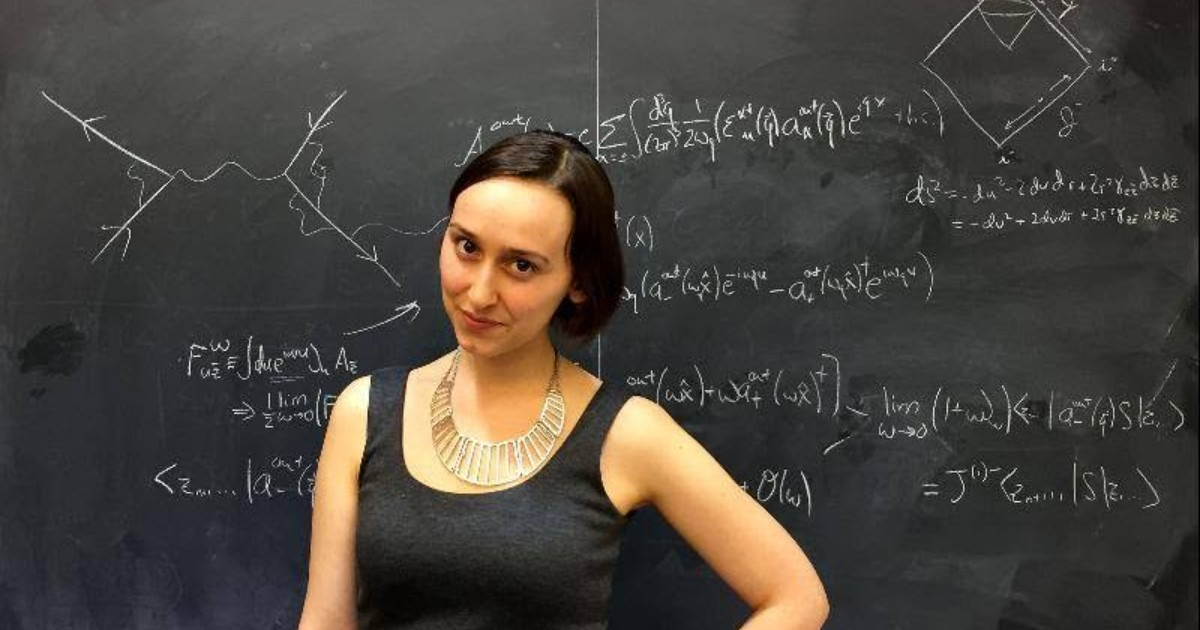
Sabrina González Pasterski, a 33-year-old native of Chicago, is tackling one of the most challenging issues in modern physics: merging Einstein's theory of general relativity with quantum mechanics.
In a discussion with El País, Pasterski reflected on her research, her Cuban-American heritage, and her evolving perspective on the frequent comparisons to the legendary German physicist. "I used to be embarrassed being called the new Einstein, but now I think: let them talk," she remarked.
Exceptional Journey from a Young Age
From an early age, González Pasterski exhibited extraordinary potential. At just 12, she began assembling a Zenith CH 601 XL aircraft model from a semi-complete kit, and by 16, she had learned to fly it.
"As a child, engineering fascinated me, pushing the boundaries of what was possible. Later, I grew to appreciate the impossible and the complexity of understanding the universe's structure," she explained.
Her time at the Massachusetts Institute of Technology (MIT) was equally remarkable. She earned her Physics degree in just three years with a perfect GPA, becoming one of the first women to achieve this distinction.
During her first year, she became the inaugural student at her level to earn an operational internship grant from NASA. Later, she was involved with the CMS experiment at CERN's Large Hadron Collider and completed her Ph.D. at Harvard in 2019 under the guidance of physicist Andrew Strominger.
Pioneering Contributions to Physics
In 2016, Stephen Hawking referenced her work on gravitational memory and black holes, while her research also helped establish the Pasterski-Strominger-Zhiboedov triangle. This theoretical framework links three fundamental physics phenomena: spacetime asymptotic symmetries, low-energy particle theorems, and memory effects from gravitational waves or electromagnetic pulses.
This model posits that understanding one of these concepts provides insights into the others. Together with Andrew Strominger and Alexander Zhiboedov, González Pasterski's contributions are part of the broader quest to deepen the connection between quantum mechanics and gravity.
Despite offers from Blue Origin—Jeff Bezos personally reached out to her in her teenage years—and NASA, she has chosen to remain in pure academic research.
Leading Celestial Holography Research
Since 2021, Pasterski has been at the Perimeter Institute for Theoretical Physics in Canada, where she founded and leads the Celestial Holography Initiative. As the name suggests, the field focuses on celestial holography, which she describes as "a useful way to mathematically describe the universe."
"Celestial holography aims to develop a holographic description of gravity in a flat spacetime, similar to the one describing our universe," she explained.
Regarding artificial intelligence, González Pasterski acknowledges its potential as a crucial tool, though she has concerns.
"We are entering an era where AI tools allow us to pose questions about the universe that surpass traditional scientific inquiries, but I'm worried that academic research might be sidelined in this process," she expressed.
Cultural Roots and Identity
Though she doesn't speak Spanish, González Pasterski proudly identifies as "a first-generation Cuban-American." Her mother, María González, was born in Cuba and moved to the United States as a child. Her father, Mark Pasterski, is an American lawyer and electrical engineer.
She has emphasized that growing up with the close-knit experience of an immigrant family shaped her worldview. Her connection to Cuba, while maternal and cultural, is something she proudly upholds; the González surname, which she uses before Pasterski, is her most visible way of honoring that heritage.
González Pasterski has been recognized in the Forbes 30 Under 30 list twice—in 2015 and 2017—and in 2018, the Albert Einstein Foundation included her in their Genius 100 Visions project as one of the top 100 innovators, scientists, and visionaries of the time.
Regarding the profound question guiding her work, González Pasterski is clear about her limitations and aspirations: "I don't think one person will solve it. I'd like to contribute to building the infrastructure needed to explore mathematically consistent theories."
Exploring Sabrina González Pasterski's Contributions to Physics
What is Sabrina González Pasterski known for in the field of physics?
Sabrina González Pasterski is renowned for her work on gravitational memory and black holes, contributing to the Pasterski-Strominger-Zhiboedov triangle, which connects fundamental physics phenomena.
Where is Sabrina González Pasterski currently conducting her research?
Sabrina González Pasterski is currently conducting her research at the Perimeter Institute for Theoretical Physics in Canada, where she leads the Celestial Holography Initiative.
How has Sabrina González Pasterski's heritage influenced her work?
Growing up in an immigrant family has shaped her perspective and worldview, which she proudly honors through her Cuban heritage and her mother's legacy.