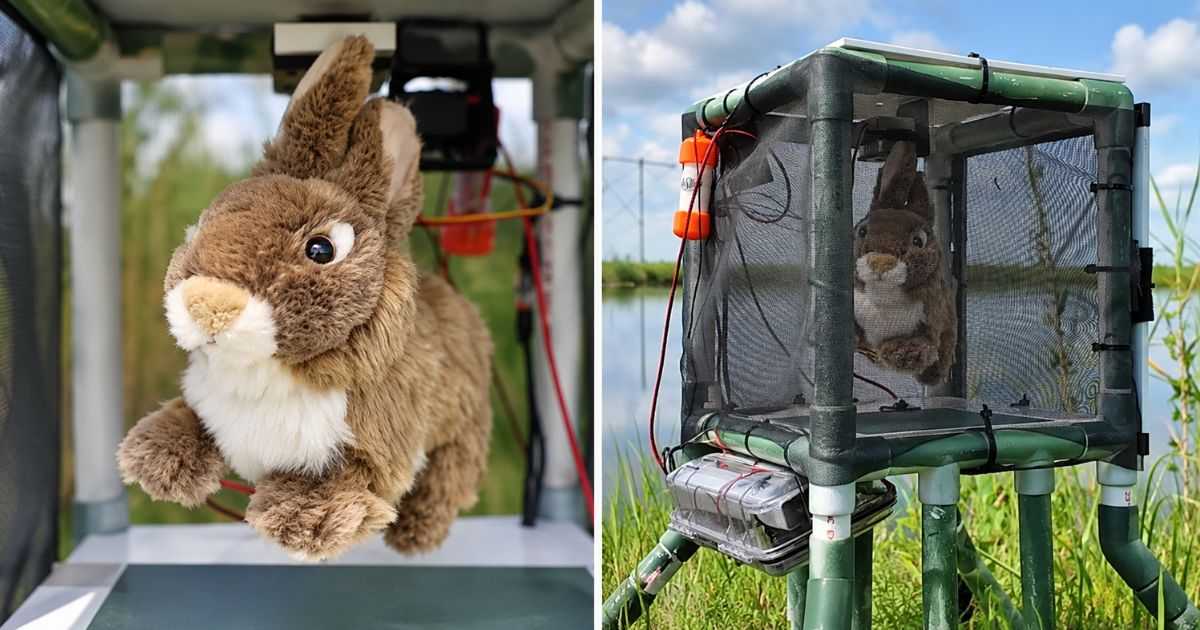
In a groundbreaking experiment in the Florida Everglades, approximately 90 robotic rabbits equipped to emit heat, scents, vibrations, and movements are being deployed. This initiative aims to attract invasive Burmese pythons, making them easier to locate and capture.
Developed by researchers from the University of Florida in collaboration with the company REWYLD, and funded by the South Florida Water Management District, this project was reported by Telemundo 51. At first glance, these devices resemble toy rabbits, yet they are engineered to mimic the various cues that snakes rely on to detect prey, thus drawing them to a location where they can be more easily found.
"We're trying to recreate these signals by generating scent, movement, visual cues, ground vibrations, and heat signatures," explained Robert McCleery, a professor at the University of Florida and the lead researcher of the initiative.
Addressing a Major Ecological Challenge
One of the primary challenges faced by those tasked with removing pythons from the Everglades is finding them in such a vast, vegetated ecosystem. Python hunter Bayo Hernández in South Florida mentioned that he can spend up to five hours daily just searching for them.
The strategy aims to reverse this arduous process: instead of scouring large areas to find the snakes, researchers are working to entice the pythons to come to the bait on their own. Each device can be programmed with different combinations of heat, scent, vibrations, and movement to determine which are most effective.
"We have about 90 deployed right now. We can activate heat, scent, vibrations, or movement and test different combinations," McCleery stated. Additionally, these units were built to withstand the harsh conditions of the Everglades, including heavy rainfall and flooding.
The Role of AI in Python Detection
The experiment also incorporates another technological aspect. REWYLD is developing an artificial intelligence system capable of recognizing when a python approaches the rabbit and notifying nearby hunters. Jean Paul De Desrochers of REWYLD explained that the technology is designed to identify the reptile, keep its focus on the lure, and subsequently send out an alert with its location.
Interestingly, researchers have observed unexpected behavior: the pythons don't always attack the rabbits immediately. "We've seen them arrive, just sit there and wait. They don't try to bite," McCleery noted. This hesitation can be particularly beneficial, giving hunters the time needed to reach and remove the animal.
Controlling an Invasive Species
For years, Burmese pythons have posed a significant threat to the wildlife in the Everglades. The University of Florida reports that these invasive snakes have led to drastic declines in native mammal populations in certain areas, and their Project Hopper is focused on developing these lures to enhance detection and removal efforts.
De Desrochers estimated to Telemundo that there might be around 300,000 pythons across Miami-Dade, Broward, and Palm Beach. However, accurately estimating the population of such an elusive species remains a challenge. Florida has long been employing various strategies to curb their numbers.
In July, another round of the Florida Python Challenge was launched, offering a $10,000 prize to whoever captured the most specimens. This year's competition concluded with a new record for the number of pythons captured by the winner, showcasing the ongoing efforts by authorities to eliminate these invasive reptiles from the ecosystem.
Shortly after, the winner shared how they managed to locate and capture enough snakes to secure the top prize.
FAQs on Florida's Python Control Strategy
What is the main goal of deploying robotic rabbits in the Everglades?
The primary objective is to attract invasive Burmese pythons, making them easier to locate and capture, thereby helping to control their population in the Everglades.
How do these robotic rabbits work?
The robots emit heat, scents, vibrations, and movements to mimic the cues that snakes use to detect prey, luring them to a specific location where they can be captured.
What role does artificial intelligence play in the experiment?
AI is used to detect when a python approaches the robotic rabbit and to notify hunters in the area, enhancing the effectiveness of the capture process.