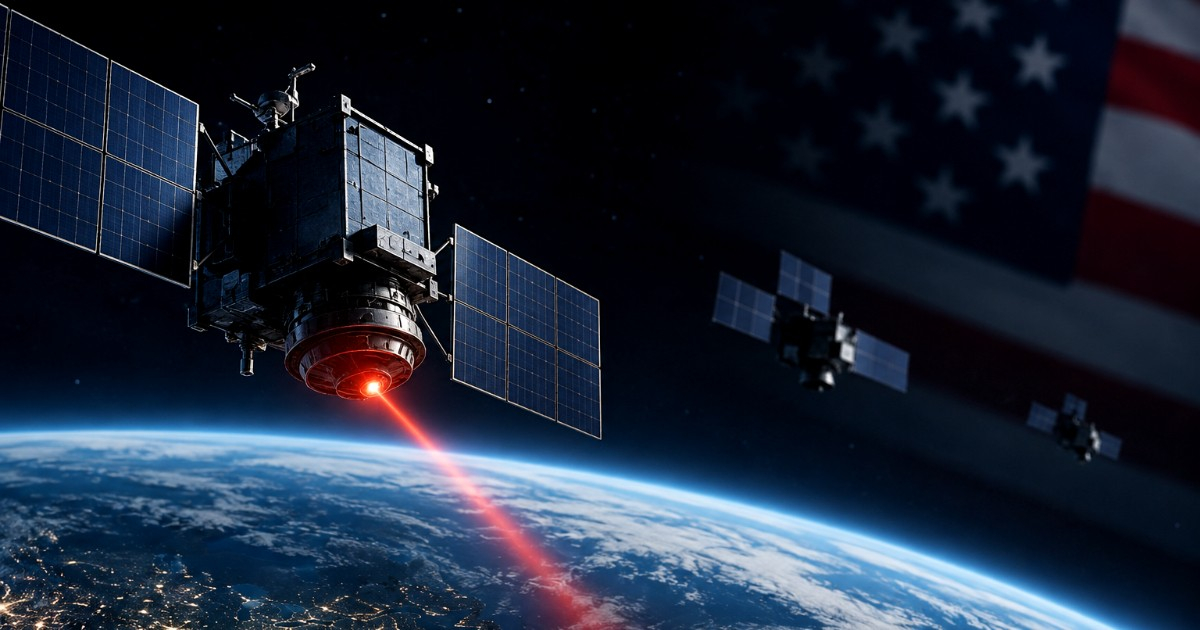
For the first time, the United States has acknowledged the presence of space control weapons in Earth's orbit, marking a significant milestone in the militarization of outer space.
On Monday, during his address at the Air, Space, and Cybersecurity Conference held in National Harbor, Maryland, Air Force Secretary Troy Meink made the announcement. He emphasized the necessity of these orbital weapons to safeguard U.S. forces against potential threats. However, Meink did not disclose specifics regarding the type of systems, the number of devices, or their deployment timeline, as reported by BBC.
General Douglas Schiess, head of space operations for the Space Force, supported Meink's statement, declaring that space has become an active battlefield due to the anti-satellite systems of rival powers.
Capabilities and Strategic Intent
A spokesperson for the Space Force elaborated on these capabilities, explaining, "Space control encompasses the mission areas required to challenge and dominate the space domain, utilizing both kinetic and non-kinetic means to disrupt, degrade, and even destroy adversary capabilities if necessary." The spokesperson added that these capabilities could be employed for both offensive and defensive purposes under combat command directives.
Speculations on the Space Weapon's Nature
The nature of the weapon remains shrouded in mystery, with experts consulted by the BBC admitting limited public knowledge about the technology. Bleddyn Bowen from the Royal United Services Institute (RUSI) in London proposed three potential scenarios: a platform capable of electronic warfare to disrupt radio communications—rendering a satellite "quite useless" without radio links. Another possibility is a kinetic impact vehicle designed to collide with enemy satellites. Lastly, it could be an inspection and capture device akin to China's demonstrated "space tug" capability, where a vehicle approaches, attaches to, and relocates a satellite to a different orbit. Bowen dismissed the kinetic option as less likely due to the high risk of generating space debris.
Geopolitical Tensions with Russia and China
This revelation comes amidst heightened geopolitical tension. The U.S. has been embroiled in conflict with Iran and has repeatedly cautioned Moscow and Beijing against supporting Tehran. Secretary of State Marco Rubio noted in May that "Russia and China, both nuclear-armed states, are aligned with Iran." In this context, the deployment of the space weapon serves as a deterrent signal specifically targeted at these two nations, which have diplomatically united against Washington at the UN.
China responded on Tuesday with a direct warning, urging the U.S. to cease expanding its military capabilities and preparing for warfare in outer space, according to a spokesperson from the Chinese Ministry of Foreign Affairs, as reported by AFP.
Rod Thornton, a professor at King's College London, explained how Russia compensates for its satellite inferiority, "The Russians have ground-based missiles that can be launched into space to target satellites in low Earth orbit. They also possess ASAT missiles that aircraft can launch from high altitudes."
The announced weapon is part of the broader strategy of the Trump administration, which is advancing the "Golden Dome" project—a missile defense shield with a space component, initially estimated to cost $25 billion but potentially reaching $542 billion long-term—and an executive order signed last year expanding the Space Force's role to include offensive functions.
The 1967 Outer Space Treaty prohibits weapons of mass destruction in orbit but does not explicitly address conventional weapons, a legal gray area that major powers have exploited for decades to develop capabilities, making space the new frontier of global rivalry.
Key Questions on U.S. Space Weaponization
What are space control weapons?
Space control weapons are systems designed to assert dominance in the space domain, using both kinetic and non-kinetic methods to disrupt, degrade, or destroy adversary capabilities.
Why is the U.S. deploying weapons in space?
The U.S. is deploying weapons in space to protect its forces from hostile actions and to serve as a deterrent against rival powers like Russia and China.
How does the 1967 Outer Space Treaty relate to current space weaponization?
The 1967 Outer Space Treaty bans weapons of mass destruction in orbit but does not explicitly prohibit conventional weapons, allowing major powers to develop military capabilities in space.