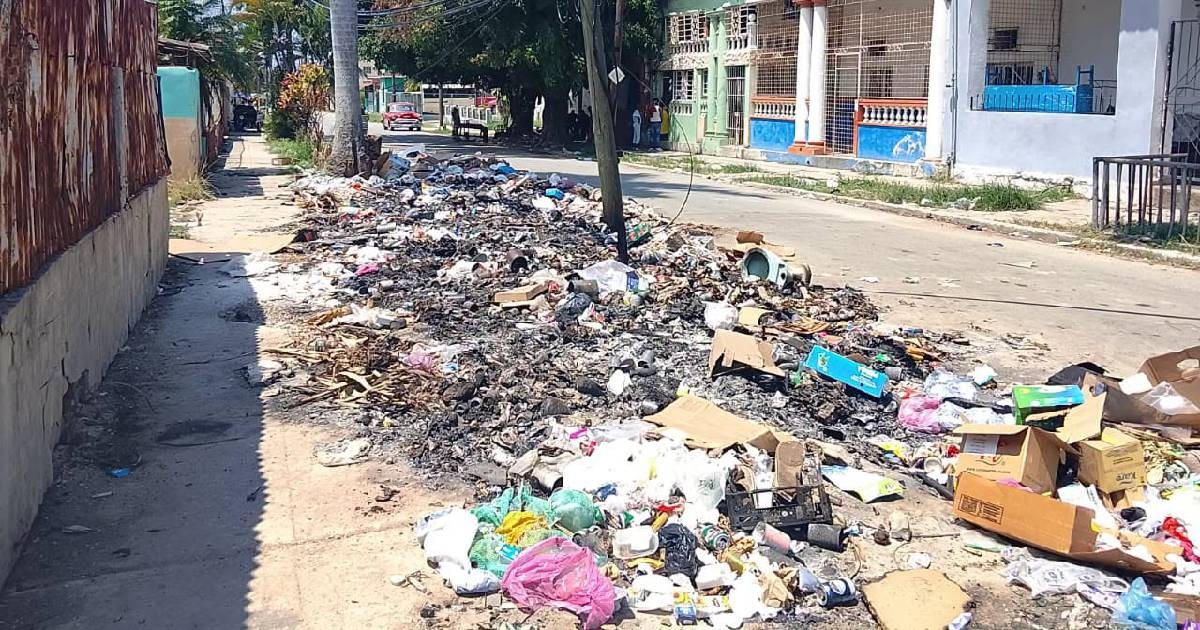
The Cuban Telecommunications Company (ETECSA) issued a plea on social media this week, urging residents not to pile or burn trash near their telecommunication poles, cabinets, and cables. This practice, ETECSA warned, leads to fires and prolonged service outages. However, the Cuban public's response was swift and unanimous: the blame does not lie with them, but with a government that fails to collect the garbage.
A phrase that echoed through countless comments was sharp and ironic: "Should we eat it?" This question reflects years of garbage accumulation on streets and corners, a fleet of garbage trucks halted due to a diesel shortage, and a waste management service that residents of Havana describe as non-existent.
"But I can't eat the trash. It's the government's responsibility to find solutions so the community doesn't resort to burning garbage or damaging electrical and telephone wiring," one user stated emphatically.
Another comment was more direct: "Tell the government to handle the situation and collect the trash. People can't eat waste. I'm not justifying littering, but the state does nothing."
Infrastructure Damage and Service Interruptions
ETECSA's concerns are valid. Fires from accumulated garbage have left entire neighborhoods without service for months. In Santa Fe, a burned cabinet deprived a residential area of landline service for three months. "The cure was worse than the disease," one commentator summarized.
In Tulipán and Mariano, the situation is even more striking: "There's no pole left; the infrastructure hangs from the branches of a burned tree, and this has been reported since March. We're still waiting for restoration."
Systemic Problems with Waste Collection
The issue isn't new. ETECSA had already issued a similar warning in February 2026 regarding the damage caused by burning trash to its facilities, but the situation remains unchanged. In April 2025, a fire in Monterrey destroyed an intelligent cabinet, and in May of that year, another fire in Marianao left around 400 customers without service.
The root of the problem is structural: in February 2026, only 44 of the 106 garbage collection trucks in Havana were operational, a mere 41.5% of the fleet, while the capital produces between 24,000 and 30,000 cubic meters of waste daily. The lack of diesel, deteriorating vehicle conditions, and shortage of spare parts are issues acknowledged by the regime without resolution.
"In Marianao, every corner is a dump," a user wrote. "Havana can't take it anymore," another concluded.
Public Outcry and Government Accountability
Instead of accepting the blame ETECSA placed on them, citizens turned the tables on the state-run company. "That ETECSA message is for the Provincial Government, isn't it?" one user asked. Another went even further: "ETECSA could sue the government for failing to collect the trash."
The public's reaction is part of a recurring pattern seen in recent months: whenever a state entity demands responsibility from the population, the comments section becomes a catalog of accumulated grievances about dysfunctional services. "The people are always blamed for everything," summed up one user succinctly, echoing thousands of others.
Understanding ETECSA's Challenges and Public Response
What is ETECSA's main concern regarding waste near its infrastructure?
ETECSA is primarily concerned that garbage accumulation and burning near its telecommunication installations cause fires and lead to extended service outages.
How have Cuban citizens responded to ETECSA's plea?
Cuban citizens have responded critically, stating that the responsibility lies with the government, which fails to efficiently manage waste collection, and sarcastically asking if they should consume the garbage themselves.
What are the systemic issues contributing to Havana's waste problem?
The systemic issues include a lack of operational garbage trucks due to diesel shortages, deteriorating vehicle conditions, and insufficient spare parts, all of which the government acknowledges but has not resolved.