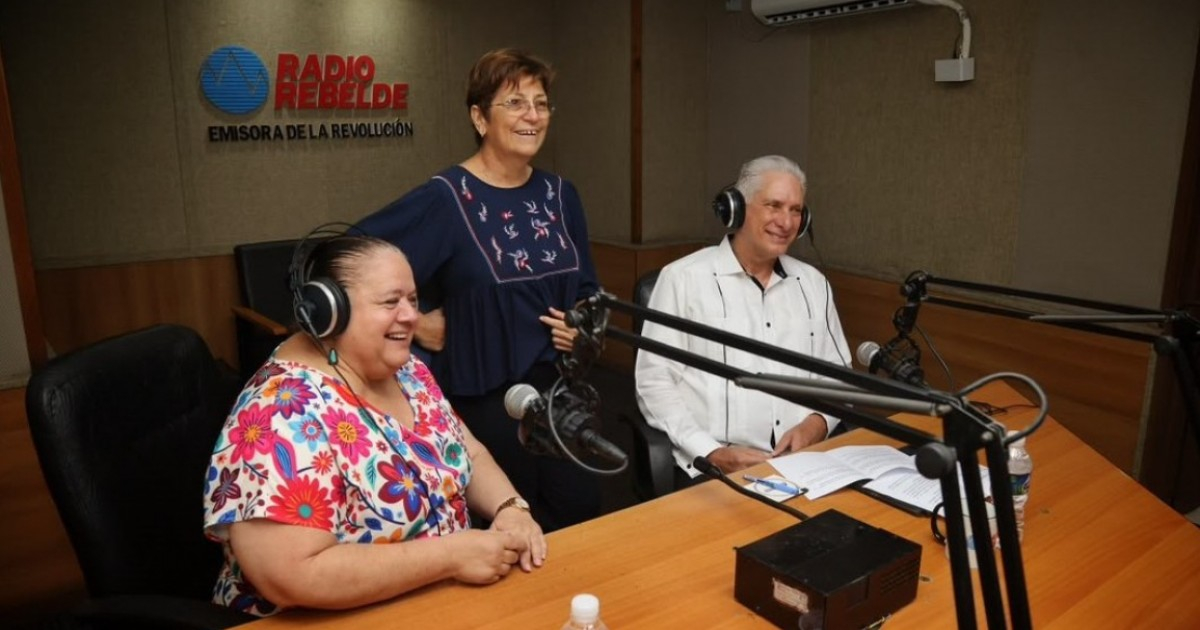
This Wednesday, Cuban leader Miguel Díaz-Canel arrived at the Radio Rebelde studios around 7:00 am to announce the upcoming launch of "Criterio Compartido," a new radio show he will co-host with journalist Bárbara Betancourt.
The official account of the Cuban Presidency on X described the show as "a space for dialogue about Cuba's reality," although details about its premiere or frequency were not provided by the regime.
During his visit, Díaz-Canel toured the station's facilities and engaged with the team from the magazine "Haciendo Radio."
A Strategic Move Amid Crisis
The choice of Radio Rebelde—a station with significant reach and symbolic history within Cuba's state-run system—and a high-profile journalist as co-host appears to be a communication strategy aimed at legitimizing the regime during a time of severe economic and social crisis on the island.
Betancourt, a seasoned figure in Cuban official media, has also worked at Radio Habana Cuba and serves as an advisor, writer, and panelist for the televised "Mesa Redonda." In August, she received the National Radio Award, the highest honor in Cuba's radio sector, and was publicly congratulated by Díaz-Canel in July.
Transition from Digital to Traditional Media
The announcement of "Criterio Compartido" follows Díaz-Canel's quiet departure from his previous venture as a host: the podcast "Desde la Presidencia," launched in March 2024, which produced around 32 episodes.
The last identified episode of that podcast, episode 32, focused on the ETECSA tariff hike and aired in June 2025. Since then, no new episodes have been released, nor has there been any official announcement regarding the podcast's suspension. The project faded away without public explanation.
Now, Díaz-Canel is opting for traditional radio over digital formats, leveraging the production capabilities of the most iconic station within the state-run system.
Increased Media Presence
This year, Díaz-Canel has significantly increased his appearances in official media: he spoke on national television in February and March, met with over 80 representatives of state media, granted interviews to NBC News, RT, and Latin American outlets, and shared his perspective on Cuba's crisis on Dominican television.
The pattern is evident: as Cuba endures its worst crisis in decades—with prolonged blackouts, widespread shortages, and a massive population exodus—the regime intensifies its presence in controlled media to attempt to shape the narrative around the country's situation.
Founded on February 24, 1958, in the Sierra Maestra, Radio Rebelde is considered by the state system as "the first and largest informational station of Cuban Radio." Díaz-Canel's choice of this platform for his new program is no coincidence; it is the most symbolically charged outlet available within the regime's media apparatus.
Understanding Díaz-Canel's Media Strategy
Why has Díaz-Canel chosen Radio Rebelde for his new program?
Radio Rebelde is the most symbolically significant station within Cuba's state-run media system, offering Díaz-Canel a platform with historical and widespread influence to legitimize the regime's narrative during a time of crisis.
Who is Bárbara Betancourt?
Bárbara Betancourt is a veteran journalist in Cuban official media, known for her work at Radio Habana Cuba and as an advisor, writer, and panelist for the televised "Mesa Redonda." She recently received the National Radio Award.
What happened to Díaz-Canel's previous podcast?
Díaz-Canel's podcast "Desde la Presidencia" quietly ended after producing around 32 episodes, with the last known episode airing in June 2025. There was no public explanation or official announcement about its suspension.