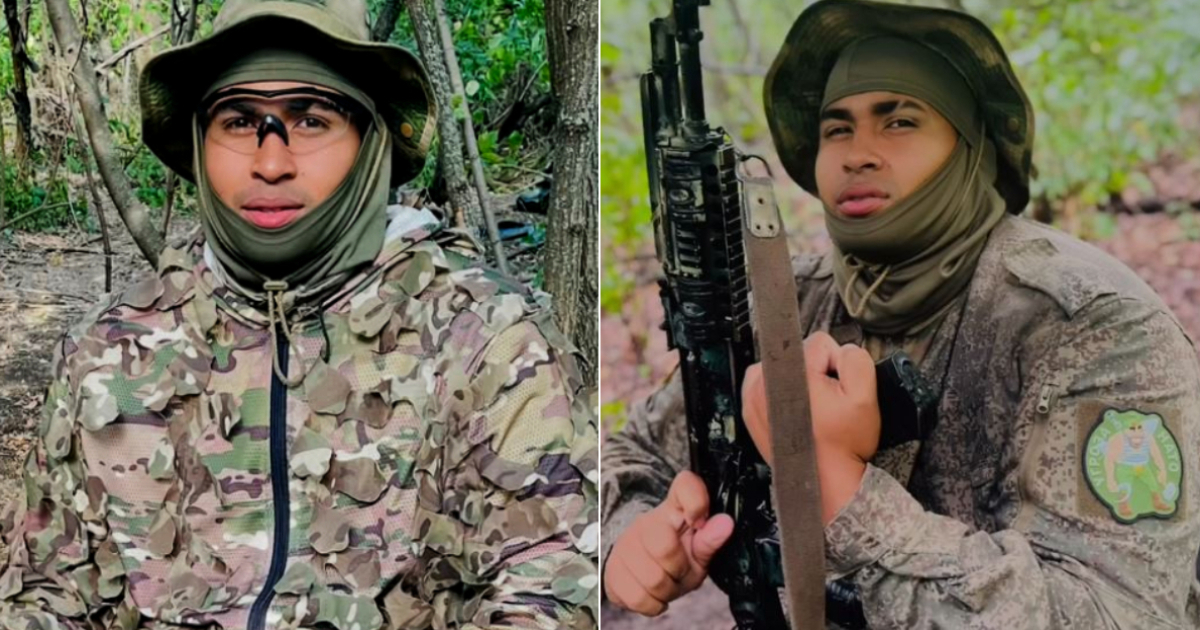
A young Cuban man, who has been documenting his involvement with Russian forces on Instagram over recent months, has responded to an investigation by CiberCuba, revealing his identity and providing a crucial detail that clarifies the timeline of his story.
His name is José Ramón Saroza Ruiz, known online as El Sensei. This 24-year-old from Cienfuegos, according to his Facebook profile, hails from Arimao and is currently residing in Moscow.
Saroza directly addressed the article published by CiberCuba on Facebook, stating, "Don't talk nonsense, I've been in Russia since 2024. Don't connect what I post with my life; social media is one thing, and personal life is another. That's where you're getting confused."
This statement clarifies a previous ambiguity. An Instagram post from April 24, 2026, showed him seemingly on a plane with the caption "I can leave but I will always return," yet this did not confirm that he was migrating to Russia for the first time at that point.
Saroza Ruiz now asserts that he has resided in Russia since 2024.
This information is consistent with earlier posts from the young man. In April, he shared an ultrasound image apparently taken in a Russian-speaking medical setting, dated November 2025.
However, his response does not address the military-related posts that prompted the CiberCuba investigation.
Military Presence on Social Media
Since June, Saroza Ruiz has frequently appeared on Instagram in military attire, wielding weapons, ammunition, and the Russian flag. His posts also include references to the so-called SVO—Russian initials for the invasion of Ukraine—and messages related to the perils of war.
In September, he publicly explained his reasoning: "Sometimes there aren't many options, and you have to jump at the first one available, even if it's the riskiest."
He claimed that his actions were motivated by "the well-being of my family."
Unverified Citizenship Claims
Some reactions on Facebook to CiberCuba's report provided further insights into Saroza Ruiz's situation.
A Cuban identified as Esneidi Matos, whose profile states he lives in Moscow, claimed that the young man already held Russian citizenship before joining the military.
"He is in the Russian ranks of his own accord; he was a Russian citizen before picking up a weapon," Matos commented. CiberCuba has not independently verified this claim. As of this writing, Saroza Ruiz has not responded to requests for comment from this publication.
If confirmed, this detail would better explain his previous activities in the country and clarify his legal status within the Russian forces.
Voluntary Enlistment or Coercion?
The publication also elicited responses from several Cubans living in Russia, emphasizing that not all foreign fighters are coerced or deceived into combat.
One notable testimony came from Yudanis Ramírez, who claims to reside in Ryazan and is currently under his second contract.
"I've been five months into my second contract, one with the Russian Federation and this one with Русб [...] no one can judge my decisions; it's my choice." CiberCuba has not been able to verify the contracts mentioned by Ramírez.
In another comment, the Cuban explained how, in his experience, the process can unfold: "Cubans don't need a visa to travel to Russia [...] once here, you just need to find a military office and go through the contract process."
While this account offers insight, it remains Ramírez's personal testimony and does not determine how many Cubans have used this method.
Ryazan, where he claims to live, has been mentioned in reports and investigations since 2023 regarding the recruitment of Cubans by Russian forces. There, selection points for foreigners and groups of Cuban nationals have been documented before their military involvement.
Another Cuban, Carlos Javier Pérez Moreira, whose profile places him in Ryazan, joined the discussion with a similar statement: "Anyone who goes to war does so of their own free will."
However, there is no evidence to suggest that Pérez Moreira has served in the Russian forces.
Diverse Experiences and Stories
The comments stand in contrast to other accounts from Cubans over the past three years, who have reported being deceived, promised false job offers, pressured, or faced conditions different from those initially presented before ending up in warfare.
These diverse realities are not necessarily mutually exclusive.
Investigations have revealed various profiles among foreigners recruited by Russia: individuals who claim to have been misled and others who admit to knowingly signing military contracts for money, residency, citizenship, or other reasons.
Even among the reactions to the CiberCuba publication, the human cost of these decisions emerged. A user named Jorje Dudefaye wrote, "In the end, they kill them like my brother."
CiberCuba has yet to identify the brother mentioned or verify the circumstances of his alleged death.
Saroza Ruiz's response provides a clearer picture of his story: El Sensei did not necessarily arrive in Russia just before appearing in uniform; instead, he claims to have lived there since 2024.
What's documented on his social media is that by 2026, he began appearing armed and in Russian military attire, presenting his decision publicly as a risky move linked to his family's welfare.
Subsequent reactions add another dimension to the phenomenon: some Cubans in Russia openly assert that their enlistment is voluntary and even outline ways to secure contracts once in Russian territory.
To what extent this mechanism accounts for the continued flow of Cubans into Russian forces remains to be verified and requires further evidence.
Understanding Cuban Involvement with Russian Forces
Why did José Ramón Saroza Ruiz move to Russia?
Saroza Ruiz claims his decision was driven by the well-being of his family and suggests that there were limited options available to him, leading him to take the risk of moving to Russia.
Is José Ramón Saroza Ruiz a Russian citizen?
There are unverified claims from a Facebook user that Saroza Ruiz held Russian citizenship before joining the military. However, this has not been independently confirmed by CiberCuba.
How do Cubans join the Russian military?
According to some testimonies, Cubans do not need a visa to travel to Russia and can find a military office to process a contract for military service once in the country.