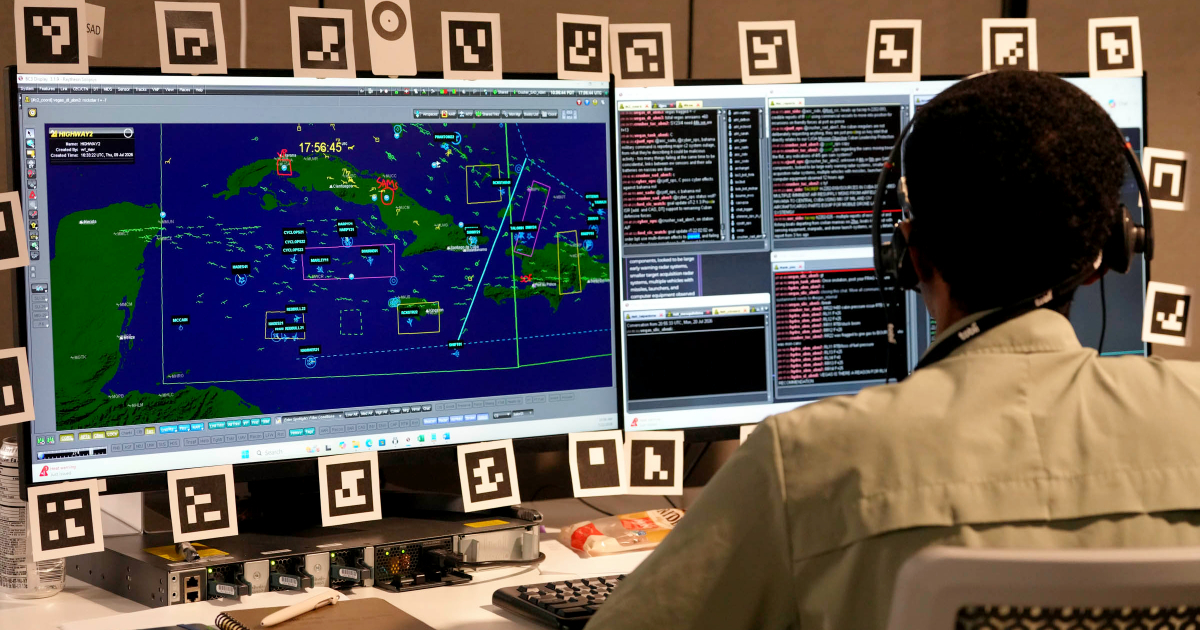
Cuba has become a focal point in a U.S. military experiment using artificial intelligence tools and the involvement of the Space Force, as evidenced by several official photographs published on the U.S. Space Force's website.
These images are from the Decision Advantage Sprint for Human-Machine Teaming (DASH), an experiment spearheaded by the U.S. Air Force Department. The goal is to integrate AI into command and control systems to handle vast amounts of data, thereby speeding up military decision-making processes.
Military Experiment Highlights Cuba
In numerous photos from the 2026 trials in Las Vegas, Cuba prominently appears on the maps displayed on monitors, alongside Florida, the Yucatán Peninsula, Hispaniola, and other Caribbean areas. Symbols, markers, lines, and zones used in the experiment are layered over Cuba and its surroundings.
This is not an isolated occurrence; several official images depict the same geographical setting as participants engage with the systems or receive demonstrations of their functions.
Advanced Battle Management System's Role
The U.S. authorities provide crucial insights into what the screens reveal through the captions accompanying these images. In one photo, Colonel John Ohlund, director of the Advanced Battle Management System (ABMS) multifaceted team, is seen explaining a battle management application to a visitor, with Cuba prominently displayed on a Caribbean map.
The Air Force clarifies that the AI tools were tested in an unclassified environment using a modular architecture designed for later secure transfer to classified combat networks.
Another image shows two air battle managers operating systems. Official descriptions note the experiment utilized U.S. government-owned digital infrastructure to facilitate the transition of validated capabilities to classified networks utilized by joint forces.
AI's Impact on Military Operations
Led by the ABMS team from the Air Force Department, in collaboration with the Air Force Research Laboratory (AFRL), the U.S. Space Force, and the 805th Combat Training Squadron, DASH demonstrated that the synergy between humans and machines could significantly accelerate the joint attack chain.
AI would manage intensive data processing, enabling operators to quickly identify pertinent information and make decisions faster. "Our aim is to rapidly equip the joint force with the most advanced capabilities," explained Lieutenant Colonel Corey Ellsworth, ABMS team integration lead.
Geopolitical Tensions and Military Exercises
The frequent appearance of Cuba in these maps gains importance against the backdrop of heightened tensions between Washington and Havana following the U.S. military operation on January 3rd, which resulted in the capture of Nicolás Maduro and Cilia Flores in Venezuela.
President Donald Trump claimed that Cubans died while protecting Maduro, directly linking the Havana government to the security apparatus that supported the Venezuelan leader. On the same day, Trump labeled Cuba as a "failed nation" and signaled future discussions on the island's situation.
In parallel, the U.S. Secretary of State Marco Rubio presented the Venezuelan operation as proof that Trump's threats of action against perceived threats are genuine. Havana responded by militarizing its rhetoric and preparing defensive measures, while the U.S. increased pressure on the Cuban regime.
Military Presence and Strategic Importance
The DASH experiment is not the first U.S. test of new military technologies this year involving Cuba. In late April, the U.S. Navy Southern Command and Fourth Fleet conducted FLEX2026 in Key West, Florida, integrating AI, long-endurance drones, unmanned maritime vehicles, aerial platforms, helicopters, and the USS Wichita.
These maneuvers tested a chain from surveillance and target detection to tracking, interdiction, and potential lethal response. The exercises took place just 90 miles from Cuba, placing the island within the immediate operational range of these new capabilities.
Guantanamo Bay Naval Base has also gained prominence. In May, Southern Command head General Francis L. Donovan visited the base to assess security and operational readiness, defining it as a "vital operational and logistical center" for U.S. operations in the hemisphere.
Strategic Developments in the Caribbean
As the U.S. accelerates its military modernization, Secretary of the Air Force Troy Meink publicly acknowledged for the first time that the U.S. has "space control" weapons deployed in orbit. While there is no direct link between these space weapons and DASH or the Cuba maps, the key takeaway is the rapid development of U.S. capabilities in AI, command and control, autonomous systems, and space operations, all while the Caribbean remains central to Washington's military strategy.
Key Questions about U.S. Military Exercises Involving Cuba
Why is Cuba featured prominently in U.S. military experiments?
Cuba's prominence in U.S. military experiments like DASH is part of a broader strategy to test AI and command systems in realistic geographical settings, given the island's proximity to U.S. interests in the Caribbean.
What is the significance of the DASH experiment?
DASH aims to integrate AI into military decision-making processes, enhancing the speed and efficiency of command operations and showcasing the collaboration between humans and machines.
How does the U.S. view Cuba in its military strategy?
Cuba is seen as a critical geographical area in the U.S. military's strategy, especially in light of its proximity to key operations and its historical ties with adversarial nations like Venezuela.