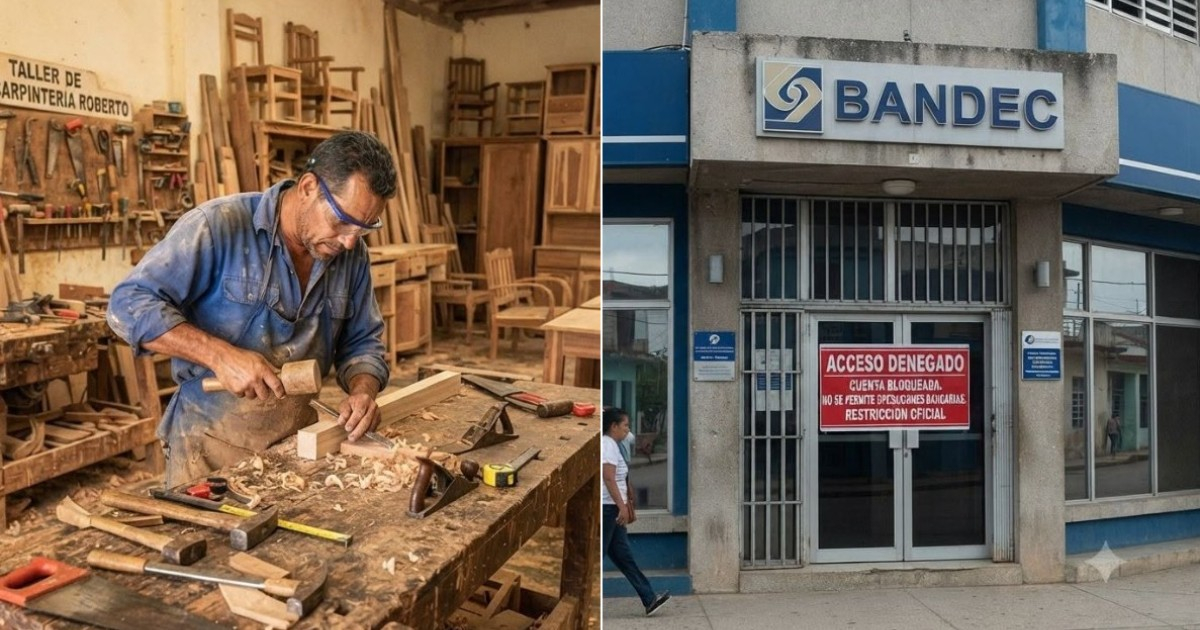
Liudys Carmona Calaña, a Cuban author living in the Isle of Youth, has taken to Facebook to express her frustration over an issue her husband is facing. Despite being a registered artist with the Cultural Assets Fund, he is unable to withdraw cash from a BANDEC account where ETECSA deposited funds as payment for furniture he crafted for the telecommunications company's outlets.
Her husband legally fulfilled a contract with ETECSA, and the payment was deposited at BANDEC's branch in the special municipality. However, when he attempted to access the money, bank officials turned him away with a bureaucratic excuse: he is not considered self-employed and is part of a state entity.
Carmona Calaña expressed her frustration, writing, "Working honestly, signing a legal contract, fulfilling obligations to a state entity like ETECSA by crafting furniture for a significant sum... What good is it if the bank shut its doors when it's time to collect payment?"
The bank justified its refusal by citing a policy that supposedly benefits only those selling goods for the public good. Carmona Calaña challenges this reasoning by questioning if ETECSA serves the people, then who benefits from her husband's work?
"Why can't a creator who legally fulfills his duties access his own money, which is essential for his family's sustenance and future investments?" she questioned. "Money earned legitimately, not stolen, meant for further production and supporting our family," she emphasized.
Adding to her frustration, Carmona Calaña noted that BANDEC's management openly acknowledges the contradiction without offering solutions. "Bank executives calmly admit the reality: they know entrepreneurs and suppliers only accept cash, forcing us to resort to the informal market, where converting transfers to cash incurs a 35% to 40% fee. It's utter madness!" she exclaimed.
She also criticized the government for talking about "national production and productive linkages" while the system itself stifles workers, pushing them toward illegality because "the bank denies them their own money."
The post sparked a wave of angry comments. One user remarked, "Your husband's situation is due to a law made by someone sitting comfortably with a full stomach, not thinking of the people. It's that simple."
Another user added, "In the end, it's all a business benefiting only those in power. They create the laws... because behind them lies a trap that lines their pockets."
A third commenter was more blunt: "Everything is a barrier, and the saddest part is that those who truly work and strive for their families have no rights, not even to their own money."
One user stated, "The Cuban regime is designed to steal from the people, with entities, companies, and ministries acting as parasites feeding off others' sacrifices."
"There are so many obstacles for artists, entrepreneurs, and self-employed workers that they are suffocated," an independent worker concluded.
This situation, like that of the artisan from the Isle of Youth, highlights the failure of Cuba's enforced banking system.
In the Isle of Youth, an article published in July by the official newspaper Victoria acknowledged this, describing an atmosphere of "anxiety and helplessness" among residents.
According to the publication, bank branches only allowed withdrawals of up to 2,000 pesos per transaction, down from a previous limit of 5,000 CUP. Meanwhile, private businesses responded with phrases like "I don't accept transfers," "I've reached my daily limit," or "due to power outages, I can't receive messages or confirm transfers."
Due to banking restrictions, the informal market for converting transfers to cash has expanded nationwide, with fees ranging from 30% to 50% depending on the province. In Santiago de Cuba, it was reported that transferring 1,000 pesos results in only 600 pesos in cash received.
In provinces like Sancti Spíritus, less than 10% of private businesses regularly accept transfers.
Even the official press has admitted the failure of transfer payments, attributing it to cash shortages, power outages, and inadequate banking infrastructure.
Understanding Cuba's Banking Challenges
Why is there a cash shortage in Cuba?
Cuba faces a cash shortage due to economic mismanagement, insufficient banking infrastructure, and frequent power outages, which disrupt banking operations.
What challenges do Cuban entrepreneurs face?
Cuban entrepreneurs struggle with accessing their funds, navigating bureaucratic hurdles, and dealing with an informal market that imposes high conversion fees.
How does the informal market operate in Cuba?
The informal market in Cuba provides cash by converting bank transfers, often charging fees between 30% and 50% due to the scarcity of cash and banking limitations.