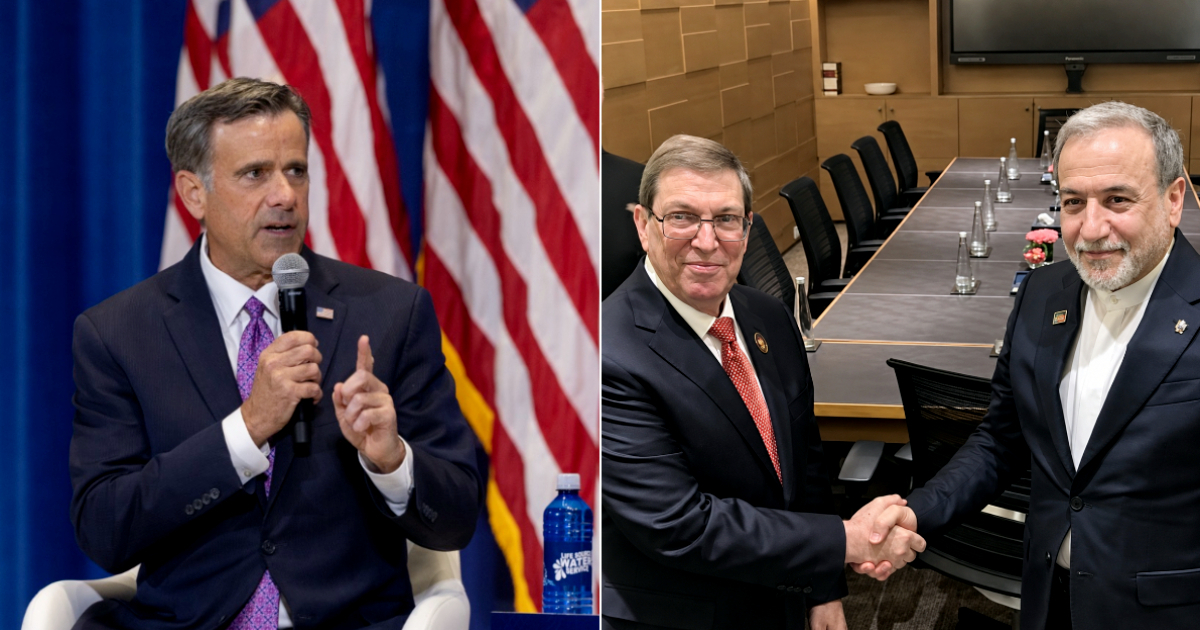
Cuban Foreign Minister Bruno Rodríguez Parrilla engaged in what he described as a "productive meeting" with his Iranian counterpart, Abbas Araghchi, during the BRICS Summit held in India. This meeting took place amid rising tensions between Havana and Washington and the ongoing armed conflict involving the United States and Iran.
On social media, Rodríguez shared that he also met with the foreign ministers of Brazil, Mauro Vieira; India, Subrahmanyam Jaishankar; and Thailand, Sihasak Phuangketkeow.
"We emphasized the need to continue strengthening bilateral ties and to harness the political and economic potential of the BRICS Group," stated the Cuban minister.
The U.S. "Siege" and Sanctions
Rodríguez seized the opportunity to criticize what he termed as an "energy siege," the "extreme tightening of the blockade," and the "secondary sanctions" imposed by the United States. He claimed these measures are inflicting "collective punishment" on the Cuban people.
Among the meetings highlighted by the foreign minister, the one with Araghchi holds particular significance given the current geopolitical landscape.
Geopolitical Implications of the Iran-Cuba Meeting
Iran is currently at odds with the United States, and Washington has expressed concerns over Tehran's collaboration with Havana, viewing it as a national security issue in the Western Hemisphere.
For months, the Trump administration has warned about Cuba being used as a platform for operations by strategic U.S. adversaries, namely Russia, China, and Iran.
In August, Secretary of State Marco Rubio directly accused the Cuban regime of operating as a base for these countries just 90 miles from U.S. shores. Consequently, Washington imposed sanctions on five entities and eight officials linked to importing foreign weaponry and military cooperation with U.S. adversaries. "We will not tolerate it," emphasized the Secretary of State.
Iranian Drones and Cuba's Military Acquisitions
The relationship between Havana and Tehran became even more sensitive following revelations about Cuba acquiring military drones from Russia and Iran. In May, Axios reported that, according to classified U.S. intelligence, Cuba had acquired over 300 military drones from these countries since 2023.
Days before these revelations, CIA Director John Ratcliffe visited Cuba to meet with the head of the regime's Intelligence Directorate. He warned that Cuba "cannot continue to serve as a platform" for adversaries to advance hostile agendas in the region.
Two days after the visit became public, Axios disclosed U.S. intelligence assessments about Cuba's military drone acquisitions, adding a concrete dimension to the CIA director's warnings.
Expanding Iran's Influence in the Hemisphere
Washington's concerns extend beyond Cuba. For years, the U.S. has monitored Iran's political, economic, and military expansion in Latin America, particularly its close ties with Venezuela. The U.S. military operation that led to the downfall of Nicolás Maduro on January 3 altered this scenario, reinforcing the Trump administration's resolve to curb adversarial powers' influence in the Western Hemisphere.
Under this context, any deepening of ties between Havana and Tehran assumes a dimension beyond typical bilateral relations, highlighting the strategic importance of these interactions for Washington.
The Limits of Cuba's Aspirations with the BRICS
Amid these dynamics, Cuba is striving to enhance its integration into the BRICS as part of a broader strategy to expand its political and economic alliances outside the U.S. orbit. Currently, a partner country, Cuba aspires to full membership for greater political influence and participation in the bloc's decisions.
However, these ambitions faced a setback when Russia confirmed that no new full memberships were on the table, despite Cuba's lobbying efforts for such support, particularly from Moscow.
As of now, Rodríguez Parrilla has not disclosed specifics about his discussions with Araghchi. The Cuban foreign minister grouped the meeting with the Iranian alongside talks with other foreign ministers, merely noting discussions on strengthening bilateral relations and exploring the "political and economic potential" of the BRICS.
While there is no public evidence suggesting that Rodríguez and Araghchi discussed military cooperation, Iranian drones, or current hostilities between Tehran and Washington, the context makes the meeting more than a routine bilateral exchange.
Araghchi represents a government currently in military conflict with the United States, while Rodríguez Parrilla represents a regime that Washington views as part of a hemispheric network of cooperation with its key strategic adversaries.
Despite Cuba's attempts to leverage BRICS relationships for political and economic alternatives, recent efforts to elevate its status within the group have encountered limitations, even among its allies.
None of this confirms what specific topics were on the table during the "productive meeting" between Rodríguez and Araghchi. However, it explains why, under the current circumstances, the meeting is unlikely to be seen in Washington as merely diplomatic.
U.S. Concerns Over Cuba-Iran Relations
Why is Washington concerned about the Cuba-Iran relationship?
Washington is worried because Iran, a strategic adversary, is strengthening its ties with Cuba, which could pose security risks in the Western Hemisphere. These concerns are heightened by Cuba's potential use as a platform for adversarial operations close to U.S. territory.
Has Cuba acquired military drones from Iran?
Reports suggest that Cuba has acquired over 300 military drones from Russia and Iran since 2023, according to U.S. intelligence. This acquisition has intensified U.S. concerns over military capabilities near its shores.
What role do the BRICS play in Cuba's strategy?
Cuba seeks to deepen its integration with the BRICS as part of a strategy to diversify political and economic alliances beyond the U.S. sphere. Full membership in the group would enhance its political influence and participation in decision-making.