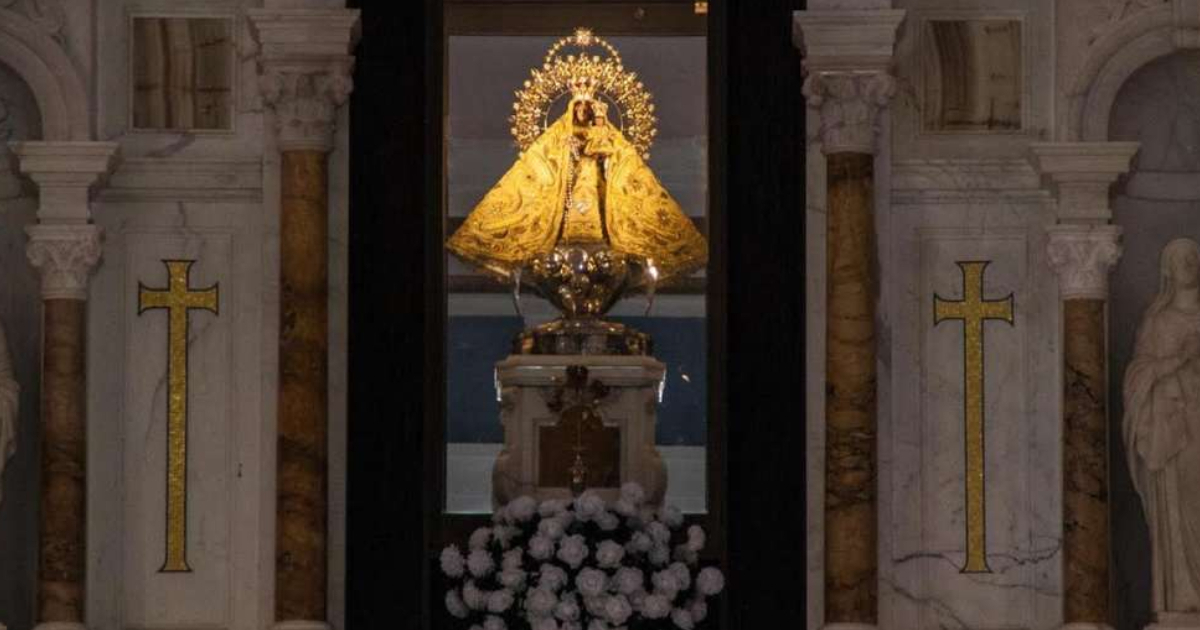
Cuban poet and improviser Juan Carlos García Guridi recently shared a set of sonnets on his Facebook page, titled "To Our Lady of Charity," which includes "Devotion," "Faith," and "Plea." This collection transforms the devotion to Cuba's patron saint into a collective call for health, freedom, and hope.
The post was shared just before Tuesday, the 8th, a day when Cubans honor the Virgin of Charity of El Cobre, amidst an ongoing humanitarian crisis.
García Guridi revives the myth of the Three Juans, using it as a metaphor for contemporary Cubans. In "Devotion," he writes, "Rowers who number nearly eleven million / bring the Virgin of Charity to every corner." This poignant number contrasts with Cuba's actual population, which dropped to 9.43 million by the end of 2025, according to the National Office of Statistics and Information.
This population decline is primarily driven by an exodus, resulting in negative migration rates of 251,221 in 2024 and 245,264 in 2025.
In "Faith," the poet asks the Virgin for what the regime has failed to provide: "I will only ask for what is necessary: / Health and freedom! - never privilege -." The sonnet grounds the poem in the sacred geography of Cuban devotion — "In Nipe as in your Sanctuary / I wish to place my Faith - the faith I have in you -."
The climax arrives in "Plea," where the poetic voice shifts from contemplation to an urgent supplication: "Come with the Three Juans to my shore, / my shore, which is the same as outside... / Do not forsake the poor who awaits you / with your Child, your mantle, and your boat." Before the final verse, García Guridi writes, "Not adrift... I don't want you like that," a reflection of a nation where power outages last over 20 hours a day in some areas and where 94% of the population lives in extreme poverty, according to the Cuban Observatory of Human Rights.
The poet concludes with a powerful supplication that resonates with the entire island: "Save us with your warrior spirit; / Cuba needs you, Holy Virgin."
This poem is the latest in a series of socially critical compositions García Guridi has released throughout 2026. In July, he published "I ASK," featuring lines like "What have they done to us? I ask / as we lose day by day / our dignity, our joy." At the end of August, a décima espinela with photographs highlighted the accumulation of waste in Bejucal, Mayabeque, ending with "that we have become / a country of garbage."
The day before the Marian triptych, he voiced support for journalist José Gabriel Barrenechea, sentenced to six years in prison for participating in a pot-banging protest in Encrucijada, Villa Clara, a sentence upheld by the Supreme People's Court on July 28, 2026.
Born in Batabanó, Mayabeque, in 1968, García Guridi is a literary researcher with over a dozen publications on décima and Cuban popular poetry. He is a member of UNEAC and part of the Ala Décima Group. In August, he shared the poem "Catharsis" with the verse: "Silently enduring / is no medal of honor: / A poet who remains silent / dies, but of silence."
Cuba's Current Challenges and Cultural Responses
Who is Juan Carlos García Guridi?
Juan Carlos García Guridi is a Cuban poet and literary researcher known for his socially critical compositions. He has published over a dozen books on décima and Cuban popular poetry.
What is the significance of the Virgin of Charity in Cuba?
The Virgin of Charity of El Cobre is the patron saint of Cuba, symbolizing hope, protection, and unity for many Cubans, especially during times of crisis.
What are the themes of García Guridi's recent works?
His recent works focus on social criticism, emphasizing issues like the loss of dignity, freedom, and the humanitarian crisis in Cuba.
How has Cuba's population changed in recent years?
Cuba's population has declined due to significant emigration, with the population dropping to 9.43 million by the end of 2025.