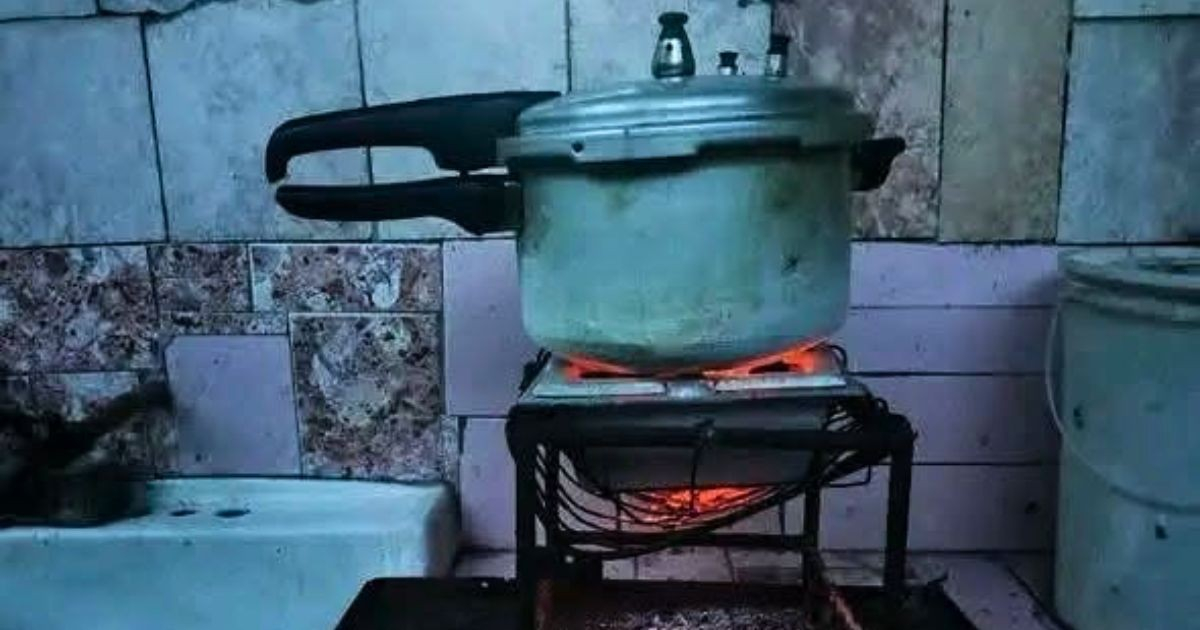
This past Sunday, José Poveda Cruz, a writer from Holguín, shared a poignant piece on Facebook called "Manual for Lighting Charcoal," using the act of igniting a stove as a metaphor for the civilizational backslide currently affecting Cuba.
The spark for Poveda's commentary was an article in a national Cuban newspaper that earnestly detailed the method of lighting a charcoal fire. Poveda refers to it with barely restrained irony, noting, "The journalist approaches it as if unveiling a new survival discipline." The fact that a state-run outlet in the 21st century feels compelled to explain how to start a fire speaks volumes about the nation's condition, perhaps more than any official statistic could.
Describing the process with surgical precision and a biting humor, Poveda writes, "Lighting charcoal today requires becoming some sort of sorcerer, alchemist, or digital prestidigitator. First, there's the match, if available. Then the matchbox, if it works. Followed by small pieces of paper, bits of plastic, or a scrap of cardboard salvaged from who knows where, leading to that tiny flame, watched with disproportionate hope that it will endure."
The Stark Reality of Cuban Daily Life
Poveda acknowledges that even in hardship, there are levels of privilege: "The luckier ones still have gas and can procure it somehow." For the rest, the day's pressing question isn't about what's for dinner, but whether it can be cooked at all: "If the charcoal doesn't catch, there will be no lunch. And without lunch, having a pot, some rice, tubers, or whatever scant foods have made it to the kitchen doesn't matter. Household technology boils down to a primal question: will there be fire?"
Economic Struggles and Resource Scarcity
The bleak backdrop to this story involves the state-owned CUPET halting liquefied gas distribution indefinitely in Santiago de Cuba and the eastern provinces since January 2026. Power outages frequently surpass 20 hours in many areas, with a record-breaking power deficit exceeding 2,400 megawatts reported in August.
The price surge in charcoal, the de facto domestic fuel for millions, is staggering, rising from 900-1,400 pesos per sack in late 2024 to between 3,200 and 5,000 pesos by 2026, while the average Cuban earns just over 7,000 pesos monthly. Ironically, Cuba ranked as the ninth-largest global exporter of charcoal in 2023, with exports valued at $61.8 million, yet its citizens struggle to light their stoves.
Survival Tactics in a Crisis
This scarcity has spawned an informal industry of survival tutorials on social media. Earlier this month, social media influencer Suramia Castro went viral with a video demonstrating how to reuse charcoal by submerging it in water to extinguish it and then drying it in the sun, which garnered over 537,000 views.
Meanwhile, authorities have responded by confiscating the output of artisanal charcoal producers. In August, a forestry worker in Camagüey reported that officials, accompanied by police, seized his entire production, leaving him without livelihood.
Poveda, who remarked in July that in Cuba "even the most basic necessities seem like luxury items," draws on Homer to conclude his narrative: ancient heroes crossed seas and battled monsters, yet no epic was ever penned about lighting charcoal. "Perhaps because for them, fire was still a certainty. For us, it has become an achievement."
His final reflection could serve as an epitaph for six decades under dictatorship: "First, we discovered fire; then we invented progress; and now we are learning once more how to light it."
Understanding the Crisis of Charcoal Shortages in Cuba
Why is lighting charcoal a significant issue in Cuba?
Lighting charcoal has become symbolic of the broader resource scarcity and economic struggles faced by Cubans. The lack of basic utilities like gas and electricity has made charcoal a critical, yet increasingly unaffordable, household necessity.
How are Cubans coping with the shortage of cooking fuel?
Cubans are turning to innovative methods and social media tutorials to manage the shortage. Techniques such as reusing charcoal by extinguishing it in water and drying it have gained popularity, highlighting the inventive survival tactics employed by many.
What actions have the authorities taken in response to the charcoal crisis?
In response, Cuban authorities have been seizing the production of artisanal charcoal makers, further complicating the situation for those reliant on this fuel source for their livelihoods and daily needs.