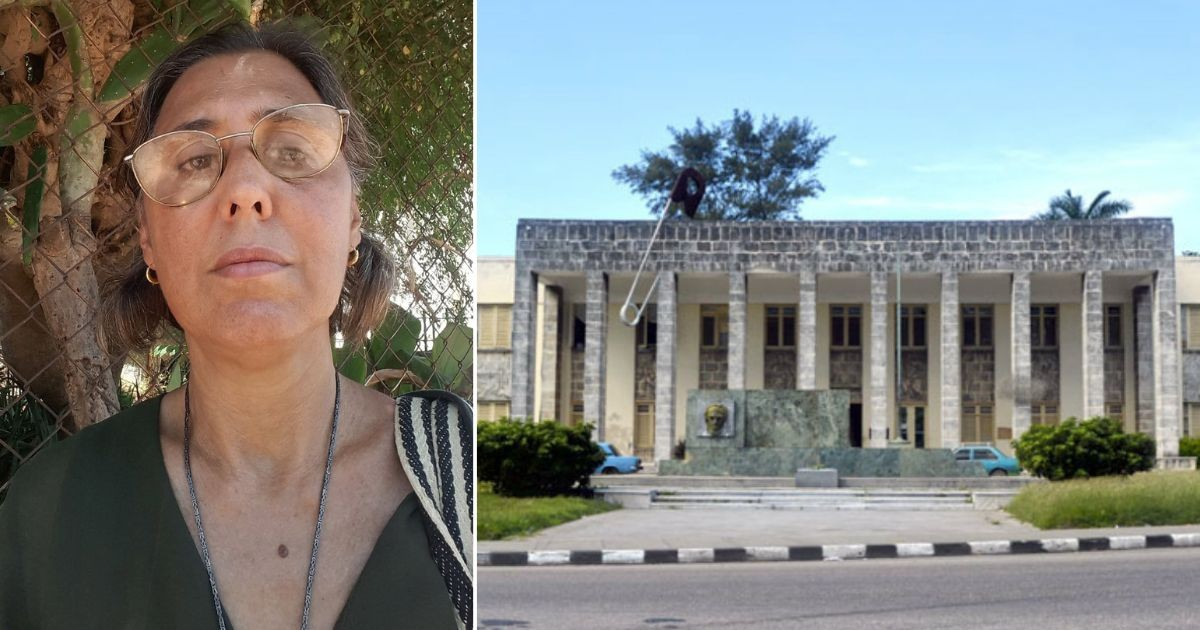
Professor Natacha de la Torre Fariñas has publicly stated that her removal from teaching at the San Alejandro Academy is due to her outspoken criticism of Cuba's political and social landscape. She believes her politically critical stance has made her a target.
In an extensive letter shared on Facebook on Saturday, De la Torre addressed Culture Minister Alpidio Alonso Grau, though she expressed doubt that her concerns would be met with "understanding or empathy" from him.
Central to her letter is the removal of a subject she had taught for years, which she sees as a calculated effort to push her out of the institution voluntarily. "They're sidelining me again, hoping I'll leave on my own to spare them any blame," she wrote, recalling how her department head once bluntly told her to "leave."
Political Inadequacy and Professional Marginalization
De la Torre was explicit about the reasons she believes are behind her marginalization, stating, "I'm being pushed aside because they refuse to see or hear. I've become the discordant note. I'm 'politically inadequate.'" She described the culmination of this situation as the loss of the subject she had taught for many years, remarking, "Today, they take away the subject I've taught for so long because I don't fit into their celebration."
Her connection to San Alejandro goes back many years. When Psychology was removed from the curriculum, she began teaching Didactics while continuing to advise students needing psychology knowledge for theses and other projects. Despite her dedication, she once had to work in hallways due to a lack of a designated space.
Highlighting Systemic Issues
De la Torre linked her current conflict to her refusal to hide the challenging conditions faced by educators. She cited low salaries, transportation difficulties, lack of water and electricity, and personal expenses for phone and internet as major issues. "I don't want tips; I don't want charitable handouts. I want my salary; a dignified compensation for my work," she asserted.
She made it clear she has no intention of abandoning teaching due to these challenges: "I refuse to work when I haven't slept or when I have to choose between having water or going to San Alejandro. But there's no reason for me to leave teaching. There is, however, a reason to state that Cuba needs a radical change."
Systemic Failures and Personal Resistance
The letter also included strong criticism of the Cuban political system, challenging the notion that leaders and institutions can act as owners of the spaces they manage. She specifically mentioned Raúl Castro, Miguel Díaz-Canel, and Alpidio Alonso. She claimed that the academy wants her to fabricate reasons, like an illness, when she can't attend work, to avoid creating dissonance and to "be part of the lie."
De la Torre concluded her letter by directly addressing the Culture Minister: "I stand with reason. You, Minister Alpidio, stand with force."
Academic and intellectual spaces in Cuba have long been targets of censorship, pressure, and retribution against educators, artists, and thinkers who voice criticism of the Cuban regime. In January, for instance, professor and playwright Roberto Viña Martínez reported being expelled from institutions where he taught after making critical social media posts. Two months later, architect and professor Abel Tablada de la Torre was dismissed from CUJAE following critiques of the country's situation and university system conditions.
Understanding the Challenges of Academic Freedom in Cuba
Why was Natacha de la Torre Fariñas removed from teaching?
Natacha de la Torre Fariñas was removed from teaching due to her critical stance on Cuba's political and social issues, which she believes made her politically incompatible with the institution's environment.
What systemic issues did De la Torre highlight in her letter?
De la Torre highlighted several systemic issues, including low salaries, transportation challenges, lack of water and electricity, and the personal costs educators must incur for phone and internet access.
How did the Cuban government respond to other educators with similar criticisms?
Other educators, like Roberto Viña Martínez and Abel Tablada de la Torre, have faced expulsion from teaching positions after expressing critical views on social media and other platforms.