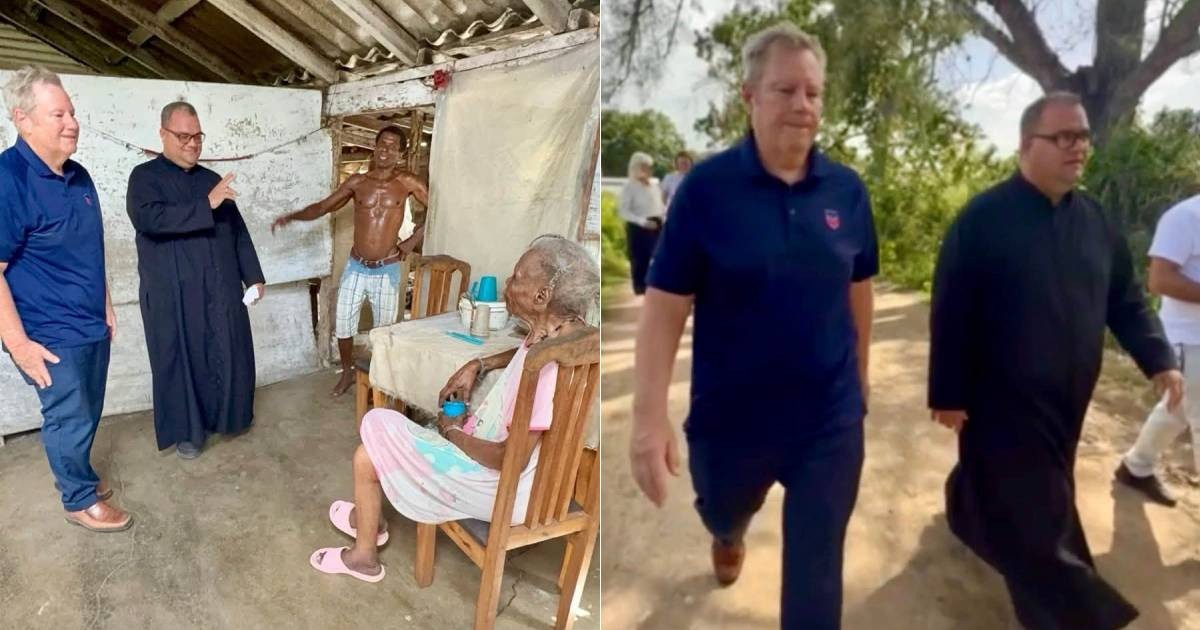
Mike Hammer, head of the U.S. diplomatic mission in Cuba, paid a visit to various communities in Villa Clara this past Sunday. He personally stepped into the homes of several vulnerable families who were recipients of humanitarian aid sent by the Trump Administration.
Hammer was joined by his wife, Margret, and members of the Embassy team, as they toured Quemado de Güines and the Cotorra neighborhood, according to social media updates from the U.S. Embassy in Cuba.
Photographs released from the visit show Hammer engaging in conversations with elderly residents inside homes that are visibly in disrepair. In one poignant image, he is pictured with an elderly man sitting on a fragile wooden structure, gently touching the man's face during their interaction.
Support from the Church and Local Volunteers
"In Quemado de Güines and the Cotorra neighborhood, we visited some of those who received the humanitarian aid sent by the Trump Administration. Cáritas is doing an outstanding job under challenging conditions to reach the most vulnerable," the diplomatic office stated.
Hammer also made a stop at the La Purísima Concepción parish, where part of the aid is stored awaiting distribution. He expressed gratitude to the parish priest Andy Acosta—affectionately known as "Father Andy"—and the Cáritas volunteers for their dedicated service.
Details of the Aid Shipment
The shipment destined for Villa Clara arrived at the Abel Santamaría International Airport in Santa Clara three days prior, containing 700 food modules and 700 hygiene kits. This marks the first shipment of its kind to this region.
The packages include essentials such as rice, beans, sugar, oil, sardines, and tuna, along with hygiene items and rechargeable lamps. The aid is prioritized for elderly individuals living alone, people with disabilities, expectant or nursing mothers, and families with young children.
The distribution began on Saturday in the community of Sevilla, located about two kilometers south of Quemado de Güines, where Cáritas Santa Clara delivered 42 aid packages.
Volunteer Marlene Betancourt described the day as "a painful reminder of the poverty surrounding us," sharing that the joy of an elderly woman receiving a rechargeable lamp underscored "the value of small things."
Controversy and Clarifications
Hammer's visit coincided with a campaign smearing the diplomat and American aid, propagated by official channels claiming the aid included "beans with worms."
Cáritas Santa Clara countered these claims, sharing photos and testimonies from beneficiaries to demonstrate that the products arrived in "perfect condition."
This assistance is part of a $100 million program announced by Secretary of State Marco Rubio in May.
Of this total, $60 million is being channeled through the Catholic Church, with the involvement of Catholic Relief Services and Cáritas Cuba, while the remaining $40 million is distributed by independent NGOs. Washington insists that the aid is intended to reach Cuban citizens directly without falling into the hands of the regime.
The program aims to benefit between 100,000 and 120,000 Cuban families.
In Quemado de Güines, the distribution effort has also attracted individuals from outside the religious community. According to Cáritas, local youths who do not regularly attend church have volunteered to assist in delivering supplies to those most in need.
Frequently Asked Questions on Humanitarian Aid in Cuba
What kind of aid was delivered to Villa Clara?
The aid included 700 food modules and 700 hygiene kits, with essentials like rice, beans, sugar, oil, sardines, tuna, and hygiene products, as well as rechargeable lamps.
Who is prioritizing the distribution of the aid?
The aid is prioritized for elderly individuals living alone, people with disabilities, expectant or nursing mothers, and families with young children.
How is the U.S. ensuring the aid reaches those in need?
The U.S. is working with the Catholic Church and independent NGOs to ensure aid reaches Cuban citizens directly, avoiding government control.