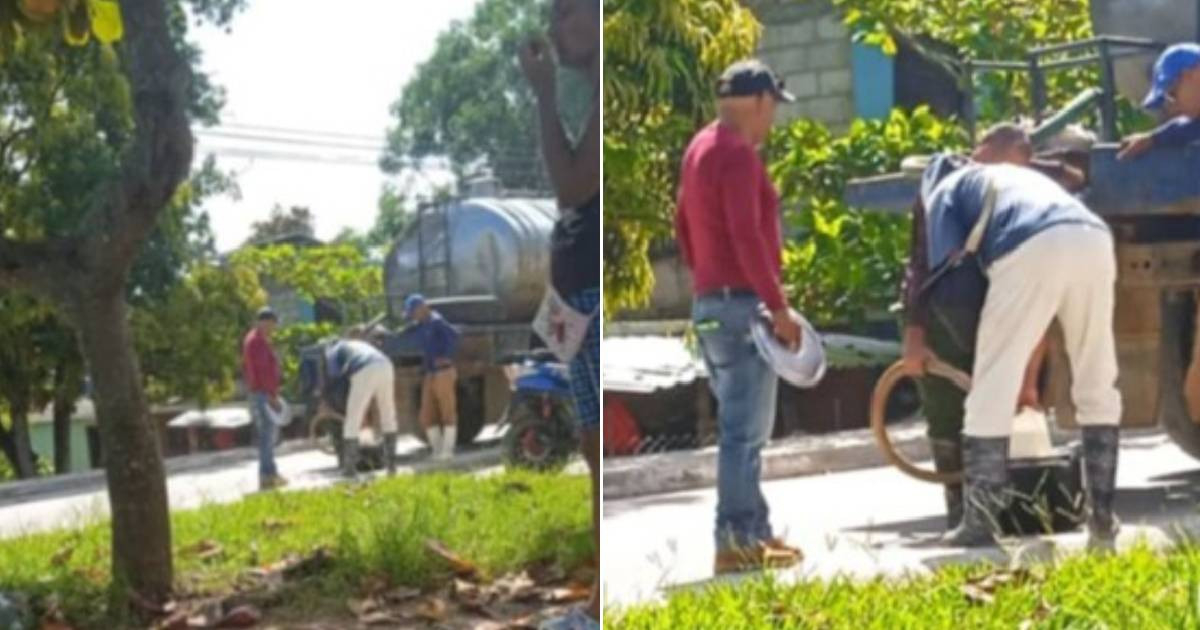
On Saturday, images circulated on social media depicting several men handling hoses and containers near a tanker parked in front of the Maternal Home in Manicaragua, Villa Clara. These men appeared to be pouring a liquid resembling milk into a plastic container on the street, sparking outrage among local residents.
A Facebook user, under the alias Héctor Tol Etón Plus, identified the vehicle as the tanker responsible for distributing milk intended for pregnant women, public services, and ration stores in the area. Residents voiced their concerns, alleging that the milk was being illicitly diverted or sold openly in the street.
"This is the last straw! Pregnant women and essential services are left without milk while this brazen display happens in plain sight. What about the milk for the vulnerable? Who is accountable?" the whistleblower questioned emphatically.
The Broader Issue of Mismanagement
Comments revealed that this incident is part of a wider pattern of mismanagement. A nurse pointed out that healthcare staff are supposed to receive milk rations, but they don’t.
A resident from the locality of Manuelita recounted that the tanker arrived on August 14 and didn't return for almost a month, delivering less than a liter upon its return.
A Widespread Crisis
In La Campana, another local complained that what’s being sold is merely "milk water," with black market vendors pricing a gallon at 780 pesos.
Reports from Santa Clara, the provincial capital, also mentioned over a week without milk for children, a situation that has reportedly recurred several times. A commenter noted that children are receiving their milk every four days, equating to one glass per day, an unprecedented situation.
A local woman summed up what many see as an open secret: "The milk being resold, meant for children, pregnant women, and those on medical diets, was cut from Manicaragua years ago. It's a business for everyone involved, and no one seems to care."
Official Silence and Growing Calls for Investigation
Authorities have remained silent in response to the Manicaragua allegations, while residents persistently call for an investigation. "If there isn't enough for those entitled, how is it possible that it’s allegedly being siphoned off in the streets?" one source argued.
This complaint is part of a larger structural crisis in Cuba's milk supply, acknowledged by the government itself. In June, the Minister of the Food Industry, Alberto López Díaz, admitted on the official television program Mesa Redonda that over 100,000 children do not receive their daily milk ration and that the official plan is unachievable.
Earlier in June, it was revealed that Villa Clara, where this complaint originated, lost about 181,000 cattle over a decade, reducing the provincial herd to 337,960.
Nationally, between 2018 and 2023, milk production fell by 58%, and imports of powdered milk dropped by 71%, according to the World Food Program.
Similarly, the theft and diversion of milk intended for vulnerable groups are repeating issues across several provinces. In June 2025, five individuals were arrested in Havana for stealing 197 sacks of baby formula from an En Frigo facility, with the product being resold at 1,650 pesos per pound.
In August, a bag of milk was priced at 6,500 pesos in Matanzas, double the monthly minimum wage of 3,210 pesos.
Understanding the Milk Supply Crisis in Cuba
What sparked the outrage among Manicaragua residents?
Residents were outraged after images showed men in Manicaragua seemingly diverting milk meant for pregnant women and public services, sparking concerns of illegal sales.
How has the milk supply crisis affected Villa Clara?
Villa Clara has experienced significant cattle losses, reducing the herd substantially, and contributing to the broader milk supply crisis affecting children's and vulnerable groups' access to milk.
What are the broader implications of the milk supply issues in Cuba?
The ongoing milk supply crisis in Cuba is part of a larger structural problem, with declining domestic production and imports, impacting vulnerable populations and highlighting government inefficiencies.